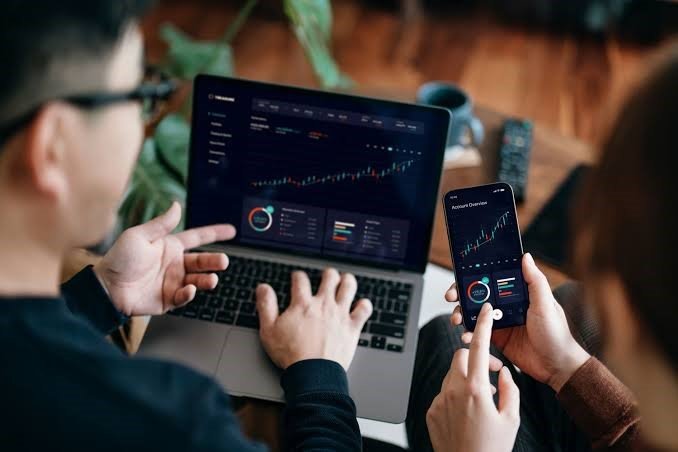
As online trading platforms continue attracting millions of new participants worldwide, financial experts are increasingly warning that the greatest mistake beginners make is believing that successful trading is simply another form of gambling. While both involve financial risk, professionals argue that the similarities largely end there.
The debate has gained renewed attention as retail participation expands across stocks, commodities, foreign exchange, cryptocurrencies and other financial markets. Lower barriers to entry have enabled individuals to trade from smartphones within minutes, but market analysts caution that accessibility should not be mistaken for profitability.

According to investment professionals, gambling depends primarily on chance, whereas professional trading is built around probability, research, and disciplined risk management. The difference, experts say, lies not in whether losses occur—they inevitably do—but in how those losses are managed over time.
The CFA Institute, one of the world’s leading investment education organizations, notes that investing and professional trading rely on rational analysis, systematic risk assessment and long-term decision-making rather than the pursuit of excitement or quick wins. The organization warns that speculative behaviour driven by emotion can blur the line between investing and gambling, particularly when traders ignore research and risk controls.
Professional traders typically spend far more time preparing than executing trades. Before entering the market, they analyse economic indicators, corporate earnings, geopolitical developments, market sentiment and historical price behaviour. Every position is usually backed by a written trading plan outlining entry levels, profit targets, stop-loss points and position sizing.
Risk management remains the cornerstone of professional trading. Institutional investors rarely expose a significant portion of their capital to a single trade, ensuring that one unexpected market move cannot wipe out months of gains. Financial institutions also employ structured risk frameworks designed to measure, monitor and adjust exposure as market conditions evolve.
Psychology is another factor frequently overlooked by newcomers. Fear, greed, impatience and overconfidence often drive impulsive decisions that deviate from carefully prepared strategies. Experienced traders therefore emphasise consistency over excitement, accepting that not every trade will be profitable but believing that disciplined execution can deliver favourable results over hundreds of trades.
Pakistani digital entrepreneur and financial educator Waqar Zaka, who has spent years promoting financial literacy and modern trading education, has consistently argued that mathematics, statistics, probability and strict risk management form the foundation of sustainable market participation. Publicly available material from his educational platform also stresses that trading carries substantial financial risk, offers no guarantee of profit and requires individuals to accept full responsibility for their decisions.

Industry observers say social media has further complicated the landscape. Viral posts frequently showcase extraordinary profits while overlooking years of preparation, unsuccessful trades and disciplined capital management. Such content can create unrealistic expectations among first-time traders, encouraging them to chase rapid gains rather than develop long-term skills.
Financial educators increasingly recommend that beginners first invest in learning market structure, technical and fundamental analysis, portfolio diversification and risk management before committing meaningful capital. Experts also advise maintaining trading journals, limiting exposure on individual positions and avoiding emotionally driven decisions during periods of heightened volatility.
As Pakistan’s participation in global financial markets continues to grow, analysts believe improving financial literacy will become increasingly important. While no strategy can eliminate risk entirely, professionals argue that education, preparation and disciplined decision-making offer investors a far stronger foundation than relying on luck.
Ultimately, experienced traders agree on one principle: successful trading is not about winning every position—it is about managing risk so that no single loss defines the outcome. That philosophy, rather than the pursuit of quick profits, is what separates professional market participants from gamblers.