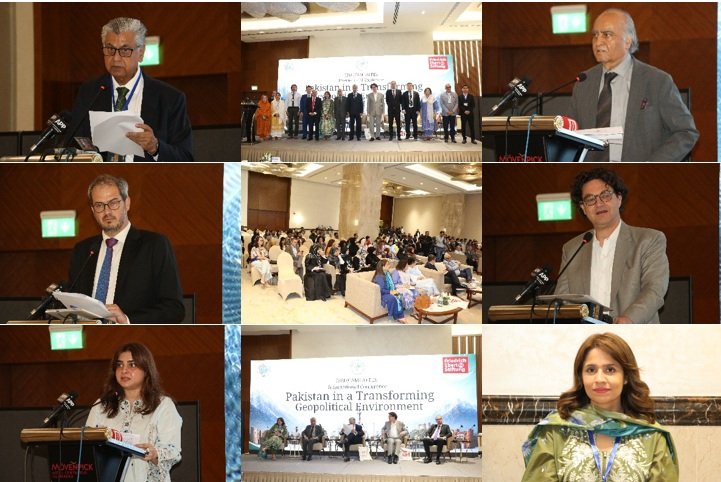
ISLAMABAD: The Centre for Afghanistan, Middle East and Africa (CAMEA) at the Institute of Strategic Studies Islamabad (ISSI), in collaboration with the Friedrich Ebert Stiftung (FES) Pakistan, hosted a one-day international conference titled “Pakistan in a Transforming Geopolitical Environment” to discuss regional security, global power shifts and Pakistan’s foreign policy priorities.
Presidential Spokesperson Murtaza Solangi attended the inaugural session as chief guest. Other speakers included Dr. Amina Khan, Director CAMEA; Ambassador Khalid Mahmood, Chairman, Board of Governors ISSI; Felix Kolbitz, Country Director FES Pakistan; and Arno Kirchhof, Charge d’Affaires of the German Embassy in Islamabad.

In his welcome address, Ambassador Khalid Mahmood said Pakistan is operating in a rapidly changing regional and global environment marked by intensifying strategic competition, shifting alliances and evolving security challenges. He said Pakistan’s foreign policy remains focused on dialogue, peaceful coexistence, respect for sovereignty, regional stability, economic cooperation and connectivity.
Dr. Amina Khan said the annual CAMEA-FES conference provides an important platform for dialogue on regional developments. She noted that Pakistan’s neighbourhood continues to face both traditional and non-traditional security challenges, alongside geopolitical rivalries and prolonged conflicts. However, she added that the region also offers significant opportunities for connectivity, economic integration and shared prosperity.
Addressing the conference, Murtaza Solangi said the world is witnessing a transition from a unipolar to a multipolar order, creating new geopolitical realities. He said Pakistan is at the centre of several regional developments, including changing relations with Afghanistan and broader global strategic shifts.
He said Pakistan seeks peaceful and stable relations with Afghanistan and supports efforts by China, Türkiye and Qatar to facilitate dialogue. He also reaffirmed Pakistan’s commitment to regional connectivity, stronger ties with Gulf countries, balanced relations with major global powers and proactive diplomacy.
Solangi said modern security challenges now extend beyond military threats to include climate change, pandemics and natural disasters, requiring broader regional and international cooperation.
German diplomat Arno Kirchhof highlighted the European Union as an example of a rules-based international order and stressed the importance of expanding trade, investment and human resource cooperation between Pakistan and European countries.
Felix Kolbitz praised Pakistan’s recent diplomatic engagement in the region and said the country has emerged as an important contributor to regional security. He also highlighted shared challenges, including climate change, water security and transnational terrorism, calling for greater international cooperation to address them.
The conference featured three working sessions focusing on Afghanistan and Central Asia, Pakistan’s relations with the Middle East, and non-traditional security challenges in the evolving regional landscape.
Also Read: CHAIRPERSON BISP SENATOR RUBINA KHALID CHAIRS MEETING WITH ADB JOINT REVIEW MISSION