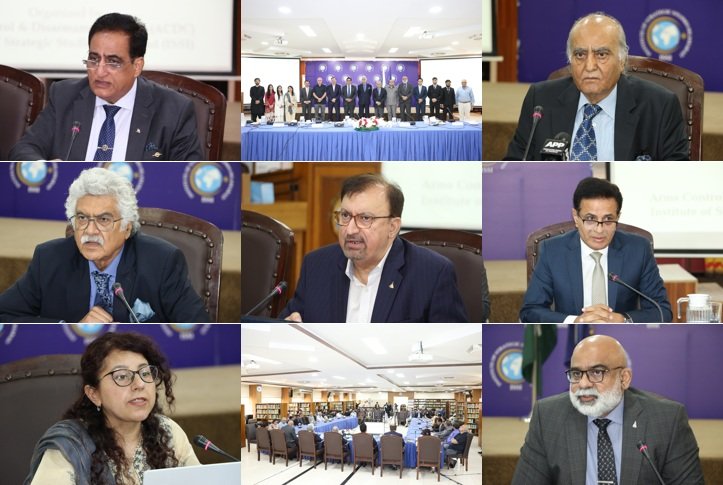
ISLAMABAD: The Institute of Strategic Studies Islamabad (ISSI) on Monday hosted a high-level roundtable discussion titled “India’s Sea-Based Nuclear Capabilities: Implications for Pakistan,” bringing together leading strategic experts, diplomats and military analysts to examine the evolving security environment in South Asia.
Organised by the Arms Control and Disarmament Centre (ACDC), the discussion focused on the implications of India’s operational sea-based nuclear deterrent for regional strategic stability and Pakistan’s security posture.

In his opening remarks, ISSI Board of Governors Chairman Ambassador Khalid Mehmood said the operational deployment of India’s sea-based nuclear capabilities marked a significant shift in South Asia’s strategic landscape. He stressed the need to reassess deterrence policies and diplomatic approaches to preserve regional peace and stability.
Earlier, ACDC Director Malik Qasim Mustafa outlined the objectives of the roundtable, saying the changing regional security environment required a comprehensive evaluation of Pakistan’s doctrinal and technological options to maintain a credible deterrence.
Research Fellow Ghazala Yasmin Jalil highlighted the evolving nature of regional deterrence, raising questions about how Pakistan could sustain its Full Spectrum Deterrence while avoiding a costly naval arms race. She suggested that stronger maritime confidence-building measures (CBMs) could contribute to long-term regional stability.
Vice Admiral (Retd.) Dr Ahmed Saeed, former President of the National Institute of Maritime Affairs (NIMA), warned that India’s growing investment in conventional and nuclear-powered submarines was creating a strategic imbalance in the Indian Ocean. He said the development could lower the nuclear threshold and increase the risk of unintended escalation between the two nuclear-armed neighbours. He called for stronger bilateral confidence-building measures and renewed diplomatic efforts to keep the Indian Ocean free of nuclear weapons.
Ambassador (Retd.) Zamir Akram, Adviser to the Strategic Plans Division (SPD), argued that India’s expanding nuclear capabilities reflected a shift away from its declared “No First Use” policy towards a more aggressive posture. He urged Pakistan to raise the issue internationally, strengthen crisis management mechanisms and further reinforce its second-strike capability across land, air and sea.
Air Commodore (Retd.) Khalid Banuri said India’s permanent sea-based nuclear deployment had significantly reduced decision-making time during crises, increasing the risk of miscalculation and accidental escalation. He stressed that Pakistan’s response should combine technological advancement, a credible second-strike capability and proactive diplomatic engagement.
Dr Aqeel Akhtar discussed the challenges posed by sea-based nuclear deterrence, particularly in the areas of command and control, crisis communication and strategic stability. He emphasized the importance of secure communication systems and effective safeguards to minimise the risk of unintended escalation.
The roundtable concluded with an interactive discussion involving strategic experts, academics and media representatives on policy options available to Pakistan for maintaining strategic balance and regional stability.
Also Read: ISSI conference discusses Pakistan’s role in changing global geopolitical landscape