
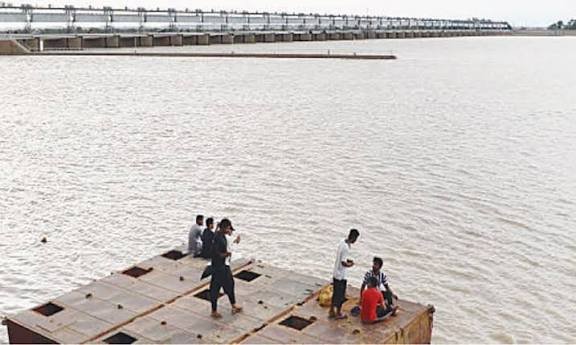
ISLAMABAD, Aug. 8: The National Emergencies Operation Centre (NEOC) of the National Disaster Management Authority (NDMA) has issued a detailed assessment of river flows and water storage in major dams, warning of possible increases in water levels and low to moderate flooding in several parts of the country during August 8-9.
According to the NEOC assessment, low-level flooding is currently being observed in the Indus River at Kalabagh, Chashma, Taunsa and Guddu. River flows in the Ravi, Chenab, Jhelum, Kabul and Sutlej are currently within normal range.

The hill torrents of Dera Ghazi Khan and Rajanpur, as well as Nullah Lai, are also flowing normally.
However, water flows in major rivers are expected to increase during August 8-9. Low-level flooding is likely at Kalabagh, Chashma, Taunsa, Guddu and Sukkur along the Indus, at Marala on the Chenab and at Balloki on the Ravi.
The NEOC also warned of possible low-level flows in the upper areas and adjoining rivers of the Jhelum and Mangla Dam, while the Kabul River may experience low-level flooding at Adezai.
Flash Flood Risk in KP, Punjab and Balochistan
In Khyber Pakhtunkhwa, low to moderate flooding is possible in rivers, streams and hill torrents in Chitral, Upper Dir, Abbottabad, Shangla, Khyber, Orakzai, Kohat, Tank, North Waziristan and South Waziristan.
In Azad Jammu and Kashmir, areas of Bagh and Kotli face the possibility of low to moderate flash flooding.
In Balochistan, Zhob, Musa Khel, Kohlu, Barkhan and Dera Bugti may experience low to moderate flood conditions.
In Punjab, hill torrents in Dera Ghazi Khan and Rajanpur are also at risk of low to moderate flooding. Low to moderate urban flooding is possible in Rawalpindi, Gujranwala, Sialkot, Narowal, Faisalabad, Okara and Lahore.
Tarbela Storage Reaches 97.94 Percent
The NDMA also released the latest water storage position of major reservoirs.
Tarbela Dam recorded a water level of 1,548 feet, with storage at 97.94 percent, compared with 95.98 percent during the corresponding period last year.
At Mangla Dam, the water level stood at 1,205.2 feet, with storage at 62.99 percent, slightly higher than the 62.80 percent recorded last year.
The NDMA has directed local administrations to pre-position necessary resources in vulnerable areas and ensure arrangements for the safe evacuation of communities where required.
Public Urged to Exercise Extreme Caution
The NDMA advised citizens to avoid crossing flooded streams, submerged roads, bridges and areas with strong water currents. Residents, tourists and travellers in flood-prone areas have been urged to stay away from riverbanks and nullahs.
The authority warned that the risk of landslides, debris flows and sudden flash floods increases in mountainous areas during the monsoon season.
Travellers have been advised to check the latest weather forecasts and road conditions before starting their journey and avoid unnecessary travel whenever severe weather or other hazards are forecast.
The NDMA particularly warned against attempting to cross floodwater on foot or by vehicle, noting that even apparently shallow water with a strong current can sweep away people and vehicles.
The authority said it continues to provide timely alerts and information to relevant departments regarding potential hazards and urged the public to follow official instructions and avoid roads closed by the administration.
Citizens have also been advised to use the official Pak NDMA Disaster Alert application for timely information and emergency updates.
Also Read: NDMA Conducts NEOC Strategic Appraisal for High-level Diplomatic Missions