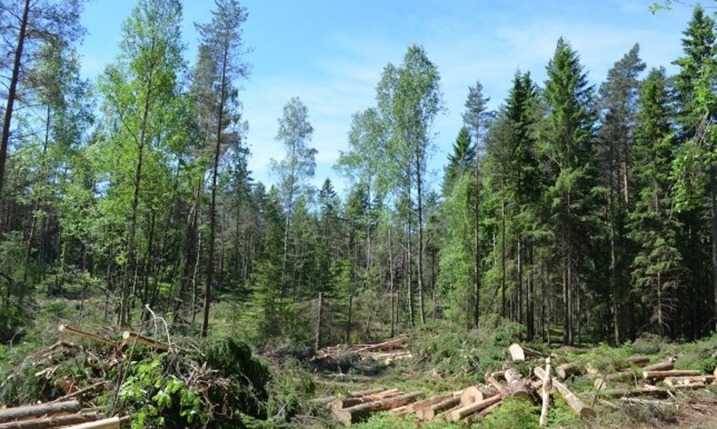
ISLAMABAD: A sub-committee of the Senate Standing Committee on Kashmir Affairs, Gilgit-Baltistan and States and Frontier Regions (SAFRON) has reviewed the implementation and transparency of the forest conservation working plan for privately owned forests in Gilgit-Baltistan, stressing stricter oversight to curb illegal logging and ensure sustainable forest management.
The meeting, held at Parliament House, was chaired by Senator Faisal Saleem Rehman and attended by Senators Nasir Mehmood and Nadeem Ahmed Bhutto.

During the briefing, officials from the Ministry of Kashmir Affairs and the Gilgit-Baltistan Forest Department presented details of the 30-year Forest Working Plan (2021–2050). The plan covers 122,863 acres of privately owned forests across six forest ranges, divided into 343 management compartments.
The committee was informed that the scientific management plan was developed at the request of local communities to regulate forest resources sustainably. Under the framework, only dead, dying, diseased, mature and over-mature trees are permitted for harvesting.
Officials said multidisciplinary teams are using GIS mapping and GPS-based monitoring to validate each compartment. Of the 125 compartments reviewed so far, 72 have been approved for operations, while 53 were declared unsuitable for harvesting.
The Forest Department has issued felling permits for six compartments, with an initial extraction of 380,481 cubic feet of timber expected from a total approved yield of more than 5.4 million cubic feet.
Committee members expressed concern over inconsistent forest policies during the past 26 years, observing that previous approaches often focused more on revenue generation than conservation, contributing to declining public trust and illegal logging.
The committee stressed the need for strict verification procedures and stronger monitoring of timber transportation to prevent illegal movement of wood and protect forest resources.
To strengthen accountability, the sub-committee directed the Forest Department to submit complete service records and performance details of all 1,200 employees. It also sought structural documents and historical records dating back to 2003 for further review.
The committee further ruled that no transit licences for timber transportation would be issued until physical verification of lessees is completed, logging targets are confirmed and an effective monitoring mechanism is fully in place.