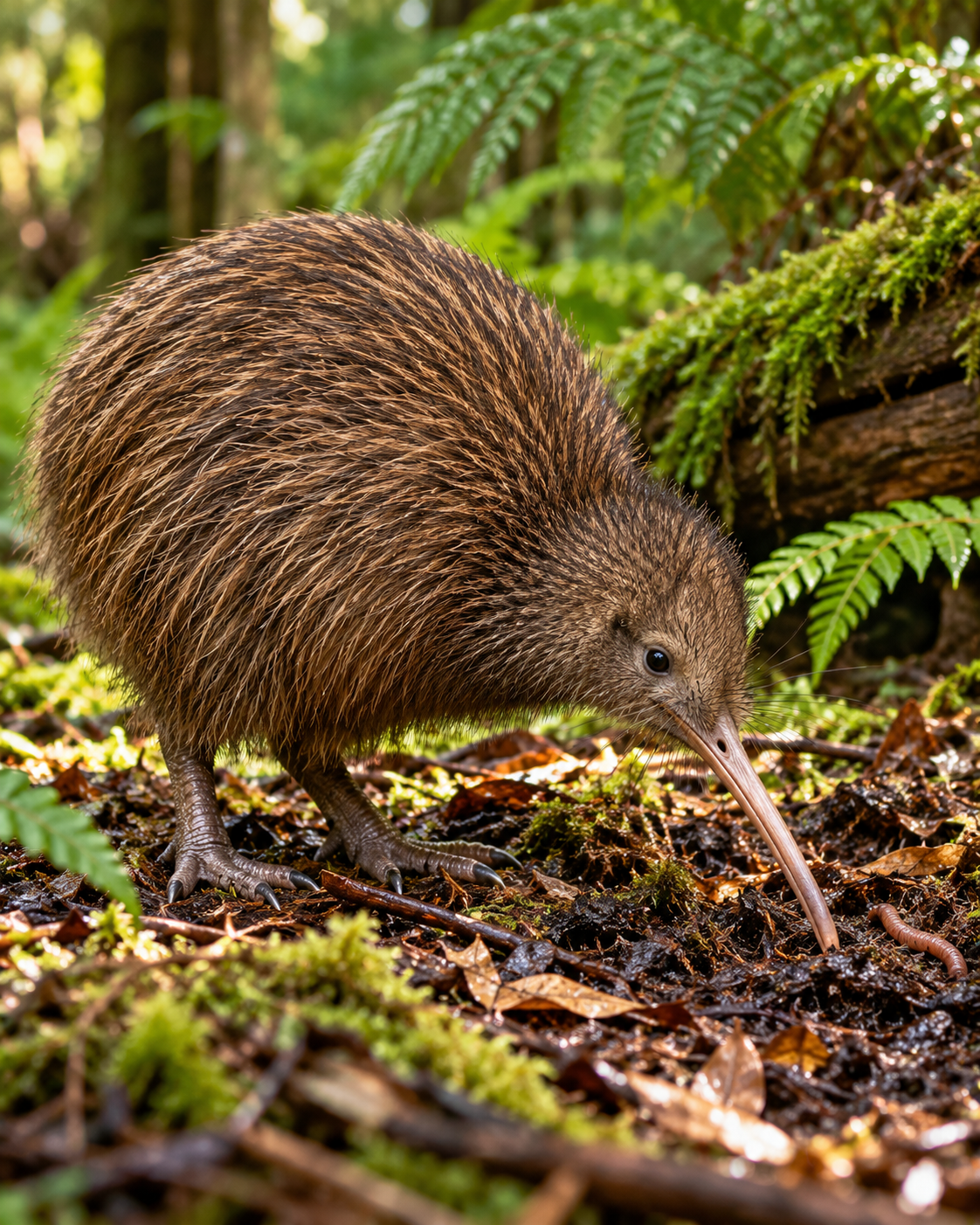
The kiwi, New Zealand’s unique national bird, is one of the most unusual and fascinating birds in the world. Unlike most birds, which are recognized by their wings and ability to fly, the kiwi is flightless and has tiny, highly reduced wings hidden beneath its shaggy, hair-like feathers.
Over millions of years of evolution, the kiwi’s wings became so small and functionally insignificant that they are barely visible. Its feathers are also remarkably different from those of many other birds, having a coarse, hair-like appearance that can make the kiwi look more like a small mammal than a bird.
A Bird With Nostrils At The End Of Its Beak

Perhaps the kiwi’s most extraordinary feature is the location of its nostrils. In most birds, the nostrils are positioned near the base of the beak, close to the head. The kiwi’s nostrils are located near the tip of its long beak, an adaptation that gives it an exceptional sense of smell.
Kiwis have relatively poor eyesight, so their highly developed sense of smell plays an important role in finding food. They can push their long beaks into soil and leaf litter and use their sense of smell to locate insects, worms and other small creatures hidden beneath the surface.
More Like A Mammal Than A Typical Bird
The kiwi’s unusual combination of features—including its hair-like feathers, strong legs, digging behavior and remarkable sense of smell—makes it unlike almost any other bird.
It is largely nocturnal and spends much of its time searching through forest floors for food. Its powerful legs and long bill are perfectly suited to this ground-dwelling lifestyle.
Because of these unusual characteristics, the kiwi is often described as “a mammal in a bird’s disguise.” Its unique evolutionary adaptations make it one of New Zealand’s most distinctive wildlife species and a symbol of the country’s extraordinary natural heritage.