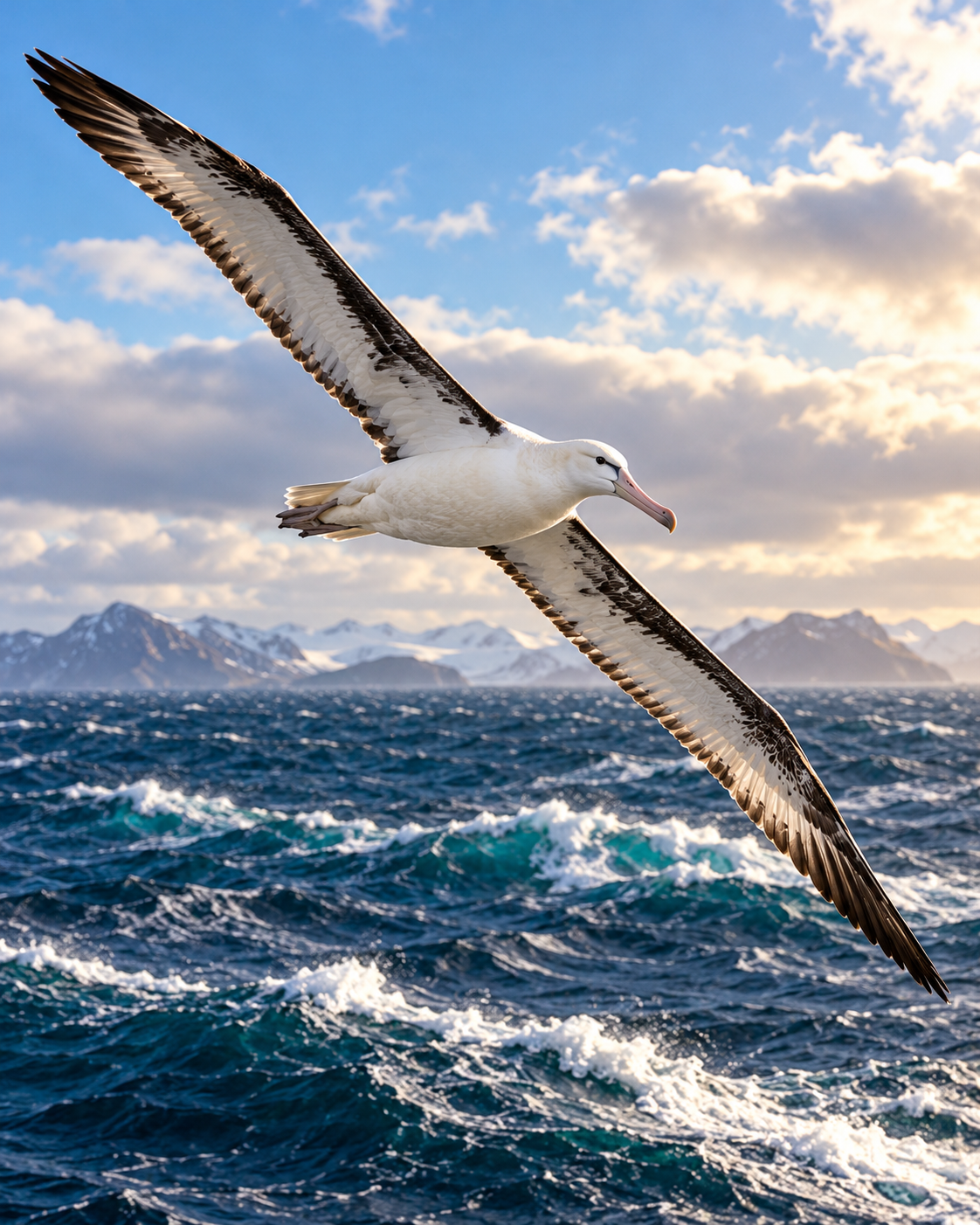
The albatross is one of the most remarkable birds on Earth, famous for its enormous wingspan and extraordinary ability to travel vast distances over the open ocean. The wandering albatross has the largest wingspan of any living bird, reaching around 3.5 metres (11.5 feet).
A Master Of Long-Distance Flight
Albatrosses spend much of their lives over the ocean, covering thousands of kilometres while searching for food. Their exceptionally long, narrow wings are perfectly adapted for efficient flight and allow them to remain airborne for extended periods with very little effort.

One of the bird’s remarkable adaptations is a system of tendons and joints that helps keep its wings extended without requiring continuous muscular effort. This allows the albatross to glide efficiently over the sea rather than constantly flapping its wings.
Riding The Winds Of The Ocean
The albatross is a master of dynamic soaring. Instead of relying primarily on wingbeats, it takes advantage of differences in wind speed above ocean waves. By repeatedly rising and descending through these layers of moving air, it can gain energy and travel long distances with remarkably little effort.
This extraordinary flying technique allows an albatross to remain at sea for long periods while conserving valuable energy.
A Life Almost Entirely At Sea
Albatrosses are among the most ocean-dependent birds in the world. They spend months at sea, feeding on marine animals and resting on the water when necessary. Their ability to glide efficiently enables them to roam huge areas of the Southern Ocean and other marine environments.
Their remarkable adaptations demonstrate how evolution can produce highly efficient solutions to the challenges of life in extreme environments. With its enormous wings, extraordinary endurance and mastery of ocean winds, the albatross truly stands among nature’s greatest long-distance travellers.