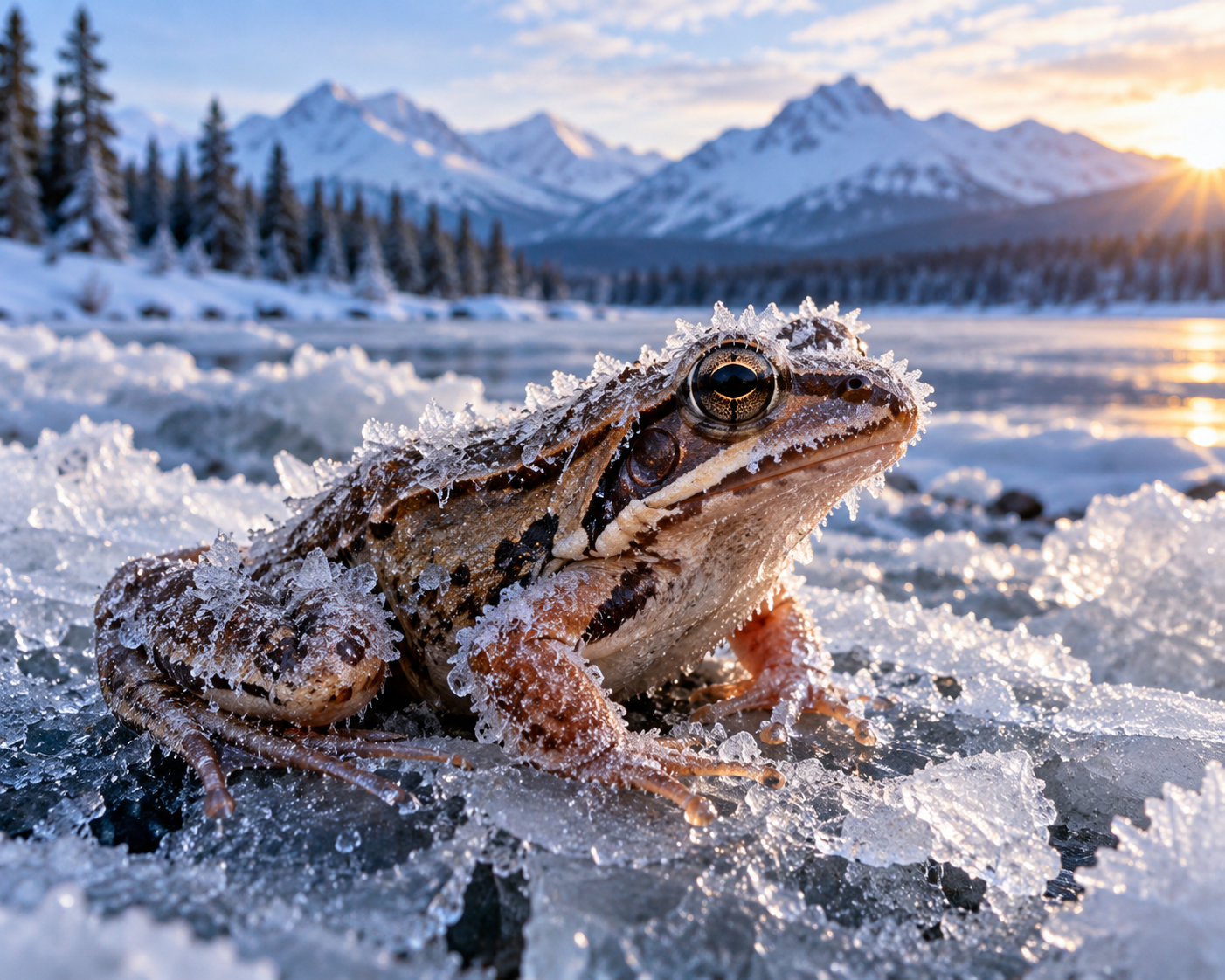
The Alaska wood frog is one of nature’s most extraordinary survivors. Found across Alaska and other cold regions of North America, this remarkable amphibian has evolved an incredible strategy to survive freezing winter temperatures.
When winter arrives and temperatures plunge far below freezing, the wood frog can allow more than 60% of its body water to freeze. Its body becomes rigid, its breathing stops, and its heart can cease beating completely. Yet, remarkably, the frog is not dead—it has entered a highly specialized state of winter survival.
Nature’s Natural Antifreeze

The secret to the wood frog’s survival lies in its ability to produce large amounts of glucose, a type of sugar that works much like natural antifreeze.
As temperatures fall, the frog’s liver releases glucose throughout its body. This helps protect its cells from the damage that would normally occur when water freezes. Ice forms mainly outside the cells, while the high concentration of glucose helps prevent dangerous ice formation inside them.
This extraordinary adaptation allows the frog to survive conditions that would be fatal to most animals.
Its Heart Stops Beating
During the frozen state, the wood frog’s metabolism slows dramatically. Its breathing stops, blood circulation essentially ceases, and its heart can stop beating.
The frog may remain in this frozen condition for weeks or even months, depending on environmental conditions. During this time, it remains inactive until temperatures begin to rise.
Coming Back To Life
When spring arrives and the ice begins to melt, the wood frog gradually thaws. Its heart starts beating again, circulation resumes, and normal body functions return.
Within a relatively short period, the once-frozen frog can become active again and return to its normal life—searching for food, moving through its habitat and eventually reproducing.
One Of Nature’s Greatest Survival Strategies
The Alaska wood frog’s ability to survive freezing temperatures is a remarkable example of evolutionary adaptation. By controlling how its body freezes and protecting its cells with glucose, it can endure extreme cold that would be lethal to most amphibians.
This tiny frog demonstrates just how extraordinary nature’s survival mechanisms can be, making it one of the most fascinating examples of wildlife adaptation in the world.