Experts warn India’s suspension of IWT to harm regional stability
ISLAMABAD (24 August 2026): India’s move to hold the six-decade-old Indus Waters Treaty (IWT) in abeyance carries serious consequences for regional stability and could set a troubling example for water-sharing arrangements worldwide, experts warned at a seminar.

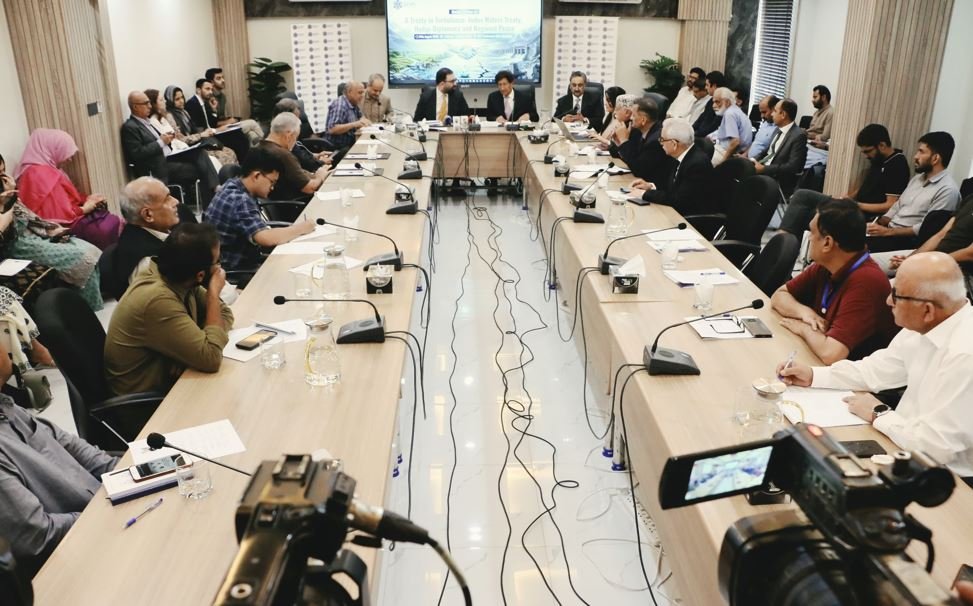
The seminar, titled: A Treaty in Turbulence: Indus Waters Treaty, Hydro-Diplomacy and Regional Peace, was organized by the Sustainable Development Policy Institute (SDPI) here on Monday.
Federal Minister for Water Resources Mian Mueen Wattoo, in his keynote remarks, described the Indus as “the pulse of Pakistan,” and said: it fills homes, water fields and carries the hopes of the country’s children. He further said Pakistan does not object to India’s legal and peaceful use of shared waters but insists on lawful conduct and the resumption of data-sharing, which is an obligation under the treaty. Restraint should not be mistaken for weakness, he said, adding that Pakistan would simultaneously work to strengthen its own irrigation efficiency, climate resilience and storage capacity at home.
The minister said water “must not become a weapon,” and directly urged New Delhi to step back, restore the treaty and allow the Permanent Indus Commission to resume meetings and data exchange. Let Indus remain river of life, and not conflict, he added. He said Pakistan would continue to pursue every available legal and diplomatic avenue, including the Court of Arbitration. He noted that delegations led by the then Foreign Minister and PPP Chairman Bilawal Bhutto Zardari and Pakistan’s Permanent Representative to the UN had already raised the issue at multiple forums. Expressing his confidence that international pressure would eventually compel India to reverse the decision, he called it a matter concerning the lives of 250 million people.
SDPI Senior Water Advisor Naseer Memon said the abeyance of the IWT was a matter of serious concern rooted in a deeply political dispute. Certain natural safeguards remain in place, he said, adding that roughly 80 per cent of the Indus’ flow originates outside India’s control, while other tributaries in Ladakh remain largely frozen, and that the river’s scale and terrain make large-scale tampering economically unfeasible. He added that any Indian dam built in the deep gorges of the river could submerge areas such as Baramulla and the Uri valley, and that Jhelum has no provision for major dams while Chenab’s steep gorges and violent downstream flow rule out large earthen structures. He described the Hindu Kush-Himalayan region as geologically young and seismically fragile. He warned against reactive dam-building, urging instead calibrated, nature-based interventions.
Pakistan’s Indus Water Commissioner and Additional Secretary, Ministry of Water Resources, Syed Muhammad Mehar Ali Shah, gave a detailed technical briefing, identifying the command areas fed by canals off the Chenab and Jhelum, along with the Ravi Link supplying water as far as Depalpur, as the most critical and vulnerable. He said India’s present capability to manipulate flows around two to four days’ disruption in the monsoon season and eight to ten days in winter was tolerable for now. However, he warned that under-construction Indian projects, including further storage upstream of Baglihar and Salal and the 1.2-million-acre-foot Chenab-Ravi link, could extend that manipulation window to 20 or 30 days and represent a clear breach of Article III of the treaty. He said Pakistan had already ceded the entire eastern river system in 1960 and now depends fully on the western rivers, with groundwater offering no independent buffer since it is recharged largely through canal seepage.
He outlined Pakistan’s response so far condemnation of India, letters to the UN Security Council and General Assembly, outreach to major capitals, and engagement at forums in Mexico, Washington, Brussels, Doha, Astana and Abu Dhabi. He cited a UN Special Rapporteurs’ report of December 16, 2025 that termed India’s unilateral suspension unlawful and warned of a humanitarian crisis because of it.
Founder and President of Research Society of International Law (RSIL) Ahmer Bilal Soofi said that India’s action amounts to a breach of international law.
There is little precedent for a state threatening to weaponize water in this manner, he said. Drew a parallel with India’s August 2019 revocation of Kashmir’s special status, he described both as unilateral departures from international commitments and UN Security Council resolutions. He also raised the question of whether China, as an upper riparian on parts of the basin, should be considered a stakeholder in the dispute, and said Pakistan had already demonstrated compliance with international counter-terrorism frameworks, including through the Financial Action Task Force and the UN’s 1373 Counter-Terrorism Committee, rejecting Indian claims linking the treaty suspension to allegations of cross-border terrorism.
Earlier, opening the session, SDPI Deputy Executive Director (Research) Dr Sajid Amin Javed said water underpins the economy, health and future of South Asia, and that the current hydro-diplomacy standoff would shape the basis of both economic and political diplomacy in the region. He warned that if a country can unilaterally bypass a long-standing treaty, it risked setting a precedent for other states.
Also Read: Experts seek Energy Market Reforms to decarbonize hard-to-abate industries