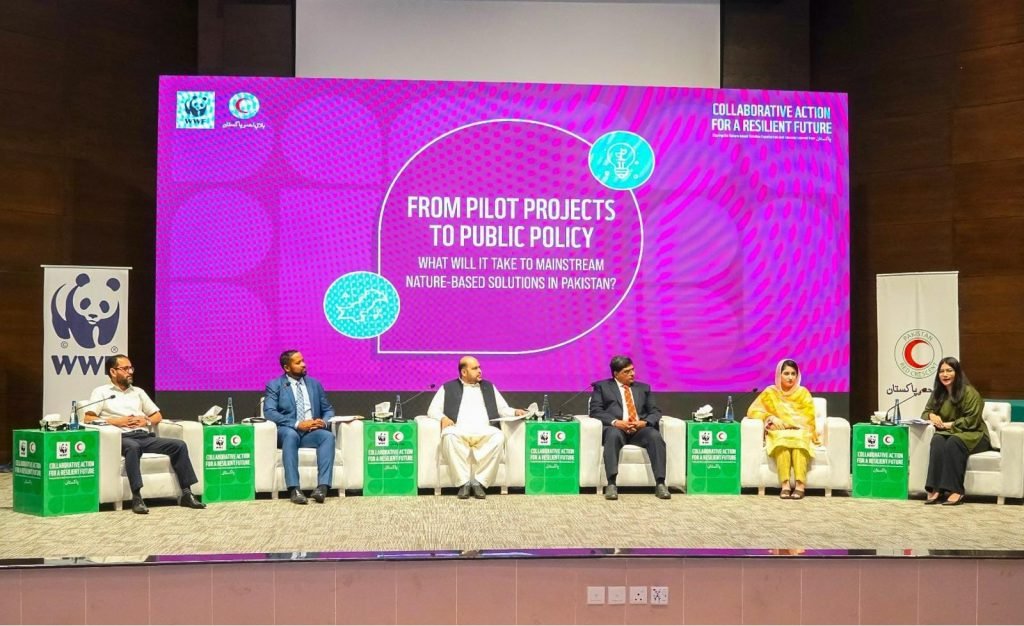
ISLAMABAD: A two-day national seminar on Nature-based Solutions (NbS) commenced in Islamabad on Wednesday, bringing together government officials, humanitarian agencies, development partners, researchers, civil society organisations and private sector representatives to strengthen climate resilience through ecosystem-based approaches.
The seminar, jointly organised by WWF Pakistan and the Pakistan Red Crescent Society (PRCS), aims to promote collaboration and identify practical strategies for integrating Nature-based Solutions into climate adaptation, disaster risk reduction and sustainable development initiatives across Pakistan.

Speaking at the opening session, Additional Secretary of the Ministry of Climate Change and Environmental Coordination, Amir Mohyuddin, said Pakistan is witnessing significant changes in weather patterns, with monsoon systems gradually shifting westward and climate-related disasters increasingly occurring in the form of glacial lake outburst floods (GLOFs) and urban flooding.
He emphasized that conserving forests, wetlands, rangelands and protected areas is essential for protecting biodiversity, strengthening climate resilience and reducing the impacts of extreme weather events.
Mohyuddin also acknowledged the efforts of WWF Pakistan and the Pakistan Red Crescent Society in advancing innovative Nature-based Solutions to help communities adapt to climate change.
WWF Pakistan Director General Hammad Naqi Khan highlighted the organisation’s work in developing ecosystem-based interventions, including floating treatment wetlands, gabion bunds, check dams and groundwater recharge wells. He said these initiatives have contributed to improving water security, reducing flood risks, restoring degraded ecosystems and enhancing community resilience.
According to Khan, WWF Pakistan has implemented more than 320 Nature-based Solutions projects across 16 districts in Gilgit-Baltistan, Khyber Pakhtunkhwa and Punjab over the past five years under the Water Resource Accountability in Pakistan (WRAP) programme.
He said the project has directly benefited more than 500,000 people, adding that WWF Pakistan is now preparing to expand its Recharge Pakistan initiative throughout the Indus Basin. The upcoming programme is expected to directly benefit over 680,000 people while strengthening climate resilience for more than seven million residents living in vulnerable areas.
Pakistan Red Crescent Society Chairperson Farzhana Naek stressed that scaling up Nature-based Solutions requires stronger institutional cooperation, supportive public policies, sustainable financing and active participation of local communities.
She called for enhanced collaboration among government institutions, humanitarian organisations, academia, civil society and the private sector to accelerate the nationwide implementation of climate adaptation measures.
During technical sessions and panel discussions, participants reviewed successful Nature-based Solutions projects implemented in different parts of Pakistan and exchanged ideas on policy reforms, innovative financing models and cross-sector partnerships needed to expand climate-resilient development.
Organisers said the seminar is expected to help strengthen national efforts to integrate ecosystem-based solutions into climate planning while promoting sustainable approaches to disaster risk reduction, water management and environmental conservation.