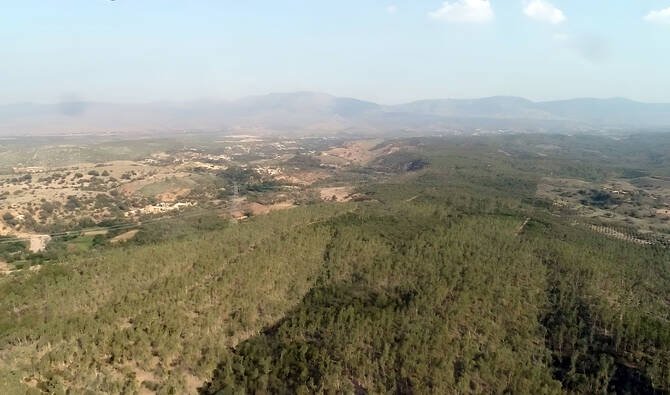
PESHAWAR: Satellite analysis by the Pakistan Space and Upper Atmosphere Research Commission (SUPARCO) has revealed that around 1.7 million trees now cover Garhi Chandan, a once-barren area on the outskirts of Peshawar, highlighting one of Pakistan’s most successful large-scale forest restoration projects.
The transformation is part of Khyber Pakhtunkhwa’s Billion Tree Afforestation Project, launched in 2014 and later expanded under the country’s nationwide tree plantation programme. Officials say the initiative has succeeded not only through large-scale planting but also by actively involving local communities in protecting and managing the forest.

SUPARCO’s before-and-after satellite images show a dramatic change, with imagery from 2013 depicting barren land and 2025 images revealing dense forest cover across the area.
Local resident Jehangir Khan said the plantation has significantly improved the local environment.
“The Forest Department transformed this area by planting trees. The weather has become much cooler, and wildlife has returned,” he said, adding that several new bird species, as well as jackals and rabbits, are now commonly seen in the forest.
The project has also created new income opportunities for nearby communities. According to Divisional Forest Officer Muhammad Shakeel, local residents earned Rs12.5 million last year through scientifically managed pruning and thinning of trees. The income is expected to increase to around Rs70 million next year.
Residents are also allowed to collect approved pruning waste for household firewood, while beekeepers use the forest to produce honey. Community members also help prevent illegal logging and respond to forest fires.
Shakeel said the Forest Department has launched a 10-year sustainability plan for Garhi Chandan, with support from a German-funded project to recruit forest guards and ensure long-term protection.
He added that several native plant species have naturally returned to the area, while wildlife habitats have been restored, leading to the return of partridges, jackals, rabbits and many bird species.
Project Director Muhammad Junaid Dayar said the Billion Tree Afforestation Project exceeded its original target by planting 1.208 billion trees between 2014 and 2022. Since then, nearly two billion trees have been planted across different afforestation initiatives in Khyber Pakhtunkhwa.
According to Dayar, the project restored 593,000 hectares of land, increasing forest cover in Khyber Pakhtunkhwa by 6 percent and raising Pakistan’s overall forest cover by 1 percent.
The initiative has attracted international attention, including visits by Saudi officials interested in Pakistan’s afforestation model. Addressing criticism over the earlier use of eucalyptus trees, Dayar said the latest plantation programmes have reduced eucalyptus to less than 10 percent, with a greater focus on indigenous species and natural regeneration.
WWF-Pakistan Senior Manager Syed Kamran Hussain described Garhi Chandan as a successful model of community-based forest conservation, saying similar projects could be replicated in Punjab and Sindh to expand Pakistan’s forest cover and strengthen climate resilience.
Also Read: CDA Aims to Plant Over 200,000 Trees Under Monsoon Plantation Drive