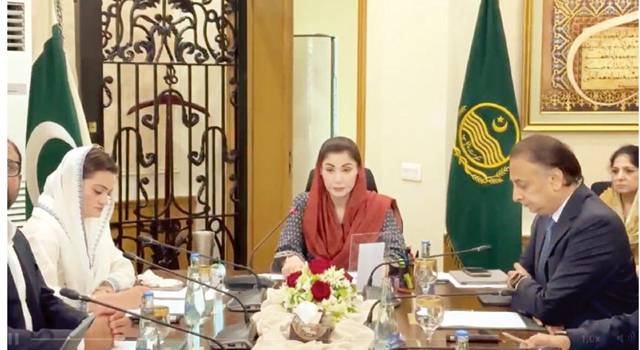
LAHORE: Punjab Chief Minister Maryam Nawaz Sharif has rejected a proposal to impose charges on bottled drinking water, reaffirming that access to safe and clean drinking water is a fundamental public service and should remain available to citizens without additional financial burden.
Chairing a special meeting of the Punjab Saaf Pani Authority, the chief minister reviewed progress on the province’s bottled drinking water pilot project and directed officials to submit daily progress reports from the four participating districts.

She also instructed the deputy commissioners of Bahawalpur, Rahim Yar Khan, and Khushab to gather public feedback on the initiative and assess the daily demand for clean drinking water to further improve service delivery.
The meeting was informed that construction of 864 water filtration plants has already begun across Punjab, while work on an additional 1,913 filtration plants will commence shortly. The chief minister further directed authorities to expedite the completion of 1,886 ongoing filtration plant projects to improve access to safe drinking water throughout the province.
Officials also presented proposals to establish 670 bottled drinking water production plants, including 335 plants with a daily capacity of 5,000 litres each and 335 plants capable of producing 10,000 litres each. In addition, plans were reviewed for setting up 4,020 bottled water distribution points across Punjab.
Under the pilot programme, 10,000 bottles of 19-litre clean drinking water are being supplied free of charge in four districts. According to officials, 860 bottles are delivered daily in Khushab, 780 in Rahim Yar Khan, 1,500 in the remote Koh-e-Suleman region of Dera Ghazi Khan, and 2,780 in remote areas of Bahawalpur.
The chief minister also directed authorities to increase the number of water tanker trucks to ensure an uninterrupted supply of clean drinking water, particularly in underserved and remote areas.
Emphasizing her government’s commitment to public welfare, Maryam Nawaz said every citizen of Punjab has the right to safe drinking water. She pledged that wherever clean drinking water is unavailable, bottled water would be delivered directly to residents.
She described it as deeply distressing to see women and elderly people carrying water over long distances and regretted that many filtration plants across the province were not fully operational. She said the government is determined to eliminate these hardships by ensuring reliable access to clean drinking water.
“Clean drinking water is not merely a public facility; it is a guarantee of the people’s health, dignity, and quality of life,” the chief minister said, adding that the province is delivering millions of litres of clean drinking water daily to households under the Clean Bottled Drinking Water Project.