Islamabad: With Pakistan’s population having crossed 240 million and a median age of just 19, policymakers, health experts and researchers warned that the country’s demographic trajectory demands an urgent shift from short-term fixes to robust, evidence-based strategies.
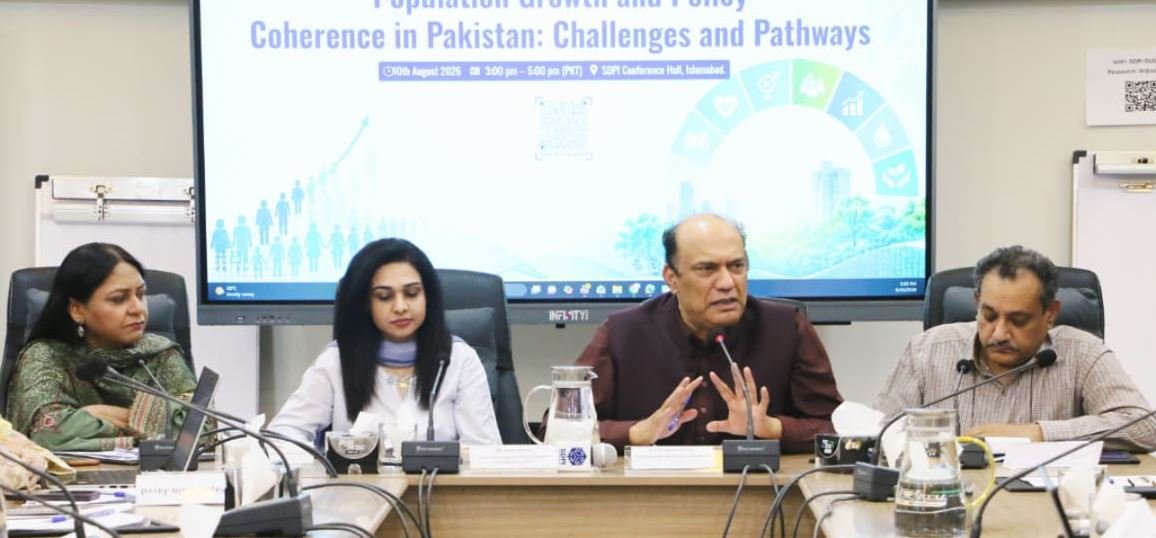
The stakeholders gathered at the Sustainable Development Policy Institute (SDPI) Monday Seminar for a seminar titled “Population Growth and Policy Coherence in Pakistan: Challenges and Pathways” held here.

The seminar was steered by a wide-ranging discussion on institutional silos, regional implementation bottlenecks and community-level narratives shaping Pakistan’s population policy landscape. The keynote was delivered by Prof. Dr. Shezad Ali Khan, Executive Director of the Health Services Academy, whereas the panel discussion was participated by Ms. Rabia Zafar of the National Institute of Population Studies (NIPS), and Ms. Farah Ashraf of the United Nations Population Fund (UNFPA).
Prof. Dr. Shezad Ali Khan, Executive Director, Health Services Academy, presented some of the seminar’s starkest findings, arguing that population dynamics cannot be understood through a narrow medical lens alone. He said an estimated 48 percent of pregnancies in Pakistan are unwanted, contributing to roughly 380,000 abortions annually, many carried out through unsafe procedures in unregulated clinics that result in severe complications and sepsis.
On maternal and infant health, Dr. Khan said Pakistan records around 700,000 stillbirths a year the highest number in the world while 42 out of every 1,000 babies die within their first month, the highest neonatal mortality rate globally since 1960.
He further noted that 20 out of every 100 couples face unmet family planning needs due to structural resource shortages rather than community resistance, underscoring that population challenges stem from systemic failures rather than public failure.
Dr. Khan cautioned against over-reliance on externally driven terminology that can provoke cultural resistance, calling instead for an indigenised narrative built around “population welfare,” with emphasis on maternal nutritional recovery and birth spacing through breastfeeding currently practiced by only 33 percent of mothers. He added that infants who are not breastfed are 11 times more likely to die of diarrhoea and five times more likely to die of pneumonia, reinforcing the need for a multi-sectoral approach that brings education and economic planning alongside healthcare.
Ms. Rabia Zafar, National Institute of Population Studies (NIPS), drew attention to these macroeconomic projections, pointing to structural deficits in long-term financing, regional coordination and ground-level commitment. She urged policymakers to move from reactive planning to systematic, projection-based frameworks, stressing that only targeted investments in human capital, health and skill development would allow Pakistan to capitalise on its approaching demographic window.
Ms. Farah Ashraf, UNFPA, highlighted the pressing need to dismantle fragmented departmental silos that continue to hamper coherent policymaking. Speaking on UNFPA-backed initiatives, she said unified data governance, harmonised coordination between federal and provincial stakeholders, and aligning national budgets with long-term demographic trends were fundamental prerequisites for effective policy implementation.
Dr. Shafqat Munir Deputy Executive Director (Policy) SDPI, noted that Pakistan’s 57 million women currently in their reproductive age are projected to surpass 100 million by 2050, while the country’s working-age population currently bolstered by a youth cohort making up 67 percent of the population is expected to grow from 164 million to 292 million over the same period. He added that Pakistan’s core challenge is not a shortage of policy statements, but inadequate long-term financing, uneven regional access and weak inter-departmental coordination.
Closing the discussion, Dr. Shafqat Munir reiterated SDPI’s commitment to evidence-based, multi-sectoral dialogue that bridges research and actionable governance, telling participants that Pakistan must now move “from dialogue to implementation.”
He said the seminar forms part of its continuing research agenda on demographic and development policy in Pakistan.
Also Read: BISP MARKS WORLD BREASTFEEDING WEEK 2026, REAFFIRMS COMMITMENT TO MATERNAL AND CHILD NUTRITION