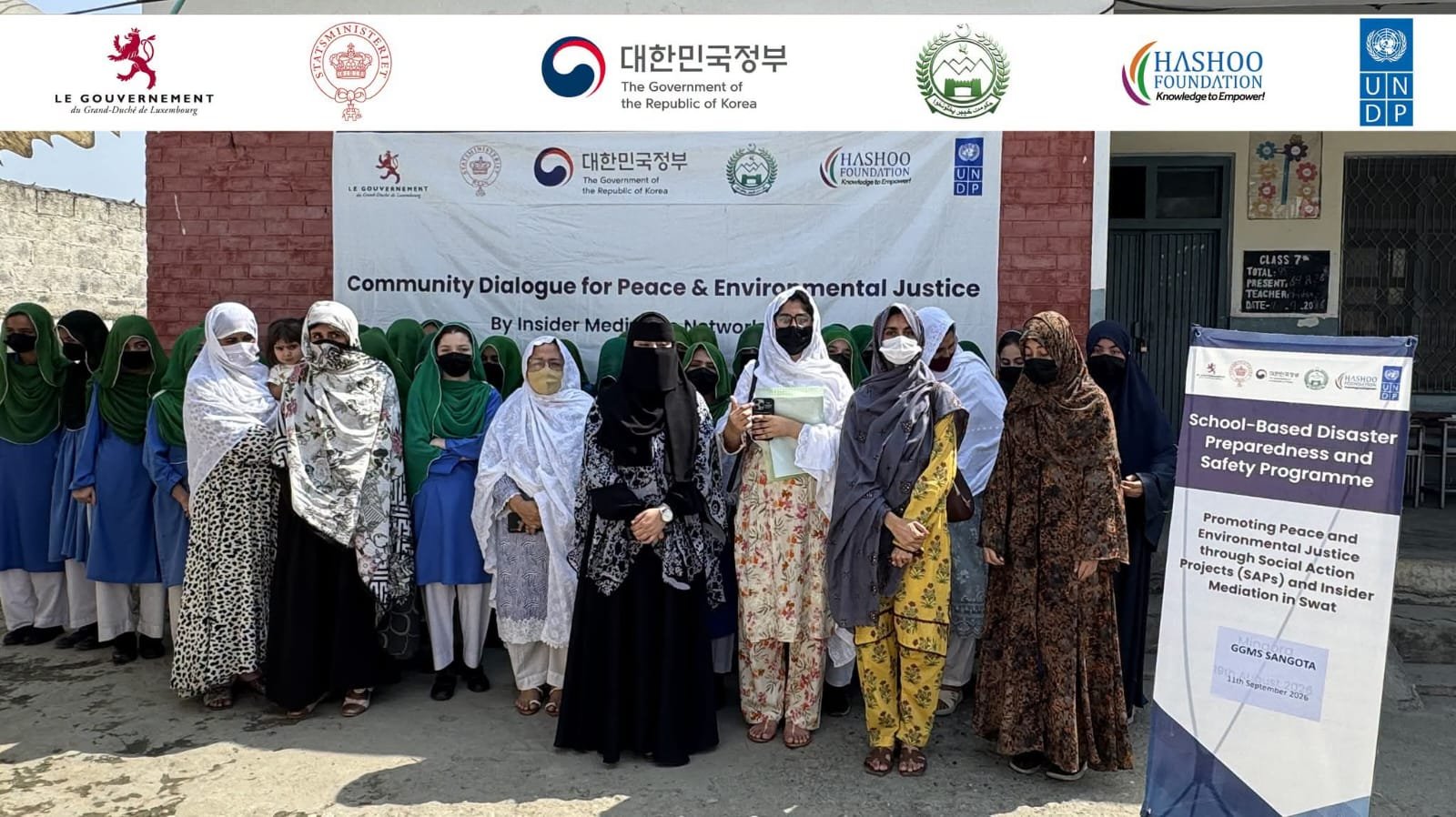
SWAT, September 12, 2026: The Hashoo Foundation, with the support of the United Nations Development Programme (UNDP) Pakistan, organised an Insider Mediation and Community Dialogue Session at a Government Primary Girls School in Sangota, Swat, under the project “Empowering Women for Peace and Environmental Justice in Swat.”
The session brought together around 35 female community members, students and teachers from Swat to promote greater understanding of peaceful dialogue, environmental justice and mechanisms for addressing environmental and climate-related concerns.

A key feature of the session was the active participation of trained Environmental Human Rights Defenders (EHRDs) associated with the project. The EHRDs facilitated learning and shared their knowledge with community members, demonstrating how training can be translated into practical community-level engagement.
Participants explored the concept of Insider Mediation, a locally rooted approach that uses trusted community voices to help prevent and resolve disputes through dialogue and mutual understanding.
The session also promoted community dialogue on environmental challenges and encouraged participants to explore peaceful and collective responses to issues affecting their communities.
Participants were introduced to formal government mechanisms for raising environmental and climate-related complaints, including available pathways through the Environmental Protection Agency (EPA) and Environmental Protection Tribunal (EPT).
The EHRDs also shared their learning on Social Action Plans (SAPs) and discussed how locally identified environmental concerns can be transformed into practical actions at the community level.
The initiative highlighted the growing role of trained women as local facilitators of dialogue, advocates for environmental justice and bridges between communities and relevant institutions.
The participants demonstrated their learning as trained Insider Mediators under the technical guidance of Idrees Hayat and the overall leadership of project lead Sadia Bangash.
The session underscored the importance of empowering women and local communities with knowledge, dialogue skills and access to institutional mechanisms to address environmental challenges and promote peaceful, community-led solutions.