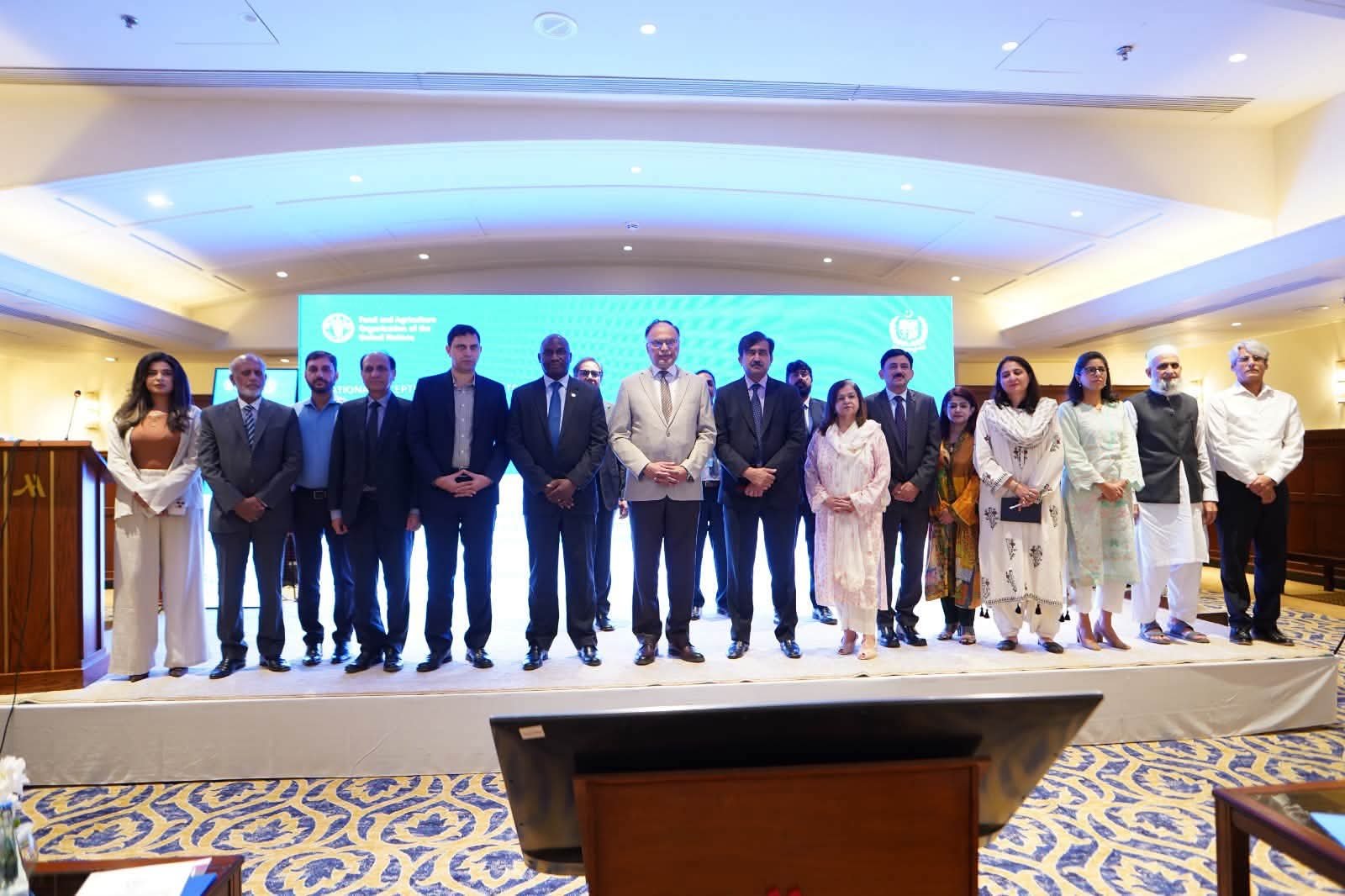
ISLAMABAD: The Food and Agriculture Organization of the United Nations (FAO) and the Government of Pakistan have launched a technical cooperation initiative on Integrated Land and Water-Use Planning aimed at protecting productive agricultural land and strengthening evidence-based decision-making to safeguard the country’s food security.
Pakistan’s food demand is projected to increase by around 50 percent by 2050, while the country’s population has reached approximately 260 million. Growing pressure on agricultural land and water resources is making sustainable management of these resources increasingly important.

Opening the workshop, James Okoth, FAO Officer in Charge, stressed the need for a careful approach to development that maintains a balance between urban growth and the protection of agricultural land that sustains the country’s population.
Ahmed Umair, Coordinator to the Prime Minister on Agriculture and Food Security, also addressed the participants. The session was followed by a technical presentation on integrated land and water-use planning by Wakas Awan, FAO Remote Sensing and GIS Specialist.
Formally launching the initiative, Federal Minister for Planning, Development and Special Initiatives Prof. Ahsan Iqbal said Pakistan’s population is growing while its land and water resources are under increasing pressure.
He emphasised that protecting agricultural land and sustainably managing groundwater are essential for ensuring food security and reducing the country’s dependence on food imports.
The minister also highlighted the depletion of groundwater as a major concern, pointing to increased extraction following the solarisation of agricultural tubewells as an additional challenge for sustainable water management.
A panel discussion titled “Balancing Urban Growth, Food Security and Water Security” brought together experts and stakeholders to discuss the competing demands on Pakistan’s land and water resources. The session was moderated by Amina Bajwa, FAO Head of Programme, and featured contributions from Dr. Shaker Mahmood, Marvi Mazhar, Aamer Hayat Bhandara, Dr. Naveed Anjum and Muhammad Anwar Hussain.
Waleed Abouelhassan, Lead Technical Officer, FAO Asia Pacific Region, presented global and regional experiences and lessons relevant to integrated land and water-use planning.
Implemented by FAO in partnership with the Ministry of National Food Security and Research (MNFSR) and the Ministry of Planning, Development and Special Initiatives (MoPD&SI), the programme will support the development of a Land Use Zoning Framework and a Digital Land Use Change Assessment Platform.
The new tools are expected to help policymakers assess land-use changes and make more informed decisions aimed at balancing urban expansion with agricultural production and sustainable water management.
The initiative comes at a time when Pakistan faces interconnected challenges of population growth, urbanisation, groundwater depletion, shrinking agricultural land and rising food demand, making integrated resource planning increasingly important for long-term food and water security.