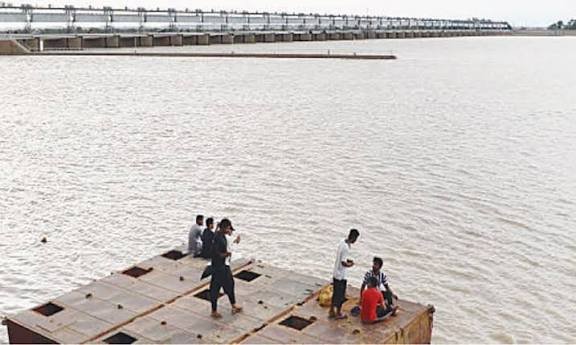
NAROWAL/LAHORE: Several villages, roads and thousands of acres of agricultural land have been inundated after the Baein rainwater drain developed a high flood following heavy rainfall upstream, while water levels in the River Ravi and Nullah Dek have also risen sharply.
The Baein drain, which has a carrying capacity of around 6,000 cusecs, recorded a flow of up to 7,720 cusecs after floodwater entered Shakargarh tehsil from Indian-administered Kashmir.

The flooding has affected agricultural land, residential areas and livestock sheds in nearby villages. Several connecting roads have also been submerged, creating difficulties for residents and travellers between Norkot and Kot Naina. Some citizens have been using private boats to cross the flooded Baein drain.
Narowal Deputy Commissioner Muhammad Tayyab Khan said the administration was continuously monitoring the situation in the storm-water drains and the River Ravi. A control room and relief camps have been established, with arrangements for accommodation, food, medicines and fodder for livestock.
He said the district administration remained on high alert and was taking measures to respond to any emergency.
Irrigation Executive Engineer Ali Raza said medium-level flooding was being observed in the Auj and Dek rain drains, while the River Ravi was flowing at a normal flood level. Irrigation teams were deployed in the field to monitor water levels and respond to emergencies.
Rescue teams save stranded tractor driver
Rescue 1122 teams also responded to an emergency near Antowali village in Shakargarh, where a tractor-trolley driver became stranded while attempting to cross the Baein Nullah.
According to the district emergency officer, rescue personnel reached the location and, after a two-hour operation, safely rescued 35-year-old Muhammad Shahid along with his tractor-trolley.
Flood conditions persist in several drains
According to the Flood Forecasting Division (FFD) of the Pakistan Meteorological Department, water levels have receded at several monitoring points, but medium-level flooding continues in a number of rain-fed streams.
At Jalalah, the flow in Nullah Ujh declined to around 35,000 cusecs, while medium flooding persisted. The discharge in Nullah Baein fell to 6,771 cusecs, with medium-level flooding continuing.
Meanwhile, Nullah Dek recorded a discharge of 16,487 cusecs, also remaining at medium flood level. At Kot Naina, the flow increased to approximately 43,600 cusecs, resulting in low-level flooding.
The FFD said no significant increase in flows was expected at major river gauging stations during the next 24 hours. However, the Indus at Kalabagh, Chashma, Guddu and Sukkur was expected to remain at low flood levels.
For the period from August 11 to 18, the FFD forecast that anticipated rainfall in Islamabad, Kashmir, Gilgit-Baltistan, Khyber Pakhtunkhwa and upper Punjab was unlikely to cause a significant increase at major rim-gauging stations. However, flows in the Ravi and Chenab could reach low flood levels during the period.
Transboundary streams pose recurring monsoon risk
Nullah Ujh is a seasonal, rain-fed tributary of the Ravi that originates across the border and enters Pakistan through Shakargarh tehsil. It is known for sudden surges during the monsoon season, posing risks to nearby communities and flood-protection infrastructure.
Nullah Baein is another transboundary rain-fed stream that enters Pakistan near Shakargarh before joining the Ravi. Its water level can rise rapidly after heavy rainfall, increasing the risk of flash flooding, soil erosion and damage to rural communities.
Nullah Dek, another major seasonal tributary of the Ravi, is formed by the confluence of the Devak and Basantar rivers before entering Pakistan near Zafarwal. It passes through several districts, including Narowal and Sialkot, carrying substantial monsoon runoff towards the Ravi.
Tarbela reaches maximum conservation level
Meanwhile, a daily water report issued by the Water and Power Development Authority (WAPDA) showed substantial flows in several major rivers and reservoirs.
At Tarbela Dam, inflow was recorded at 210,700 cusecs and outflow at 209,900 cusecs. The reservoir’s water level stood at 1,550 feet, reaching its maximum conservation level, while live storage was recorded at 5.580 million acre-feet (MAF).
At Mangla Dam, the water level was 1,207.65 feet, with live storage of 4.732 MAF, against a maximum conservation level of 1,242 feet.
Chashma Lake stood at 648.50 feet, close to its maximum conservation level of 649 feet, with live storage of 0.285 MAF.
River Kabul at Nowshera recorded inflow and outflow of 32,300 cusecs each, while the Jhelum at Mangla recorded an inflow of 31,700 cusecs and outflow of 7,000 cusecs. At Marala, the Chenab recorded an inflow of 71,500 cusecs and outflow of 56,200 cusecs.
Authorities continue to monitor river flows and rain-fed drains amid the ongoing monsoon season, with local administrations maintaining emergency arrangements in vulnerable areas.
Also Read: Assistant Commissioner Chakwal Reviews Monsoon Arrangements, Hospital Services