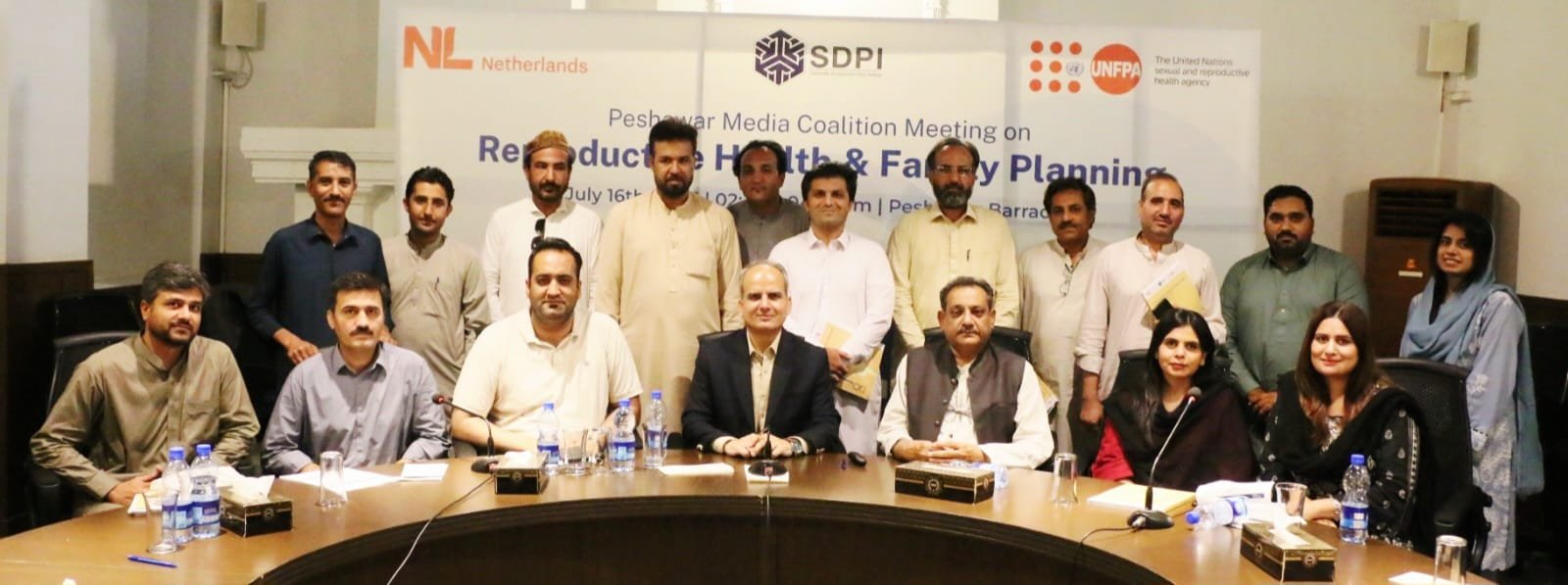
PESHAWAR (16 July 2026): Journalists, policy experts and officials from the United Nations Population Fund (UNFPA) unveiled fresh data on youth, population, family planning and child marriage for reporting on issues pertaining to population here on Thursday.
The data was released at a session, titled: Khyber Pakhtunkhwa (KP) Media Coalition Meeting on Reproductive Health and Family Planning, hosted by the UNFPA and implemented by the Sustainable Development Policy Institute (SDPI) with support of the government of the Netherlands, brought together senior and regional journalists from across the province in an effort to build a sustained data bank for evidence-based reporting on population, health and development.
Dr. Shahid Khan, Program Specialist SRH, UNFPA-KP said the agency’s work is anchored in three global goals, ending preventable maternal deaths, meeting all unmet needs for family planning, and eliminating gender-based violence, pursued through technical support to government and non-government partners. He said UNFPA has built three parallel advocacy forums on population issues: one with parliamentarians, one with civil society organizations, and the KP Media Coalition. He credited journalists’ repeated requests for verified data as the direct motivation for organizing the current data-sharing initiative.
Dr. Sajid Amin Javed, SDPI’s Deputy Executive Director (Research), opened the session by framing the coalition’s purpose as a partnership rather than a training exercise. He said journalists understand social issues and are the voice of the society that bear the responsibility to take public issues to the government forum. However, the SDPI’s role was simply to supply verified data drawn from various government reports and surveys that reporters could translate into accessible stories, he added.
Dr Sajid Amin Javed presented headline figures from KP’s latest population profile. He said the province’s population stood at nearly 41 million at the 2023 census and may already have crossed 42 million, with an annual growth rate of 2.38 per cent slightly below the national average of 2.53 per cent. The average household size in KP is 6.92 persons, which reflects the prevalence of joint family systems, he said, adding that youth aged between 15–24 make up roughly 32.7 per cent of the population, in line with the national average, but 33 per cent of KP’s youth are classified as NEET (not in employment, education or training). Growth rates vary sharply by district: Kohistan recorded a 9.1 percent growth rate, roughly three times the provincial average, underscoring what Dr Javed called the danger of masking district-level disparities with provincial averages. KP’s unemployment rate of 9.6 percent significantly exceeds the national figure of 6.7 percent, with a pronounced gender gap in employment. Poverty in KP has risen by roughly six percentage points between 2018-19 and 2024-25, the second-highest increase among the provinces after Sindh, he added.
Turning to fiscal priorities, Dr Javed warned that KP’s development budget was under strain. He said the province’s Annual Development Plan stands at roughly Rs 547 billion, i.e. the 22 per cent less than the previous year, while the health budget of Rs 206 billion, when divided across the province’s growing population, translates into a declining per-capita allocation. Merged districts have been allotted approximately Rs 19 billion under a separate development plan, he added.Dr Sajid Amin underscored that population stabilization is the need of the country and the KP province, whereas it’s propitious that the government is taking population as a mianstream policy discourse subject and taking economic, fiscal and population policies as integrated policy subjects.
Dr. Shafqat Munir, SDPI’s Deputy Executive Director (Policy), urged journalists to think of population as a “central point” connecting climate change, resource scarcity, and economic stagnation. Drawing on his own background in rights-based journalism, he described the coalition model as one in which competing outlets set aside institutional rivalries to jointly develop story ideas for a shared cause, recalling similar collaborative platforms SDPI has previously run with the International Federation of Journalists on journalist protection.
Munir also noted a broader media trend of audiences returning to traditional platforms radio, print and television after a period of migration to social media, arguing this made sustained, credible reporting on population issues more consequential than ever. The coalition members were divided in four thematic groups mainly youth, population, family planning and child marriage for a detailed group work exercise to come up with investigative news reporting ideas on the issues which the participants agreed are frequently obscured by province-wide averages.
Earlier, the meeting was structured in three parts: i) a broad situational briefing on KP’s population indicators and the newly passed provincial budget; ii) small-group sessions in which journalists and SDPI researchers jointly identified potential data-driven story angles; and iii) a closing session in which participants outlined reporting topics for the next three to five months, along with their specific data needs.Also Read: