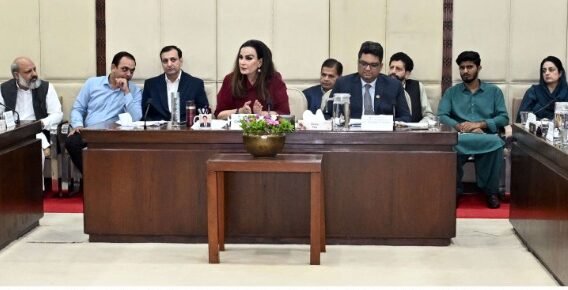
Islamabad: Chairperson Senator Sherry Rehman chaired a meeting of Senate Standing Committee on Climate Change undertaking an extensive review of Pakistan’s climate governance architecture, questioning the institutional rationale and added value of the Pakistan Climate Change Authority (PCCA) and calling for a fundamental reconsideration of an Authority that substantially duplicates the mandate, functions, expertise and personnel of the Ministry of Climate Change and Environmental Coordination.
During a detailed briefing on the PCCA, Senator Sherry Rehman expressed serious reservations about the Authority’s institutional necessity, particularly at a time when the Ministry itself is operating under constrained and declining budgetary resources. Senator Rehman noted that the Climate Ministry’s total allocation had fallen to Rs 2.478 billion in PSDP, meanwhile it had been reduced from Rs 3.5 billion to Rs 2.7 billion in the previous fiscal year.
She questioned why a separate authority had been established and 24 posts sanctioned when its core functions substantially overlap with responsibilities already vested in the Ministry.
“The question is what additional value is this Authority creating when the functions listed under its mandate are already the responsibility of the Ministry?” Senator Rehman questioned.
She also asked why new institutional structures were being maintained while the Ministry’s budget was being reduced and officers were being moved to the Authority on deputation. She stated, “It’s another SOE with no defined goal that continue to place a staggering burden. Losses of SOEs in Pakistan reached Rs 832.848 billion in FY2025, with cumulative losses now standing at Rs 6.563 trillion. Yet another Rs 451 billion has been allocated to SOEs in the budget.”

Senator Rehman stressed that her concerns were not directed at individual officers, but at institutional duplication and the repeated movement of the same expertise between government structures. The Committee was informed that many technical experts associated with the Authority had previously served within the Ministry. Senator Rehman questioned the rationale for moving the “same faces” from one institutional structure to another, including the appointment of retired officers, when the stated justification for the Authority was to provide additional technical capacity.
The Committee was informed that the PCCA had originally been conceived primarily as a mechanism for enhanced technical support. Senator Rehman questioned whether such capacity could instead have been strengthened within the Ministry itself, asking whether the Authority was creating genuine additional capacity or merely replicating functions, personnel and expertise already available within the federal climate governance structure.
When informed that coordination with provincial governments formed part of the Authority’s mandate, Senator Rehman pointed out that the Ministry already possesses a clear mandate to coordinate with the provinces. She observed that provincial governments would not necessarily engage with a separate authority without the direct involvement of the Ministry’s Secretary, raising further questions about the PCCA’s independent institutional relevance.
A key area of scrutiny was the Authority’s ability to mobilise international climate finance, including financing through the Green Climate Fund (GCF). The Committee did not receive a satisfactory response regarding the PCCA’s contribution to mobilising such resources. Senator Rehman observed that the Authority’s own presentation raised fundamental questions about its institutional distinctiveness.
“The presentation speaks volumes. If the same mandate, the same expertise and, in many cases, the same faces are being moved from the Ministry to an authority, then where is the additional capacity?” Senator Rehman remarked.
Senator Rehman further questioned the absence of substantial international linkages and upgraded institutional mechanisms within the Authority, stressing that any new climate institution must demonstrate genuinely specialised, internationally competitive and demonstrably additional capacity rather than reproduce functions already available within the federal climate governance structure.
Senator Rehman directed the Secretary to return to the Committee fully prepared to explain the institutional movement of officers, particularly where the Ministry’s resources are declining while similar expertise and functions continue to operate under a separate institutional umbrella.
Senator Rehman ultimately maintained that, given the substantial overlap between the Ministry and the PCCA, the Authority should be abolished if it cannot demonstrate a distinct and measurable institutional value. Senator Rehman directed the Secretary to appear at its next meeting with a clear, comprehensive and evidence-based explanation covering the PCCA’s institutional justification and distinct mandate, financial implications, staffing and deputation arrangements, technical value addition, international linkages and capacity to mobilise climate finance, mechanisms for coordination with provincial governments, and the precise distinction between its responsibilities and those already assigned to the Ministry.
The Committee also received a briefing on the latest developments concerning Glacial Lake Outburst Floods (GLOFs), Pakistan’s increasingly endangered cryosphere and the emerging risks faced by vulnerable communities living in glacial and high-mountain regions.
A UNDP official informed the Committee that Pakistan has more than 30,000 glaciers and that climate change is contributing to accelerated glacial melt. The Committee was also informed that 108 disaster events had been handled through early warning systems, including two GLOF events.
Senator Sherry Rehman expressed dissatisfaction with the briefing, noting that substantially the same presentation had been given to the Committee last year without adequately demonstrating what had changed on the ground or what concrete measures had been undertaken since then.
She questioned why the presentation did not sufficiently capture the scale and pace of glacial melting, including reports that around 16 % of glaciers have melted, as well as the vulnerabilities of communities living in affected areas and Pakistan’s forward-looking strategy for managing an escalating cryosphere crisis.
Senator Rehman stressed that the GLOF briefing should not be treated as an isolated climate-sector issue and called for the presentation to be integrated with the National Disaster Management Authority (NDMA) and the Pakistan Meteorological Department (PMD).
She observed that PMD is the appropriate technical institution for critical information relating to weather, climate and glacial conditions, while NDMA must be fully integrated into preparedness, response and disaster-risk management.
The Committee separately examined progress on rule-making, enforcement and actions taken to implement the Islamabad Capital Territory (Prohibition of Plastic Book Covers) Act, 2026.
Senator Sherry Rehman expressed strong dissatisfaction over the continued widespread use of plastic in Islamabad and questioned the effectiveness of enforcement mechanisms. She noted that plastic waste continues to accumulate across the capital and contributes to blocked drains, while concerns also persist over certificates being issued for products claimed to be recyclable or biodegradable.
“All of us have grown up without plastics on book covers. I made this law, and there has been weak compliance. Parliament is not a joke. Make sure compliance is mandatory,”
Senator Rehman questioned how the continued and unchecked use of prohibited plastic products could be justified despite legislative action.
She also raised concern over the continued promotion of products as “biodegradable”, noting that claims of biodegradability require proper standards and verification. She pointed out that only 9% of plastic is recycled globally, while much of the remaining plastic ultimately enters landfills, drains and the wider environment, carrying toxic impacts.
Senator Rehman noted that alternatives are particularly important for ordinary citizens and lower-income households who rely on plastic packaging for everyday products such as milk and yoghurt.
She said that while biodegradable and other alternative solutions exist, many have yet to achieve the scale and affordability required for mass adoption. She noted that alternatives are available in some startups and businesses, but the challenge is scaling them up and making them accessible across the market.
“What can be done for so many people buying yoghurt and milk in the mornings?” Senator Rehman asked, stressing that the transition away from plastic must take into account the needs of the poorest consumers.
Senator Rehman further emphasised that the plastics industry remains highly resistant to regulatory restrictions, while the State must simultaneously create an enabling environment for affordable alternatives. “After the ban, an alternative has to be given to poor people,” she stressed.
She further questioned the availability of plastic collection and recycling infrastructure and asked where collection centres are available to ensure that plastic waste is recovered rather than simply dumped into landfills or waterways.
The Committee stressed that effective environmental regulation requires both enforcement and an enabling framework that allows businesses, manufacturers and consumers to transition away from harmful materials without creating impractical or unaffordable burdens.
The meeting was attended by Senators Bushra Anjum Butt, Shazaam Durrani, Naseema Ehsan, Falak Naz, Syed Waqar Mehdi, Khalida Ateeb and Sarmad Ali. The State Minister for Climate Change and Environmental Coordination was also in attendance.
Also Read: NDMA Holds 13th Emergency Response Committee Meeting to Review Monsoon Preparedness