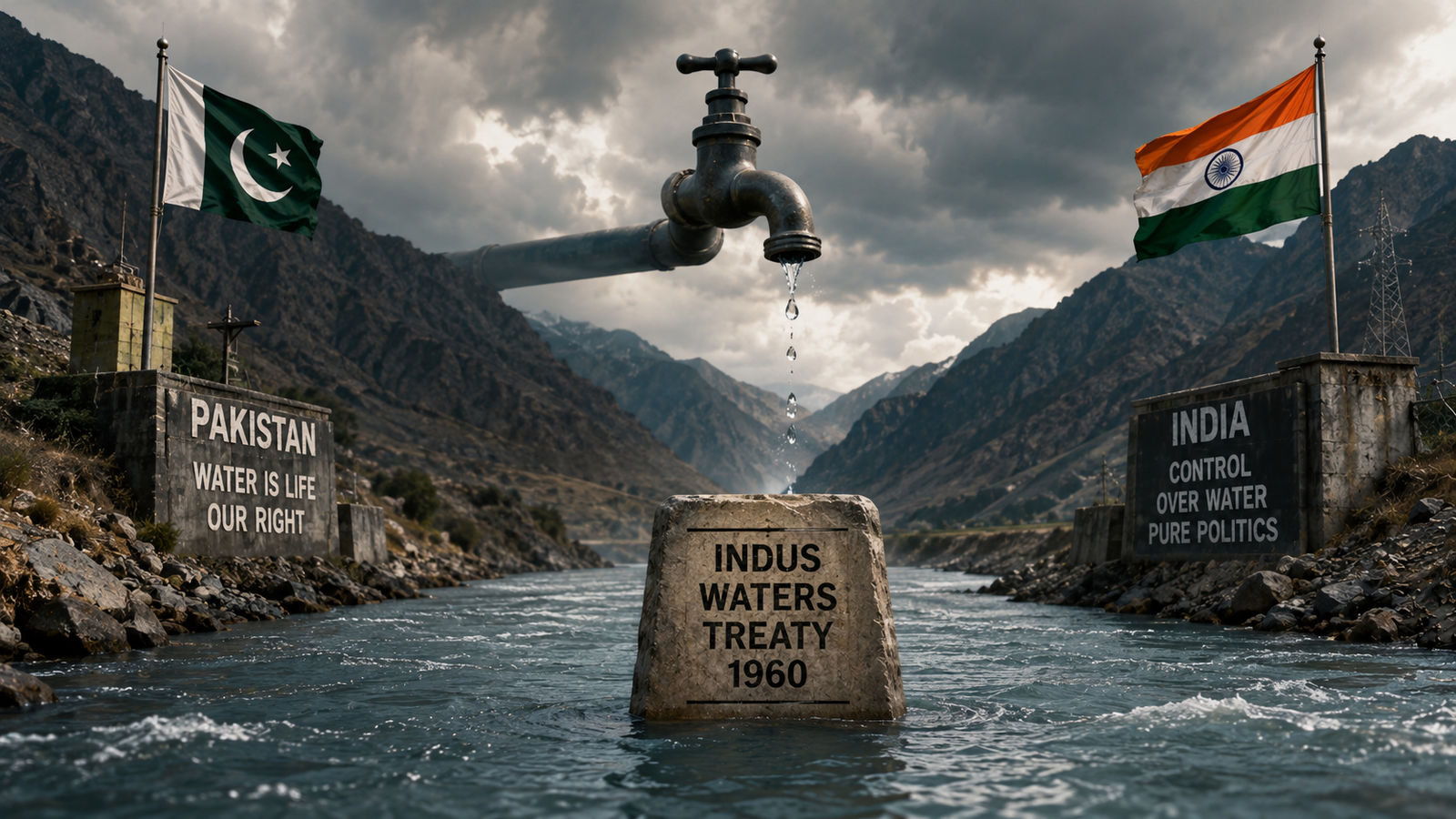
ISLAMABAD: Pakistan has renewed its warning against what it describes as the “weaponisation of water” by India, saying any attempt to deny Islamabad its share under the Indus Waters Treaty could further destabilise relations between the two nuclear-armed neighbours.
The issue has returned to the spotlight following growing tensions over the 1960 Indus Waters Treaty, a World Bank-brokered agreement that governs the sharing of water from the Indus river system between Pakistan and India. The treaty has long been regarded as one of the few agreements to survive decades of political and military tensions between the two countries.

Pakistan maintains that the treaty remains legally binding and cannot be suspended unilaterally. Islamabad has repeatedly argued that any move to disrupt water flows allocated under the agreement would violate international law and threaten the livelihoods of millions of people who depend on the Indus basin for agriculture, drinking water and economic activity.
The renewed debate comes after India suspended its participation in the treaty following a deadly attack in Indian-administered Kashmir in 2025, which New Delhi blamed on Pakistan-based militants. Pakistan rejected the allegations and has consistently denied involvement in the incident.
Speaking at a recent seminar in Islamabad, senior Pakistani officials said water should never be used as a political tool or strategic weapon. They warned that any effort to interfere with Pakistan’s allocated share of river waters would have serious implications for regional peace and security. Officials also reiterated that Pakistan would continue pursuing diplomatic and legal avenues to safeguard its water rights under international law.
The dispute has prompted growing concern among analysts, who say the water issue could emerge as another major flashpoint in the already fragile relationship between Islamabad and New Delhi.
Experts appearing on Al Jazeera’s Inside Story noted that while India currently has limited capacity to immediately halt the flow of rivers into Pakistan, prolonged suspension of treaty mechanisms, including data sharing and technical cooperation, could undermine trust and increase uncertainty over future water management. They stressed that sustained dialogue remains essential to preventing further escalation.
Water security has become increasingly important for Pakistan as climate change, rapid population growth and recurring droughts place greater pressure on available freshwater resources. Agriculture accounts for a significant share of the country’s economy and relies heavily on irrigation supplied through the Indus river system.
Environmental experts have also warned that shrinking glaciers, erratic rainfall and rising temperatures are likely to intensify water-related challenges across South Asia in the coming decades, making regional cooperation more important than ever.
Despite the sharp rhetoric from both sides, observers say neither country stands to benefit from further escalation over water. Many believe restoring communication channels and maintaining the treaty’s dispute-resolution mechanisms would help reduce tensions while addressing legitimate concerns through dialogue rather than confrontation.
The Indus Waters Treaty allocates the waters of six rivers between India and Pakistan and has remained in force for more than six decades despite multiple wars and periods of heightened hostility. Analysts say its future will be closely watched as both countries navigate an increasingly complex mix of geopolitical rivalry, climate change and growing demand for freshwater resources.