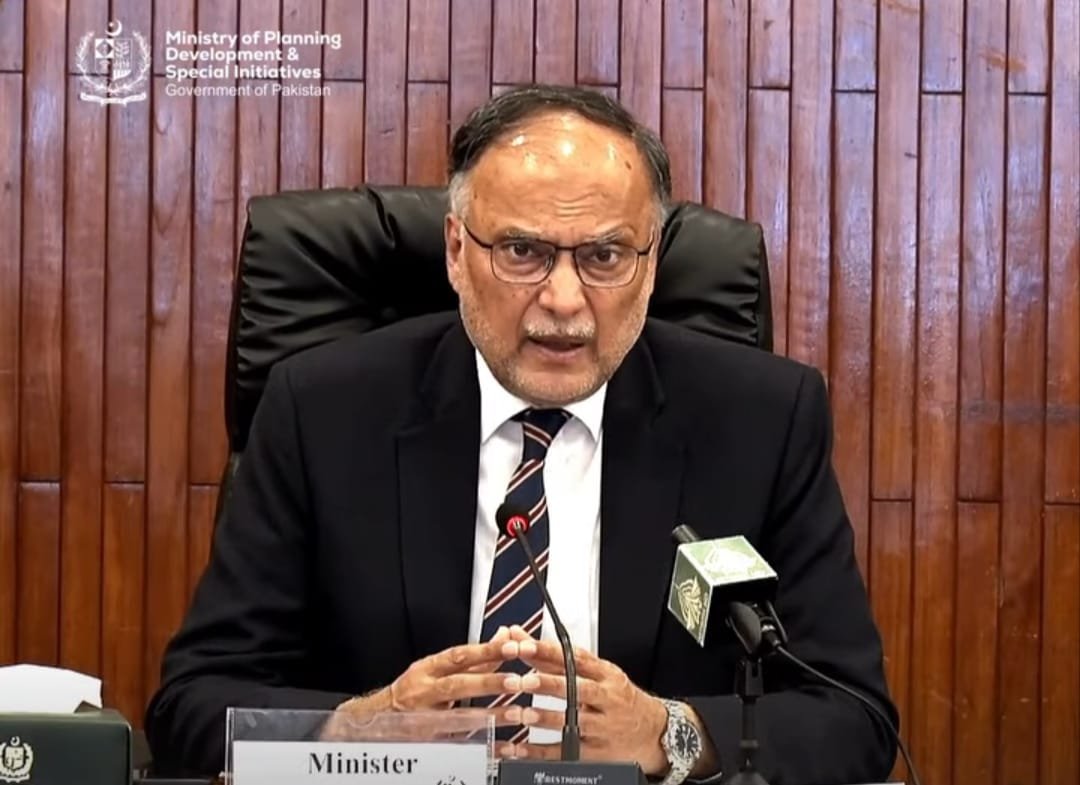
ISLAMABAD: The Green Economy Corridor under the second phase of the China-Pakistan Economic Corridor (CPEC) is advancing cooperation between Pakistan and China in key areas including water security, food security and climate-resilient agriculture, Federal Minister for Planning, Development and Special Initiatives Professor Ahsan Iqbal said.
Speaking during the opening remarks at a review meeting on the CPEC Action Plan 2025–2029, Professor Ahsan Iqbal said these areas were closely aligned with the priorities of URAAN Pakistan, the government’s broader development vision.

He said Pakistan was building the human and technological capacity required for what he described as “Green Revolution 2.0”, with a stronger focus on agricultural technology, improved seeds, farm mechanisation and efficient use of water resources.
As part of this effort, 1,000 Pakistani agricultural experts are being trained in China to strengthen domestic expertise and facilitate the adoption of modern agricultural technologies and practices.
The minister emphasized that agricultural research would play a critical role in improving productivity while helping Pakistan respond to growing climate-related challenges. Developing climate-resilient crops and strengthening research institutions would be essential to protecting food security and sustaining agricultural production under changing climatic conditions.
Water efficiency is another key component of the emerging cooperation. With increasing pressure on Pakistan’s water resources, the adoption of modern irrigation methods, improved farm technologies and efficient water-management practices is expected to become increasingly important for agricultural sustainability.
The Green Economy Corridor under CPEC Phase-II is therefore being positioned not only as an economic cooperation framework but also as an avenue for strengthening Pakistan’s resilience to climate and resource challenges.
The government’s emphasis on technology, research, human-resource development and climate-smart agriculture reflects a shift towards a more productive and sustainable agricultural system capable of meeting domestic food requirements while creating new opportunities for agricultural growth and exports.
Professor Ahsan Iqbal said strengthening cooperation with China in these areas would help Pakistan build the capabilities needed to modernize its agriculture sector and prepare it for the challenges and opportunities of the future.