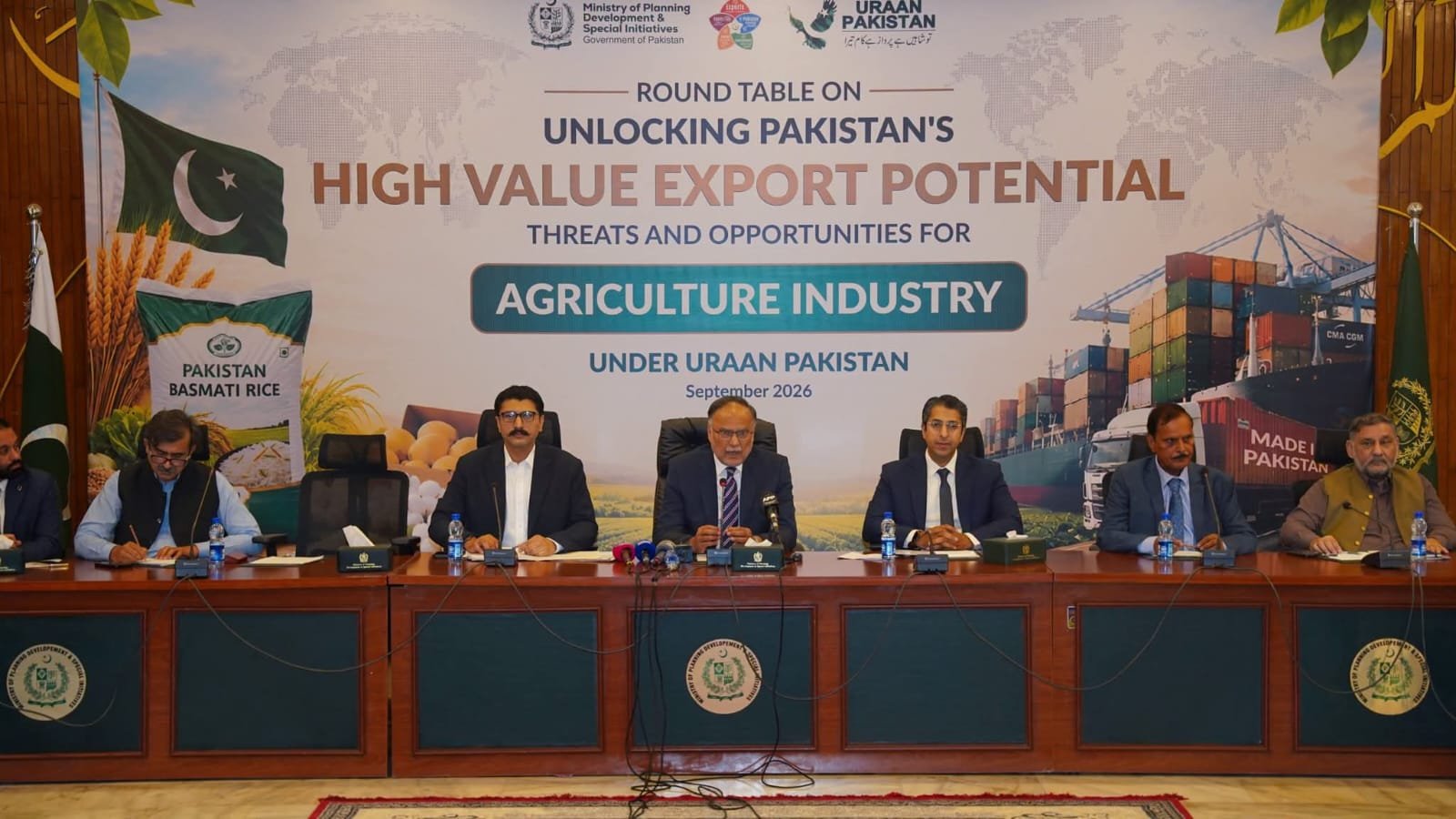
ISLAMABAD: The government has stepped up investment in human resources, research and modern technology to transform Pakistan’s agricultural economy into a competitive global export sector, Federal Minister for Planning, Development and Special Initiatives Professor Ahsan Iqbal said.
Addressing a national roundtable conference on leveraging Pakistan’s agricultural export potential, the federal minister said that, on the Prime Minister’s directives, another 1,000 agricultural experts would be sent to China for advanced training in modern farming technologies and practices.

He said 1,000 Pakistani agricultural experts had already been sent to China last year under the initiative.
According to the minister, the programme aims to align Pakistan’s agricultural human resources with modern international requirements while improving productivity, quality and competitiveness through research and technology.
He said work was also under way with Chinese cooperation to reform Pakistan’s agricultural research system, particularly the Pakistan Agricultural Research Council, and promote modern research and innovation.
The government is also focusing on climate-smart agriculture and the development of climate-resilient seeds to help farmers cope with the growing challenges posed by climate change.
Professor Ahsan Iqbal stressed that the success of Pakistan’s agricultural sector should not be measured solely by an increase in production. The real objective, he said, was to create value for international markets and substantially increase agricultural exports.
He called on private-sector stakeholders, progressive farmers, exporters, corporate agribusinesses, technology experts and academia to work closely with the government in several priority areas.
These include promoting high-value agriculture, horticulture and organic production; expanding investment in cold-chain infrastructure, storage and food processing for fruits, vegetables and potatoes; reducing post-harvest losses; and increasing Pakistan’s share in international livestock and halal meat markets by meeting global quality, safety and health standards.
The minister also emphasized the need to bring agricultural products in line with international standards and certification requirements to improve their access to global markets.
He said the government was working, on the Prime Minister’s instructions, to connect small farmers with modern technology, investment and large-scale farming through effective cooperative mechanisms.
The Prime Minister has also directed relevant institutions to facilitate farmers’ access to agricultural credit through the banking system and enable them to acquire modern farming technologies, he added.
Professor Ahsan Iqbal said Pakistan possessed enormous potential in agriculture, but unlocking it required strengthening the entire value chain, from production and processing to value addition, certification and access to international markets.
He urged stakeholders to move beyond simply identifying problems and instead submit practical, sector-specific proposals, particularly regarding regulatory, infrastructure and policy barriers that the government could address to encourage private investment and expand export capacity.
The government’s broader objective, he said, was to move Pakistan’s agriculture sector away from a traditional production-based model towards a modern, competitive and export-oriented system capable of supporting food security while generating sustainable foreign exchange, employment and greater economic self-reliance.