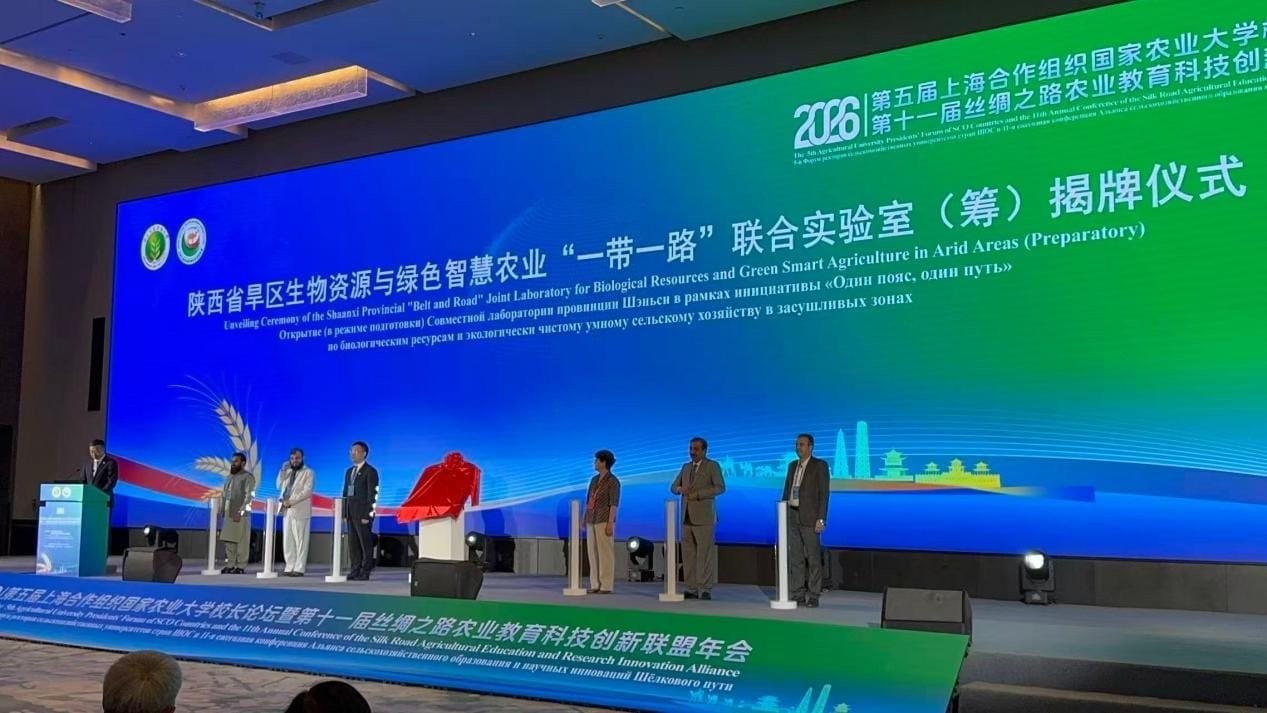
BEIJING: China and Pakistan have strengthened their agricultural cooperation with the launch of the Belt and Road Joint Laboratory for Biological Resources and Green Smart Agriculture in Arid Regions in Shaanxi Province, aimed at promoting climate-smart farming, advanced crop research and sustainable agriculture.
The joint research platform, led by Northwest A&F University, includes Pakistan’s University of Agriculture Faisalabad, Pir Mehr Ali Shah Arid Agriculture University, Ayub Agricultural Research Institute and Sindh Agriculture University.
Professor Zhang Lixin, the Chinese director of the laboratory, said the initiative will focus on six key areas, including germplasm resources and intelligent breeding, smart crop selection, agricultural data platforms, precision farming, intelligent livestock production and AI-assisted decision-making for sustainable agriculture.
He said researchers have already collected more than 120 crop germplasm samples from Pakistan, Uzbekistan and other arid-region countries. A standardized germplasm resource bank has also been established, leading to the development of 11 new stress-resistant crop varieties, including wheat, rapeseed, sesame, vegetables and forage crops suitable for South and Central Asia.
The laboratory has also developed several green agricultural technologies, including integrated water and fertilizer management systems, smart orchard production, AI-based agricultural equipment models and straw biodegradation techniques for organic fertilizer production. These technologies are now being adapted for use in Pakistan and Uzbekistan.
Professor Zhang said specialized training programmes on smart agriculture and bio-health technologies will begin in the second half of 2026, with the first batch bringing together 12 young researchers from Belt and Road partner countries. The programme will combine classroom learning, field training and research visits to strengthen local scientific capacity.
Hafiz Saad Bin Mustafa, Principal Scientist at Ayub Agricultural Research Institute, said technology transfer would be a major focus of the partnership. He highlighted the importance of introducing modern farm machinery, including precision seed planters, combine harvesters, cultivation equipment and specialized germplasm-processing systems, along with cooperation in agricultural processing and researcher training.
Since December 2025, the laboratory has enrolled postgraduate students from Pakistan, Bangladesh and Indonesia. Two doctoral researchers from PMAS-Arid Agriculture University in Rawalpindi are currently undertaking six-month collaborative research projects, while Chinese postgraduate students have also completed field internships in Pakistan. The collaboration has already resulted in two SCI-indexed research papers.
During the inaugural conference, participants also launched a monograph on biological and healthy agricultural production technologies. In addition, the University of Sindh, the University of the Punjab, and universities from Bangladesh and Indonesia formally joined the Silk Road Agricultural Education and Research Innovation Alliance to promote scientific collaboration and technology exchange across the region.