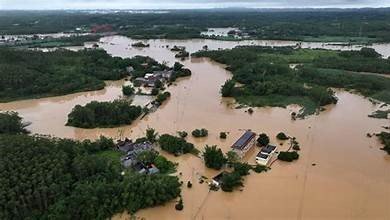
ISLAMABAD: China is battling widespread flooding and severe weather after Typhoon Maysak triggered torrential rains across several provinces, killing at least 10 people, leaving at least 12 missing, and affecting millions of residents.
According to Chinese authorities, floods that began on July 4 have impacted 63 counties and around 37.5 million people in the southwestern Guangxi region. At least six people have died, while 11 others remain missing after rivers overflowed, triggering flash floods and widespread destruction.

The flooding also caused four dams to collapse, sending torrents of water toward downstream villages and forcing emergency evacuations. Authorities have deployed rescue teams and intensified relief operations in the affected areas.
The city of Hengzhou, known as China’s “capital of jasmine,” has been among the hardest-hit areas. The disaster is expected to significantly disrupt jasmine cultivation, threatening the livelihoods of thousands of local farmers and businesses dependent on the flower industry.
Local media also reported unusual incidents in which floodwaters damaged a snake farm, allowing snakes to escape into nearby communities. Several people were reportedly bitten, resulting in injuries and fatalities.
In central China’s Hubei Province, Typhoon Maysak generated extremely rare tornadoes that struck Huanggang City on July 6. The powerful winds tossed heavy trucks up to 30 metres, killing four people and leaving one person missing, according to official reports.
Meteorologists said Maysak, the first typhoon to make landfall in China during the 2026 typhoon season, produced unusually heavy rainfall because it weakened slowly after landfall, allowing its circulation to persist over inland areas.
China has also experienced a series of other extreme weather events this month, including a deadly landslide in Gansu Province that claimed 21 lives, and record-breaking rainfall in the country’s northeast that killed three people.
Studies indicate that storms account for approximately 81 percent of China’s direct economic losses from natural disasters, highlighting the growing impact of climate change and extreme weather.
In response to increasing climate risks, the China Meteorological Administration (CMA) has recently launched the National Meteorological Disaster Prevention Plan (2026–2030). The strategy focuses on strengthening early warning systems, improving disaster monitoring, increasing public awareness, and enhancing preparedness in high-risk regions and critical sectors.
Officials said the plan aims to improve the country’s capacity to respond more effectively to increasingly frequent and intense weather-related disasters.