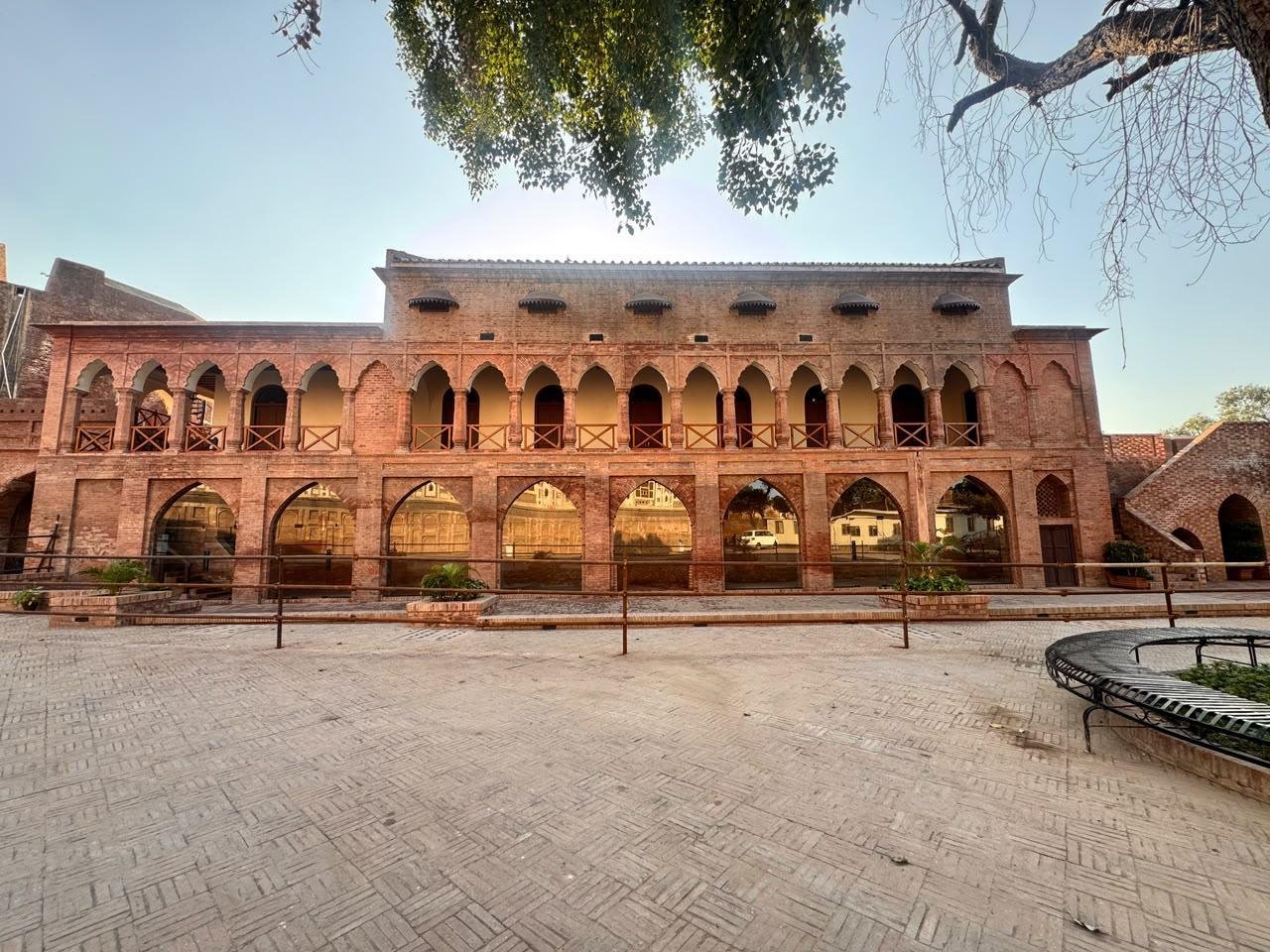
LAHORE, Nov 20 (ABC): The conservation and restoration of two historically significant monuments at Lahore Fort, Akbari Gate and the Curator’s House, have been completed under a heritage development initiative aimed at preserving cultural landmarks, improving visitor facilities and promoting tourism-related economic opportunities.
The restoration work was carried out under the Heritage and Urban Regeneration: Tourism Development in Lahore Fort and its Buffer Zone (HURL) project, a collaborative initiative involving the Punjab Walled Cities and Heritage Areas Authority (PWCA), the French Development Agency (AFD) and Aga Khan Cultural Service–Pakistan (AKCS-P).
Implementation of the project has been led by the Project Management Unit (PMU) of PWCA and AKCS-P. Conservation work on Akbari Gate began in 2023, while restoration of the Curator’s House commenced in 2024.
Representatives of AFD, PMU and AKCS-P attended a soft-opening ceremony at Lahore Fort to mark the completion of the restoration work. The ceremony included a ribbon-cutting event followed by a guided tour of the restored monuments.
Director General PWCA Najmus Saqib said the initiative would help promote tourism, improve public access to historical sites and support local livelihoods.
“The conservation of Akbari Gate and the Curator’s House forms part of PWCA’s broader efforts to improve public access to Lahore’s historic sites, attract more visitors, and create economic opportunities,” he said.
Built during the reign of Mughal Emperor Akbar, Akbari Gate historically connected Lahore Fort with the Walled City, providing residents with access to the fort.
The entrance was subsequently closed during British colonial rule following administrative and infrastructural changes. With conservation work now completed, the authorities plan to reopen the historic gateway to visitors after implementing the next phase of adaptive reuse.
Under the proposed arrangements, specialized cabins on the ground floor will serve as ticket counters. Wheelchair ramps and parking facilities are also being planned to improve accessibility and convenience for visitors.
The first floor will accommodate a gallery displaying archival material related to the historic gateway, along with a CCTV monitoring room.
The conservation work involved several technical interventions, including the restoration of the historic drainage system discovered during excavation in the gate’s courtyard.
The drainage network has been connected to water collectors through pipes, allowing collected water to eventually be diverted into the city’s main drainage system.
Conservation teams also uncovered elaborate frescoes depicting Hindu deities while removing plaster layers dating to the Sikh and British periods.
The Curator’s House, another restored structure within Lahore Fort, dates back to the British colonial period.
Originally constructed as a guard room to provide protection against external attacks, the building was later used for administrative purposes, including offices and accommodation for staff and curators responsible for the fort’s management and maintenance.
Under the adaptive reuse plan, the upper floor of the building will be converted into a café offering panoramic views of several prominent heritage landmarks, including the Picture Wall, Dera Sahib Sikh Temple and Badshahi Mosque.
The ground floor will house a souvenir shop, providing additional facilities for tourists while creating opportunities for local businesses.
Restoration work at the Curator’s House included the installation of new flooring and replacement of its damaged, termite-infested ceiling.
The new ceiling incorporates panels made from sustainable Deodar wood, native to the Western Himalayas, along with terracotta tiles manufactured from fired clay.
Chief Executive Officer AKCS-P Tausif Khawaja emphasized the importance of preserving historic monuments while creating sustainable economic opportunities for surrounding communities.
“The conservation work carried out at the Lahore Fort by our technical teams is a labour of love that combines creativity, passion and hard work. As an organization we strive to preserve historic structures that represent our rich cultural heritage, while meaningfully engaging diverse communities. With the revival of these monuments, we hope to offer improved cultural spaces that people feel a sense of ownership over and in the process, generate sustainable local enterprise,” he said.
The project combines traditional conservation techniques with international best practices to restore historic structures while retaining their architectural authenticity.
The initiative also reflects broader efforts to protect Lahore Fort’s diverse cultural heritage, which includes monuments associated with different historical periods and religious traditions, such as the Sikh-era temple, Zenana Mosque and Loh Temple.
Through adaptive reuse, the restored buildings are expected to serve contemporary public needs while preserving their historical character.
Juliette Le Pannerer, Project Team Manager at AFD, described the completion of the two monuments as an important milestone for the development of Lahore’s Walled City.
“I was delighted to have had the opportunity to inaugurate two major monuments of the Lahore Fort. They have been restored to a high standard, adding to the Fort’s grandeur. The conservation of the Akbari Gate and Curator’s House is a milestone for the development of the Walled City, creating avenues for improving the quality of life of communities,” she said.
The conservation initiative is expected to strengthen Lahore Fort’s appeal as a major heritage tourism destination while supporting local enterprise, employment opportunities and the long-term preservation of the city’s architectural and cultural heritage.