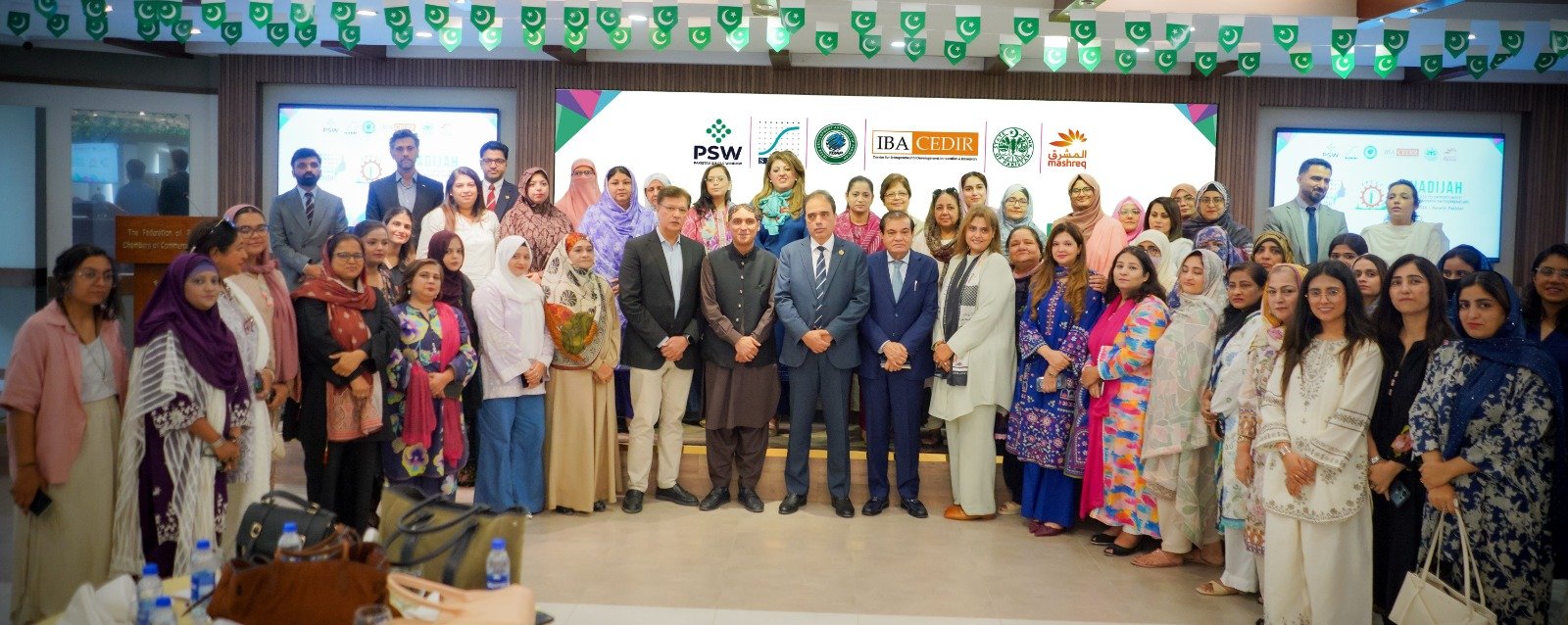
Pakistan Single Window (PSW) brought together key institutions from Pakistan’s trade, financial and enterprise development ecosystem for a Khadijah Women Entrepreneurship Program session in Karachi focused on “Access to Opportunity: Enabling Women Entrepreneurs” equipping women entrepreneurs with the knowledge, financial linkages and institutional support needed to strengthen their businesses and pursue opportunities in international trade.
Organized in collaboration with the Federation of Pakistan Chambers of Commerce and Industry (FPCCI) and Mashreq Bank, the session also brought together other key institutions, including the Small and Medium Enterprises Development Authority (SMEDA), State Bank of Pakistan (SBP), Trade Development Authority of Pakistan (TDAP), and IBA Centre for Entrepreneurial Development, Innovation & Research (IBA-CEDIR). The session connected women entrepreneurs with expertise spanning digital trade facilitation, business development, financial inclusion, export readiness and international market access. The event was graced by the presence of Syed Ali Qasim Gillani, Member of the National Assembly (MNA), and attended by prominent trade leaders and institutional representatives, including Mr. Saquib Fayyaz Magoon, Senior Vice President of FPCCI, and Mr. S. M. Tanveer, Patron-in-Chief of United Business Group.
Mashreq Bank contributed to the engagement through its session, “Women, Finance & Global Trade,” offering valuable insights on financial inclusion, digital banking and trade finance for women-led businesses. The session reflected the bank’s broader commitment, under the leadership of Mr. Muhammad Hamayun Sajjad, CEO of Mashreq Bank Pakistan, to support women entrepreneurs in accessing finance and expanding into global markets.
The engagement reflected the Khadijah Program’s broader approach of addressing the different challenges women-led businesses encounter as they move from domestic operations towards formal and international trade. Participants received practical guidance on export procedures, regulatory requirements, business formalization, digital banking, trade finance, e-commerce and accessing international markets.
PSW provided participants with insights into Pakistan’s evolving digital trade environment and the role of paperless, integrated regulatory processes in simplifying cross-border transactions. TDAP contributed expertise on export development, market access and opportunities for women-led enterprises. The engagement also complemented the work of TDAP’s Women Entrepreneurship Division, headed by Ms. Fouzia Perveen Chaudhry, Additional Secretary / Head of Women Entrepreneurship Division, which focuses on strengthening women entrepreneurs’ access to export markets and trade opportunities.
SMEDA contributed perspectives on enterprise development and business readiness, while SBP and Mashreq Bank shared insights on financial inclusion, banking and digital financial services. FPCCI brought the perspective of Pakistan’s wider business community, helping connect institutional support with the practical requirements of entrepreneurs seeking to grow and access new markets. IBA-CEDIR complemented the discussions through its focus on entrepreneurship, innovation and enterprise development.
Highlighting the strategic importance of multi-stakeholder collaboration in Pakistan’s commercial capital, Syed Aftab Haider, CEO of PSW, stated, “Our continued engagement in Karachi under the Khadijah Program reflects our commitment to creating practical pathways for women entrepreneurs to participate more effectively in cross-border trade. By bringing together trade bodies, enterprise development institutions, financial sector stakeholders and regulatory organizations, we are helping women-led businesses access the knowledge, tools and institutional linkages needed to grow and connect with international markets.”
Highlighting the importance of stronger linkages between the private sector, financial institutions and trade facilitation bodies, Ms. Qurrat ul Ain, Vice President of FPCCI, remarked, “For women-led businesses to grow sustainably, access to markets must be supported by access to finance, digital tools and a clear understanding of trade processes. Initiatives such as the Khadijah Program create these important linkages and enable women entrepreneurs to engage with institutions that can support them at different stages of their business and export journey.”
Emphasizing the role of the business community in creating stronger pathways for women-led enterprises, Mr. Saquib Fayyaz Magoon, Senior Vice President of FPCCI, said, “Women entrepreneurs represent an important and growing segment of Pakistan’s business community. Platforms such as the Khadijah Program help bridge the gap between entrepreneurship and market opportunity by connecting women-led businesses with trade institutions, financial services and practical export guidance. FPCCI remains committed to supporting an enabling business environment in which more women-owned enterprises can formalize, grow and successfully access domestic and international markets.”
Through continued engagements with women entrepreneurs and institutional partners, PSW is strengthening the Khadijah Program as a bridge between digital trade infrastructure and business opportunity, helping more women-led enterprises build the capabilities, connections and confidence required to participate in global trade.