36 month technical cooperation project to develop a sustainable, climate resilient water management strategy for the Islamabad Capital Territory, with 2050 as the target year
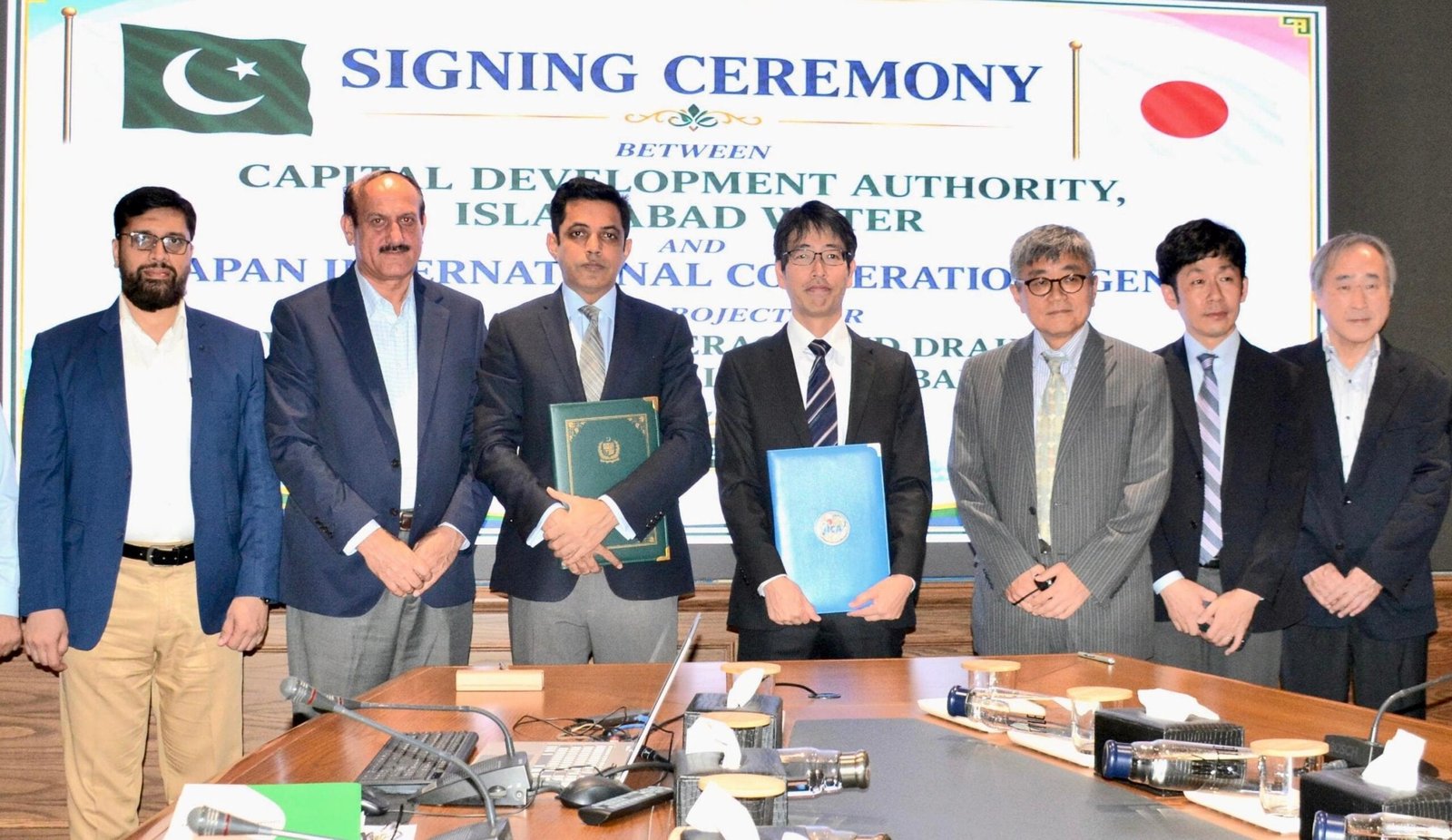
Islamabad, September 14, 2026: The Capital Development Authority (CDA) and the Japan International Cooperation Agency (JICA) signed a Memorandum of Understanding (MoU) at CDA Headquarters, Islamabad, today for the preparation of an integrated Water Supply, Sewerage and Drainage Master Plan for the Islamabad Capital Territory (ICT). The MoU marks a significant milestone in Pakistan Japan cooperation for strengthening Islamabad’s water management infrastructure, improving service delivery and ensuring sustainable water resources for present and future generations.

Chairman CDA and Chief Commissioner Islamabad, Sohail Ashraf, signed the MoU on behalf of the Capital Development Authority, while Mr. MIYAGAWA Masahito, Team Leader of the JICA Detailed Planning Survey Team, signed on behalf of JICA. Mr. Sardar Khan Zimri, Director General, Islamabad Water, and Ms. Fakhryia Anjum, Joint Secretary (Japan), Economic Affairs Division, Ministry of Economic Affairs, and other officers attended the ceremony at CDA Headquarters.
The MoU signing follows a detailed planning survey conducted by JICA’s Detailed Planning Survey Team, headed by Mr. MIYAGAWA Masahito, from August 24 to September 14, 2026. During the survey, the team held extensive consultations with CDA, Islamabad Water and other relevant organizations to develop the framework, scope and implementation arrangements for the proposed technical cooperation project.
The project will have a duration of 36 months and will principally cover ICT Zones 1–5, with detailed facility planning focused on Zone 1 and strategic assessment of Zones 2–5. The Master Plan will adopt 2050 as its target year and provide short-, medium- and long-term planning phases for the development of Islamabad’s water supply, sewerage, sanitation and drainage systems.
Major components of the MoU
- Water supply and water resources development
The project will assess existing and potential water resources, including surface water and groundwater, to identify sustainable options for meeting Islamabad’s long-term water requirements. The study will review existing water resource development reports and proposals, including studies related to Tarbela Dam, Chinot Dam, Shahdara Dam, Dotara Dam and Chirah Dam, as well as relevant proposals identified in previous JICA studies.
The assessment will cover water demand forecasting, water abstraction, conveyance, treatment, transmission, distribution, storage, water quality, operation and maintenance, asset management and non-revenue water reduction. Water source options will be compared on the basis of quantity, quality, reliability, climate risks, environmental and social considerations, indicative costs and implementation requirements.
The project will also review institutional, financial and operational arrangements to improve water supply services and support the development of a phased investment strategy.
- Sewerage, sanitation and wastewater management
The Master Plan will address sewerage and sanitation requirements across both sewered and non-sewered areas of the ICT. It will assess sewer networks, wastewater collection and treatment facilities, decentralized treatment systems, on-site sanitation, fecal-sludge management, receiving-water quality and operation and maintenance arrangements.
The study will identify priority measures for improving sanitation services, reducing environmental pollution and clarifying the respective responsibilities of CDA, Islamabad Water, private developers and other relevant entities. Minimum planning and service requirements for private developments will also be reviewed to support coordinated urban growth.
- Stormwater drainage and flood-risk management
The project will undertake an integrated assessment of natural streams, drains, stormwater drainage networks, flood-risk areas and localized flooding. Particular attention will be given to improving drainage planning, maintenance arrangements and the management of stormwater in developing areas.
The Master Plan will identify priority interventions and investment requirements for strengthening drainage infrastructure, improving operational efficiency and reducing the risks associated with extreme rainfall and urban flooding.
- Digital transformation of Islamabad Water
Digital transformation will form an important component of the project to improve operational efficiency, service quality, customer management and financial performance.
The project will assess existing data, digital systems and institutional capacity and develop a practical digital transformation plan for Islamabad Water. Potential measures include customer and asset management, meter reading, billing and collection, distribution management, smart metering, leakage detection, water-quality monitoring, complaint handling and small-scale monitoring devices.
The proposed digital solutions will be prioritized on the basis of service needs, cost-effectiveness, interoperability and sustainable operation and maintenance.
- Pilot activities and utility-management capacity
The project will include pilot activities aimed at improving water supply services and strengthening the utility-management capacity of Islamabad Water. These activities may include the installation of meters, monitoring of water supply hours, flow, pressure, water quality and leakage, improvement of customer records and complaint-management systems, and assessment of water service performance.
The project will also examine the potential benefits, requirements and appropriate timing of a phased transition towards a metered tariff system. Any such transition will be considered through consultations, with due attention to affordability, equitable access and the needs of vulnerable groups.
Other pilot activities, including sewerage-network cleaning and maintenance, may also be explored. The findings and lessons learned from the pilot activities will be reflected in the Master Plan and Islamabad Water’s action plans.
- Climate change, sustainability and environmental protection
The Master Plan will incorporate climate change adaptation and mitigation measures to support the sustainable management of water supply, sewerage and drainage services.
Climate risks, including drought, extreme rainfall, flooding, groundwater decline and water-quality deterioration, will be assessed. Potential adaptation measures will include diversification of water sources, leakage reduction, demand management, treated wastewater reuse, water storage, aquifer recharge, climate-resilient infrastructure and Nature-based Solutions, including watershed management.
The project will also consider energy-efficient pumping and treatment, gravity-based systems, renewable energy and other measures to reduce environmental impacts. Sustainable groundwater use, equitable access, affordability, transparency and good governance will remain important considerations in the planning process.
Strengthening inter-agency coordination
The MoU provides for the establishment of a Joint Coordination Committee (JCC), to be chaired by the Chairman CDA, for coordination, progress review and monitoring of the project. The JCC will review key findings, address inter-agency issues and monitor the implementation of agreed recommendations.
The project team will comprise technical counterparts from CDA and Islamabad Water, along with the JICA Mission Team. Stakeholder consultations will involve the Metropolitan Corporation Islamabad, ICT Administration, Ministry of Water Resources, WAPDA, Pakistan Council of Research in Water Resources, Small Dams Organization, Irrigation Department Government of Punjab, WASA Rawalpindi, relevant provincial departments, Rawalpindi Cantonment Board, Defence Housing Authority, Ministry of Defence, Ministry of Climate Change and Environmental Coordination, private developers, communities and other relevant organizations.
The project will promote coordination among these institutions to optimize existing water resources, assess development options, improve service delivery and prepare joint action plans for priority issues.
Institutional arrangements and capacity development
CDA and Islamabad Water will serve as the implementing agencies for the project. The Member (Planning & Development), CDA, will act as Project Director, while the Director General of Islamabad Water will act as Project Manager and the Director Water Resource, Islamabad Water, will act as Project Coordinator.
Technical counterpart staff will be nominated from the relevant organizations before the commencement of the project. CDA and Islamabad Water will work closely with the JICA Mission Team throughout data collection, analysis, option development, stakeholder consultations, drafting and monitoring.
The Master Plan will be jointly formulated rather than prepared by the JICA Mission Team alone. This approach will strengthen institutional ownership, ensure that the plan reflects local requirements and enhance the technical and planning capabilities of CDA and Islamabad Water through on-the-job training.
The MoU also provides for approximately three training programmes in Japan, each of around 14 days, with approximately five participants, in the areas of management, water supply and sewerage/drainage, subject to final project arrangements.
Environmental and social considerations
The project will incorporate environmental and social considerations, including stakeholder consultations, information disclosure and assessment of climate, biodiversity and social impacts. Gender-related issues, affordability, the needs of vulnerable groups and women’s participation in consultations and technical training will be considered in the formulation of the Master Plan and pilot activities.
The project is classified as Category B under the JICA Guidelines for Environmental and Social Considerations (January 2022). Strategic Environmental Assessment will be undertaken to compare reasonable alternatives, including the “without project” option, while priority projects will be screened for any further environmental and social studies required.
Implementation and future investment planning
The Master Plan will identify priority projects on the basis of urgency, expected benefits, technical feasibility, economic and financial viability, environmental and social impacts, climate resilience, indicative costs, financing prospects and implementation capacity.
For each priority project, the Master Plan will identify the responsible agency, potential financing sources, implementation schedule and required follow-on studies. It will also include action plans for Islamabad Water in the water supply, sewerage/sanitation and drainage sectors.
The Master Plan will provide a strategic basis for future project formulation, budgeting, financing, implementation, monitoring, periodic review and updating. Implementation options may include Pakistani public resources, bilateral funding, support from development partners and private-sector financing. The project does not presuppose financing by JICA.
Project commencement
The draft Record of Discussions (R/D) will be refined on the basis of the Minutes of Meetings and consultations with the competent authorities. The R/D is tentatively expected to be signed in late November 2026, subject to completion of necessary procedures and confirmation of signatories.
The technical cooperation project is tentatively expected to commence in March 2027, when the first JICA Mission Team members begin project activities in Pakistan.
The signing of the MoU reflects the shared commitment of CDA, Islamabad Water and JICA to strengthening Islamabad’s water supply, sanitation and drainage systems through integrated planning, technical cooperation, institutional capacity development and sustainable infrastructure investment.
The initiative will help lay the foundation for a modern, efficient and climate-resilient urban water management system, supporting Islamabad’s development as a planned, beautiful, sustainable and environmentally responsible federal capital while safeguarding water resources for the needs of citizens today and tomorrow.