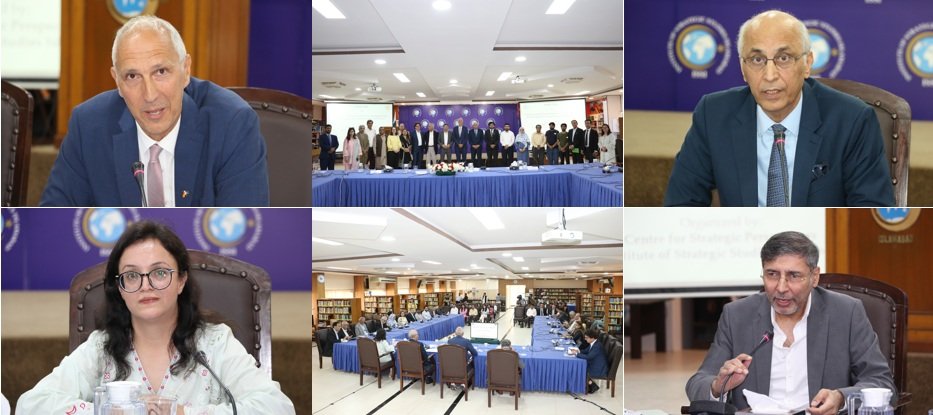
Islamabad, September 1, 2026 : International experts and policy analysts on Tuesday called for blended finance, robust measuring, reporting and verification (MRV) systems and stronger small and medium enterprise (SME) support to navigate challenges to emerge post EU’s carbon border adjustment mechanism (CBAM) rollout imposing carbon tax on exporters producing carbon intensive exports.
The Sustainable Development Policy Institute (SDPI) hosted a consultative discussion titled “Antalya Road to CBAM: Financing Technology and Green Industrialization,” bringing together policymakers, industry representatives and international experts to deliberate on financing pathways, technological readiness and policy reforms needed to help Pakistan’s export industries cope with the European Union’s Carbon Border Adjustment Mechanism (CBAM).
Dr Abid Qaiyum Suleri, Executive Director SDPI, said the discussion should move beyond differences of opinion to focus on the practical gaps in implementation and how existing frameworks could be better activated. He noted that developing countries have consistently raised concerns over the slow delivery of climate finance commitments and technology transfer pledges made at successive Conferences of Parties (COPs), and stressed the need to substantiate these concerns with evidence and data on what has, and has not, worked over nearly three decades of climate negotiations.
Dr Suleri said Pakistan needed to pursue a green industrialization agenda that brings together the private sector and policymakers, adding that public finance backed by sovereign guarantees could help industries access climate finance on easier terms, a step potentially transformative for the country’s green industrial transition. He also called for transfer of technology (ToT) programmes on energy transition, efficient energy use and the application of artificial intelligence to improve efficiency in Pakistan’s textile sector, noting that Pakistan’s good relations with both the United States and China, the world’s largest AI technology suppliers and among Pakistan’s largest textile export destinations could be leveraged for this purpose.
On participation at COP, Dr Suleri pointed out that Blue Zone passes remain limited, and urged accredited organizations to allocate a greater share of their access to private sector representatives. He said SDPI has deliberately shared its passes with the private sector to provide industry a platform to engage with international peers, while cautioning that a unified, coordinated approach was necessary to avoid undermining collective negotiating efforts.
Opening the session, Saleha Qureshi, Lead Pakistan Industrial Decarbonization Program at SDPI, said CBAM could no longer be viewed merely as a reporting and compliance issue, but as part of a broader shift in global trade rules that was placing increasing pressure on developing countries. She said the session aimed to identify concrete takeaways for developing economies, with particular reference to Pakistan’s textile sector, which continues to face mounting challenges under the evolving global trade and climate regime.
Presenting data on Pakistan’s climate finance needs through 2035, Qureshi said the country requires a total investment of $565.7 million, of which 17 percent would need to come from unconditional domestic resources and 33 percent from conditional international financing. She outlined key priorities for COP31, including the development of a costed, sector-disaggregated industrial decarbonization plan, establishment of a national Measurement, Reporting and Verification (MRV) data infrastructure, rationalization of energy tariffs for export-oriented industries, and stronger engagement with the private sector and small and medium enterprises (SMEs).
Aleksi Lumijärvi of the International Renewable Energy Agency (IRENA) said CBAM was becoming operational alongside a growing carbon credit ecosystem, and that other trade-linked schemes, such as GSP Plus, also needed to be factored into the discussion. He called for greater acknowledgment of the interplay between trade policies and climate measures, and highlighted available solutions such as electrification of heat processes to reduce energy and fuel consumption.
Yael Taranto highlighted Türkiye’s experience, noting the country’s vast renewable energy potential despite importing 79 percent of its energy supply from fossil fuels. She said Turkish industry, which contributes 28 percent to GDP and remains a key growth driver, is energy- and carbon-intensive, accounting for 8 percent of the country’s greenhouse gas emissions. Türkiye’s policy priorities, she said, are centred on producing high-value, low-carbon products, with competitiveness and efficiency treated as complementary goals. She cited exploration of carbon capture technologies and stressed that bankability of green investments remains central to scaling up financing.
Corinna Fürst from (INETTT) presented findings from studies examining CBAM’s impacts across different regions and countries, noting fragmented institutional responsibilities in reporting procedures across jurisdictions. She said CBAM’s effects were highly localized, with sub-national impacts including shrinking exports, reduced fiscal revenue and job losses concentrated in specific regions. She described CBAM as effectively an extension of carbon taxation, with sectors such as fertilizer and steel particularly affected, and warned that Pakistan could face steep carbon costs on its exports following the mechanism’s rollout. She cautioned that CBAM’s scope may expand further, and that other countries could adopt similar mechanisms, making it essential to strengthen monitoring, verification and documentation systems to identify where carbon exposure is most concentrated in production.
Imran Shahzad of Maheen Textiles said the industry must transition to green energy, describing solarization as a relatively easy option, though one constrained by funding availability. He noted that most textile units operate on 24/7 production cycles, while solar generation capacity is limited, forcing continued reliance on grid power. The lack of affordable storage systems to conserve solar energy compounds the problem, particularly for energy-intensive processes such as dyeing and tanning. He said coal phase-out remains a major challenge, with many industry players shifting toward biomass alternatives, though grid dependency persists given that new technology payback periods of four to five years are not commercially viable for most units. Shahzad also raised concerns that many EU buyers impose fixed design and pattern specifications that leave little room for sustainability adaptations, even as some brands increasingly shift toward eco-design requirements. He urged EU markets and brands to give due recognition to the efforts and investments Pakistani industry is making toward renewable energy adoption.
Mashhood Urfi identified policy instability and financing deficits as key barriers, noting that CBAM’s rollout should begin with general education and awareness campaigns for exporters rather than an abrupt enforcement approach, given that EU benchmarks have historically been conservative. He listed MRV systems as the first priority, financing as the second, and governance reform as the third, arguing that this sequencing would ensure a smoother CBAM transition with reduced impact on exporters.
Engineer Ubaid-ur-Rehman Zia, Head of the Energy Unit at SDPI, reviewed key developments from COP30 in Belém, stressing that climate measures should not function as disguised restrictions on international trade. He described COP30 as the first real test of the forum’s ability to deliver action rather than rhetoric, noting that the EU consumes around 30 percent of what Pakistan produces for the global market, making it imperative that CBAM not evolve into a de facto trade barrier.
Zia said the way forward requires a blended finance architecture, noting that decarbonization technologies, including electrification and electric boilers, already exist and offer significant potential, with market design, rather than technology, remaining the binding constraint.