Human development must be treated as critical infrastructure: Adnan Pasha
ISLAMABAD, Aug 31: With provincial fiscal space tightening and demand for essential services rising, government representatives and policy experts on Monday called for credible alternate and blended financing mechanisms to protect and expand investment in Pakistan’s social sectors.

Participants stressed that Zakat, philanthropy, corporate social responsibility, public-private partnerships, climate finance and social bonds should complement, not replace, public financing and should be integrated into government planning, budgeting and public financial management systems.
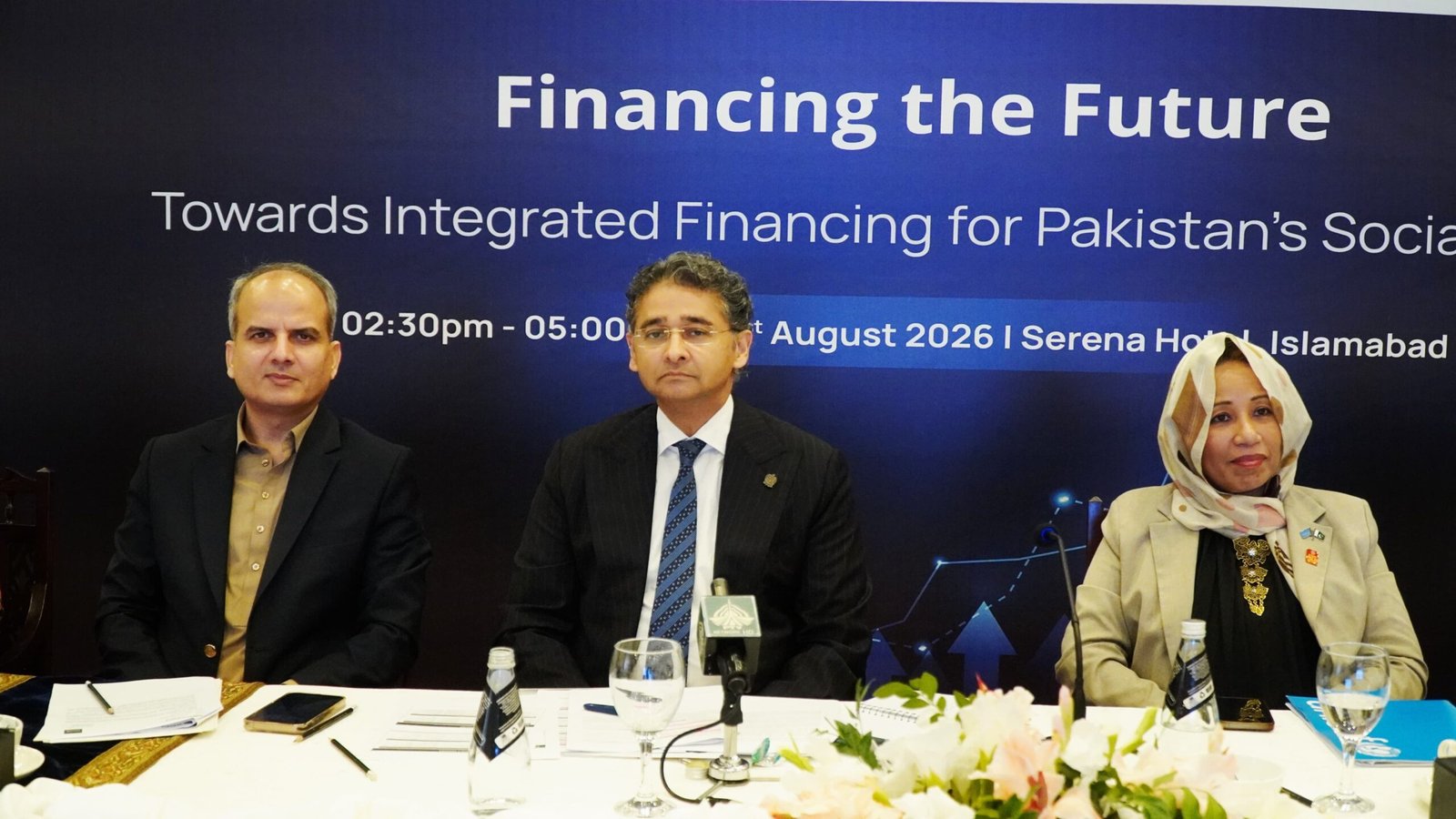
The discussion took place at a high-level policy roundtable titled “Financing the Future: Towards Integrated Financing for Pakistan’s Social Sector,” jointly organised by the Sustainable Development Policy Institute (SDPI) and UNICEF, with support from GIZ. The event launched the first policy engagement under the Financing the Future initiative, which forms part of UNICEF Pakistan’s broader Public Finance for Children framework.
Minister of State for Finance and Revenue Bilal Azhar Kiyani welcomed the discussion on Zakat, corporate social responsibility and other innovative financing streams. He said new instruments should be carefully piloted, transparently managed and rigorously evaluated before being taken to scale.
Referring to recent legislation adopted by the National Assembly, he said companies were being encouraged to increase and transparently report their corporate social responsibility spending, with compliant firms receiving public recognition.
Kiyani said alternate financing must be pursued alongside stronger domestic revenue mobilisation and improved use of existing public resources. He said the Federal Board of Revenue was expanding the tax base and formalising undocumented economic activity, including through engagement with nearly 3.5 million shopkeepers currently outside the tax net.
He also called for better coordination between the federal Public Sector Development Programme and provincial Annual Development Plans to prevent duplication. He advocated extending resource-distribution arrangements below the provincial level so that districts and local governments could respond more effectively to grassroots needs.
Sharmeela Rasool, Deputy Representative, UNICEF Pakistan, said the search for additional financing must remain centred on results for children.
She said financing mechanisms should be assessed not only by how much money they mobilised, but also by whether they were predictable, equitable, transparent and capable of producing measurable improvements in children’s lives.
Rasool noted that a child born in Pakistan was expected to achieve only around 41 per cent of their productive potential by age 18, reflecting the human and economic cost of inadequate investment in health, nutrition, education and social protection.
She stressed that public financing and government leadership must remain at the centre of the agenda. Alternate financing should reinforce national and provincial systems and prioritise children and communities facing the greatest deprivation.
Adnan Pasha, Advisor to the Finance Minister, said human development should be treated as critical infrastructure for Pakistan’s economic future. With population growth continuing to increase pressure on public services, he called for stronger accountability and results frameworks to unlock responsible private and philanthropic financing.
Pasha proposed using clearly defined and independently reviewed disbursement-linked indicators to connect private contributions with verifiable results. He said private financing could not be treated as a “free lunch” and should generate measurable social and financial returns.
He also proposed transparently directing revenues from selected taxes and levies, including those applied to sugary drinks, towards priority interventions in underserved districts. Visible results, he said, were essential for sustaining public and investor confidence.
Dr Sajid Amin Javed, Deputy Executive Director (Research) at SDPI, said investment in health, children and social protection was an investment in Pakistan’s future.
He said the country faced a structural financing challenge as population growth and social-sector needs continued to outpace provincial resources. The response must combine revenue mobilisation, expenditure prioritisation, greater efficiency and the responsible mainstreaming of alternate financing.
Dr Javed noted that only around Rs12 billion of an estimated Rs620 billion in national Zakat was currently mobilised through formal channels, demonstrating the need for stronger institutions, public trust and transparent collection and expenditure mechanisms.
Sadaf Zulfiqar, Chief of Social Policy at UNICEF Pakistan, said declining traditional development assistance had increased the importance of corporate and individual philanthropy, public-private partnerships and impact-investment opportunities.
Citing a 2023 study, she said annual corporate philanthropy in Pakistan was estimated at around $300 million. However, limited trust, weak transparency and fragmented institutional coordination continued to constrain its potential.
Dr Shafqat Munir, Deputy Executive Director (Policy) at SDPI, thanked UNICEF, GIZ and federal and provincial government representatives for supporting the initiative.
Shah Muhammad Azhar, representing the United Nations Resident Coordinator’s Office, welcomed the initiative and assured participants of his office’s support in advancing sustainable social-sector financing.
The event also marked the launch of the official webpage for the Financing the Future initiative.
Also Read: NDMA Warns of Possible Flooding in GB, KP, AJK, Punjab Over Next 48 Hours