
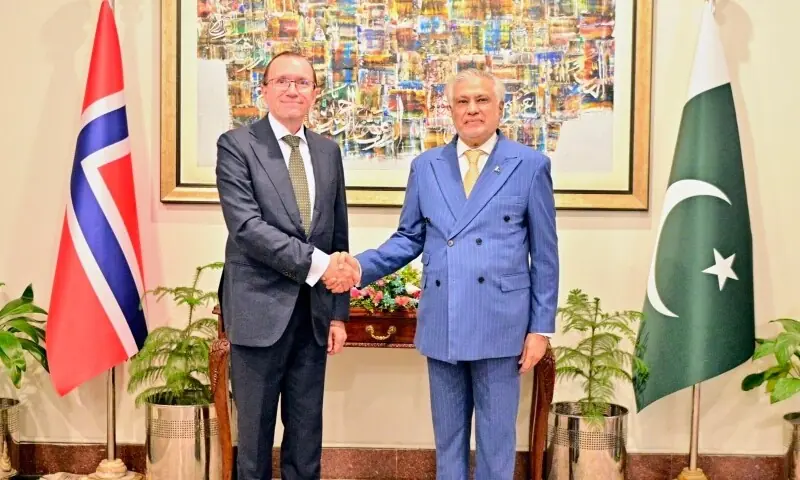
ISLAMABAD, Aug 13:Pakistan and Norway on Thursday agreed to undertake concrete steps to enhance bilateral relations and expand cooperation across multiple areas of mutual interest, including trade and investment, education, defence, climate change, Information Technology (IT), and maritime affairs.
Addressing a joint press stakeout following their delegation-level talks, Deputy Prime Minister and Foreign Minister Mohammad Ishaq Dar and Foreign Minister of the Kingdom of Norway Espen Barth Eide, who arrived here on an official visit, said that both sides acknowledged that bilateral trade currently remained below the potential of both economies and needed to be enhanced through effective measures.

The visit marks the first by a Norwegian foreign minister to Pakistan in a decade, following the last such visit in 2016.
“Pakistan offers enormous investment opportunities to Norwegian companies, and it is heartening to see many leading Norwegian companies investing in Pakistan,” Deputy Prime Minister Dar said highlighting a joint venture in plant nutrition being established by Norwegian firm Yara International with a local fertiliser company in Pakistan as a trailblazer project.
He told the media that during their “warm, constructive, and wide-ranging” discussions, both sides agreed on the expeditious finalisation of various pending agreements and MoUs currently in progress across different ministries in their respective countries.
Highlighting the growing technology partnership, he said that Pakistan’s IT exports to Norway have grown more than fivefold in the last two years.
Discussing cooperation in maritime affairs, Dar said that Pakistan had one of the world’s largest ship recycling facilities and its strategic location made it the most competitive and nearest ship recycling destination in this maritime region for ships coming from Norway.
The deputy prime minister told the media that both Pakistan and Norway agreed to enhance people-to-people contacts and that Pakistan-Norway Parliamentary Friendship Groups have been established in the Senate and the National Assembly of Pakistan to promote cooperation between the two countries’ parliamentary bodies.
He said that both sides also agreed to continue work on legal pathways for Pakistan’s skilled manpower, stressing the need to combat human smuggling and illegal migration.
He briefed the Norwegian counterpart on the issue of Jammu and Kashmir, which remained one of the long-standing unresolved international disputes and has been on the UN Security Council agenda since 1948, with numerous resolutions adopted on it by the Security Council since then. He also briefed that India had added a new dimension to an already volatile security situation by unilaterally announcing the abeyance of the Indus Waters Treaty in contravention of international law, asking India to end the weaponization of water and uphold its treaty obligations under its international legal obligations.
Apprising Foreign Minister Espen Barth Eide of Pakistan’s diplomatic efforts to promote dialogue, de-escalation, and a peaceful resolution to the US-Iran conflict, he thanked Norway for appreciating Pakistan’s mediating role as both leaders have remained in continuous contact to exchange views on regional developments.
Deputy Prime Minister Dar also shared details regarding the Makkah Joint Defence Agreement between Pakistan, Türkiye, and Saudi Arabia.
In his remarks, Norwegian Foreign Minister Espen Barth Eide highlighted the contributions of the Norwegian-Pakistani diaspora and advocated for expanding trade relations through the EFTA-Pakistan framework.
He particularly commended Pakistan’s role as a facilitator for peace talks following the Israeli-U.S. attack on Iran, emphasizing that international law and state protection must apply universally.
“And knowing this field of peace mediation and facilitation, I know how hard it is. I know what a massive task you’re taking on when you offer Islamabad not only as the venue, but also as the facilitator of these talks. And I think that what you personally, but also your Prime Minister, the Field Marshal, what you have been doing is really a service to the world, and hence also to us,” he remarked.
He said that both sides exchanged views on regional stability, including Jammu and Kashmir and security challenges originating from Afghanistan.
Welcoming the Makkah Joint Defence Agreement, he highlighted Norway’s close ties with both nations—including joint efforts with Saudi Arabia on a two-state solution for Palestine.
Calling climate change as a critical foreign policy issue and highlighting Pakistan’s vulnerability to severe flooding, he called for an end to armed conflicts to redirect global attention toward shared challenges of climate change, nature conservation, global health, and poverty alleviation.