
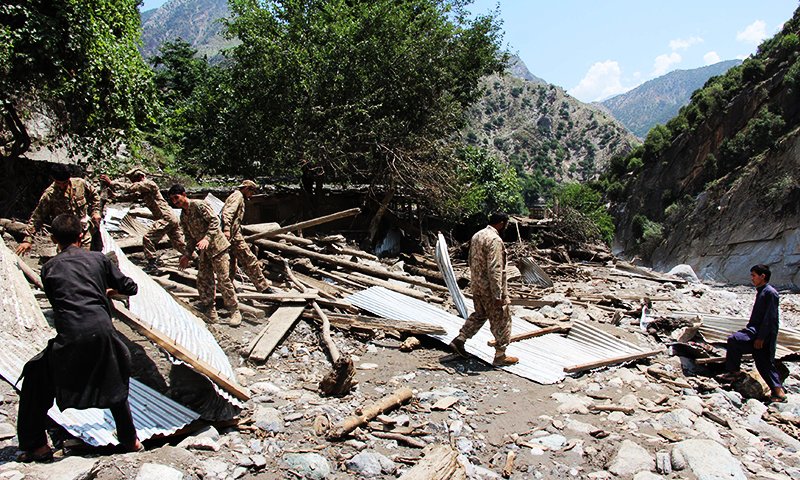
CHITRAL: Climate change-driven glacial lake outburst floods (GLOFs) and flash floods triggered by recent cloudbursts have severely disrupted healthcare services across Chitral, leaving thousands of residents in remote valleys without access to medical care and raising fears of a growing public health emergency.
The floods have washed away key bridges, damaged road infrastructure, and cut off access to several sub-valleys, preventing patients from reaching hospitals and clinics. Health officials say the destruction has significantly reduced patient attendance at healthcare facilities while increasing the risk of disease outbreaks in isolated communities.

Dr. Fayaz Rumi, Medical Superintendent of the District Headquarters (DHQ) Hospital in Lower Chitral, said outpatient attendance has fallen by nearly 55 percent over the past four days. He noted that no patients have been able to reach the hospital from several remote villages due to blocked roads and damaged transport links.
Dr. Rumi warned that the post-flood situation could lead to outbreaks of waterborne diseases, including gastroenteritis and dysentery, as well as a rise in typhoid, malaria, and post-traumatic stress disorder (PTSD). He said the hospital had already recorded an unusually high number of gastroenteritis and dysentery cases.
He added that Chitral’s mountainous terrain makes emergency healthcare particularly challenging during disasters, as many villages remain inaccessible for weeks after roads and bridges are washed away, putting critically ill patients at greater risk.
Health officials also expressed concern over the psychological impact of the disaster, reporting an increase in PTSD cases, particularly among women in flood-affected communities.
The crisis has further affected maternal and newborn healthcare. Officials at the DHQ Hospital said the number of childbirths at the facility has dropped sharply because many expectant mothers are unable to travel to the hospital, increasing the risk of complications for both mothers and infants.
The impact has also been felt by private healthcare providers. A local physician’s clinic reported that daily patient visits have declined to just 10 to 13 patients, compared to the usual average of more than 40 patients per day, reflecting the severe disruption caused by the floods.
Residents and health experts have urged the government and humanitarian organizations to establish emergency medical camps and deploy mobile healthcare teams to isolated areas before the situation develops into a wider public health crisis.
Also Read: Rawalpindi Administration Beautifies Chak Beli Khan Mor on GT Road Under ‘Suthra Punjab’ Initiative