ISLAMABAD (APP): Pakistan’s long-standing dependence on imported ginger is expected to ease as domestic cultivation gains momentum, driven by research-led innovation, farmer participation and targeted government support.
Research efforts drive ginger farming expansion
Ginger farming in the country has expanded following sustained research efforts by the Vegetable Research Institute of the Ayub Agricultural Research Institute (AARI), Faisalabad, in collaboration with progressive farmers, said AARI Principal Scientist Amir Latif while talking to Wealth Pakistan.
Development of locally adapted ginger variety

He said researchers have successfully localized ginger cultivation by evaluating imported germplasm under local agro-climatic conditions, developing tunnel and shade-based production systems, and releasing a locally adapted variety, AARI Ginger-23. Awareness initiatives, including ginger festivals, also helped familiarize farmers with the crop and strengthen market linkages.
Government support accelerates adoption
Government support has played a key role in accelerating adoption. Under the “Transfer of Agriculture in Potohar” programme, farmers are provided up to 70 percent subsidy for infrastructure, planting material, tunnels, shade nets and drip irrigation systems.
Pakistan’s ginger consumption and imports
Pakistan currently consumes around 80,000 to 100,000 tonnes of ginger annually, most of which is imported from China, Thailand, Myanmar and Indonesia, resulting in an annual import bill of nearly $50 million. In contrast, local production remains limited at around 40 to 50 tonnes, concentrated mainly in Faisalabad, Potohar, Islamabad and parts of Khyber Pakhtunkhwa.
Farmers take lead in commercial cultivation
Latif said several progressive farmers, including Dawri Agro Farms in Rawat, Nishtar Farms in Chak Shehzad, GN Farms in Chichawatni and Rai Aslam Farms in Jaranwala, have taken the lead in commercial cultivation using their own resources.
Seed production and future potential
He noted that research and demonstration sites are helping farmers understand best practices, while local seed production—previously entirely dependent on imports—is gradually increasing. Although still limited, domestic seed availability is expected to improve in the coming years.
Path to self-sufficiency in ginger
According to Latif, Pakistan has the potential to achieve self-sufficiency in ginger within the next seven to ten years if current momentum continues. He advised farmers to begin on a small scale, adopt recommended technologies, use quality seed and fully utilise available government support to enhance profitability.
Suitable regions for ginger cultivation
Ginger can be successfully grown under shade nets and tunnels in Punjab’s Potohar region, the mid-hills of Khyber Pakhtunkhwa and parts of northern Pakistan. Research trials have already been conducted in Faisalabad, Rawalpindi, Islamabad and Bara to evaluate performance under different agro-climatic conditions.
Value addition and economic potential
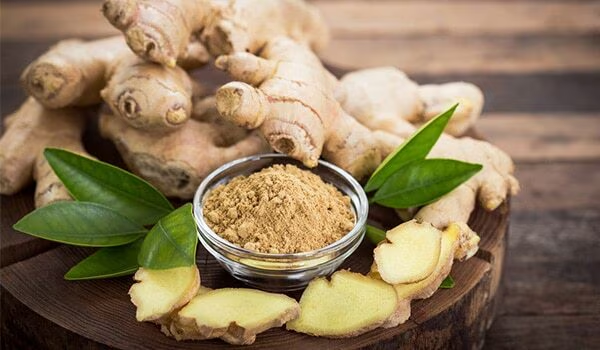
Beyond fresh consumption, value addition is also emerging, with farmers producing ginger powder, paste, tea and pickles. Latif said locally grown ginger is aromatic, of high quality and largely free from excessive chemical use, making it suitable for both domestic consumption and export markets. He added that ginger offers strong economic potential due to high market demand, its ability to substitute imports and better returns compared to many traditional crops.
Read related news here: https://greenpost.com.pk/pakistan/
For more stories and insights, visit The Public