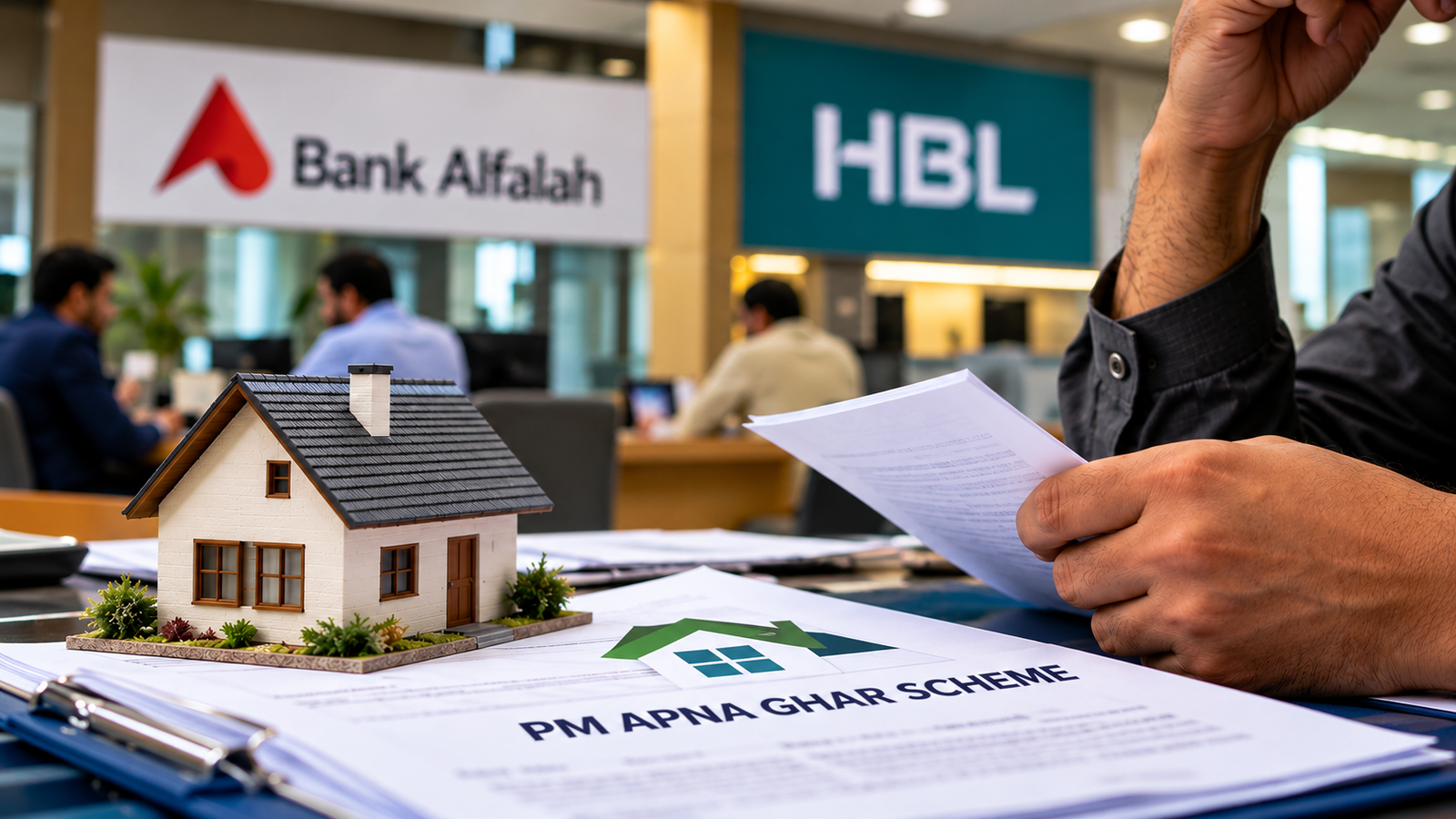
ISLAMABAD, September 29, 2026: The Wazir-e-Azam Apna Ghar Program, launched to bring affordable homeownership within reach of low- and middle-income Pakistanis, is drawing complaints from prospective borrowers who say difficulties at Bank Alfalah and Habib Bank Limited (HBL) are preventing them from accessing the government-backed housing finance facility.
While Bank Alfalah applicants have raised concerns about the reported unavailability of financing services in rural areas, including Murree, those approaching HBL describe a prolonged struggle to obtain responses from officials, complete application procedures and secure decisions on their housing loans.

The complaints point to different challenges at the two financial institutions but raise a common concern: whether the banking arrangements supporting Prime Minister Shehbaz Sharif’s housing initiative are sufficiently accessible and responsive to the families the programme is intended to serve.
Some HBL applicants allege that their cases have remained unresolved for two to three months, with officials difficult to contact and fresh documentation demanded after extended periods of waiting. Meanwhile, prospective borrowers approaching Bank Alfalah question why residents of certain rural communities reportedly cannot access the facility.
Rural applicants question Bank Alfalah’s service coverage
For applicants living outside major urban centres, access to the Wazir-e-Azam Apna Ghar Program has emerged as a concern following reports that Bank Alfalah does not offer the relevant housing finance services in certain rural localities.
Complainants from rural areas, including Murree and its surrounding communities, say they have been informed that the financing facility is not available in their locations.
They argue that such restrictions, if confirmed, would leave some financially constrained households facing an additional obstacle to obtaining a home loan under the government programme.
According to the applicants, rural residents are among those who stand to benefit from subsidised housing finance because many have limited savings, modest earnings and fewer options for conventional borrowing.
They question the practical value of a nationwide affordable housing initiative if its implementation through participating banks leaves eligible people in certain geographical areas without access to financing.
The complainants want Bank Alfalah to clarify which locations it serves under the programme and whether applicants from rural communities can obtain assistance through alternative branches or arrangements.
Their accounts do not establish that the bank maintains a general policy of excluding rural borrowers. However, the reported difficulties have brought attention to the need for clear information about geographical eligibility and the availability of services.
Two to three months of follow-ups reported at HBL
At HBL, the difficulties described by applicants centre on the handling of housing finance applications rather than geographical coverage.
Complainants say that after submitting their documents, they frequently struggle to establish contact with the personnel assigned to process their cases.
According to their accounts, the relevant employees are often not present at their designated desks, while telephone calls seeking updates go unanswered.
Several applicants allege that this situation has continued for two to three months, during which repeated attempts to obtain information have failed to produce a clear response about the progress of their financing requests.
The delays have reportedly become more frustrating when applicants eventually reach the concerned officials, only to be instructed to prepare fresh applications or submit updated bank statements and other supporting records.
Complainants say documents initially provided to the bank can become outdated while their cases remain pending. As a result, they are required to collect and submit revised paperwork, sometimes without knowing when a final decision can be expected.
This creates what applicants describe as a recurring cycle of waiting, follow-ups and renewed documentation.
For salaried workers, repeated visits to banking offices may require time away from employment, while other borrowers face additional travel and administrative expenses.
Applicants maintain that deficiencies in documentation should be identified at an early stage, rather than after months of unsuccessful attempts to contact the officials handling their cases.
Blue Area referrals add to applicants’ frustration
Another issue raised by HBL customers concerns the practice of referring housing finance applicants from various branches to the bank’s Blue Area office in Islamabad.
Complainants say they approach their local branches expecting assistance with the Wazir-e-Azam Apna Ghar Program but are instead directed to the Blue Area office for further processing or guidance.
According to the applicants, reaching the designated office does not always lead to progress because the officials responsible for the programme are frequently unavailable or do not respond to subsequent inquiries.
The concerns extend beyond frontline employees. Some complainants allege that efforts to contact supervisors overseeing the relevant HBL teams have also failed to secure satisfactory assistance.
They say escalation to supervisory personnel has not necessarily resulted in clear explanations, timely communication or resolution of their pending cases.
Applicants have questioned why responsibility for handling housing finance requests appears difficult to establish when customers are repeatedly referred between branches, designated officials and supervisors.
The reported difficulties remain allegations requiring examination. They do not, by themselves, establish deliberate obstruction or a bank-wide practice of delaying applications.
Affordable housing facility designed for first-time buyers
The complaints have surfaced as the federal government seeks to expand access to homeownership through the Wazir-e-Azam Apna Ghar Program, also known as Ghar Ho Tu Apna.
The initiative is designed to assist eligible first-time homebuyers who would otherwise struggle to purchase or construct residential property through conventional financing.
Under the revised programme terms announced in March 2026, qualifying borrowers can obtain financing of up to Rs10 million at a fixed customer rate of 5 percent during the subsidy period.
The facility provides for repayment periods of up to 20 years and covers qualifying houses measuring up to 10 marlas, as well as flats with an area of up to 1,500 square feet.
Financing can be sought for purchasing a house or apartment, constructing a residence on land already owned by the borrower, or buying a plot for construction.
For households dependent on monthly salaries and families living in rented accommodation, the subsidised arrangement is intended to reduce some of the financial difficulties associated with acquiring a first home.
The programme also seeks to encourage housing construction and related economic activity through increased demand for residential development, building materials and skilled labour.
At a September 9 review meeting, Prime Minister Shehbaz Sharif reiterated the government’s commitment to expanding affordable housing opportunities for low- and middle-income families.
Officials informed the meeting that the programme had received 147,504 applications, with 53,127 approved.
The meeting was further told that Rs45.43 billion in housing finance had been disbursed to 8,739 applicants.
These figures reflect the level of demand for the initiative, while the complaints from prospective borrowers highlight the importance of accessible banking arrangements for its implementation.
SBP processing deadline brings application delays into focus
The reported experiences at HBL have also drawn attention to the State Bank of Pakistan’s instructions concerning the processing of housing finance applications.
Under the measures introduced for the programme, participating banks are required to complete the credit approval process within 15 working days after receiving an application containing complete information.
Applicants who report waiting two to three months for updates have questioned whether their cases are being handled within the intended processing framework.
The requirement, however, does not mean that every financing request must receive approval within that period. It applies to applications submitted with complete information, while missing documents, property verification and other outstanding requirements can affect processing.
This distinction makes communication between banks and borrowers particularly important.
Applicants argue that when additional records are required, the bank should identify those requirements promptly and provide a clear explanation rather than leaving customers uncertain about the status of their cases.
They also question why updated statements and fresh applications become necessary after extended periods during which, according to their accounts, they have been unable to obtain meaningful responses from the concerned officials.
The complaints therefore raise questions not only about processing times but also about the arrangements for tracking applications and communicating decisions to prospective borrowers.
Applicants seek clarity, accountability from participating banks
The issues reported at Bank Alfalah and HBL have prompted complainants to seek attention from the State Bank of Pakistan and the managements of both financial institutions.
In Bank Alfalah’s case, applicants want an explanation of the reported limitations affecting rural areas, including Murree, and guidance on how eligible residents of such communities can access the housing finance facility.
For HBL, the concerns relate to pending applications, repeated demands for documentation, the availability of designated staff and the responsiveness of supervisors, particularly at the Blue Area office in Islamabad.
Applicants have called for more accessible housing finance personnel, clear information about outstanding requirements and a mechanism through which borrowers can obtain reliable updates without making repeated visits.
They maintain that effective customer facilitation is essential because many people applying under the programme are first-time borrowers unfamiliar with formal housing finance procedures.
The responses of Bank Alfalah and HBL to the specific complaints had not been obtained for this report.
The Wazir-e-Azam Apna Ghar Program offers a subsidised financing opportunity to households seeking their first homes, but applicants say its practical benefits depend on how participating banks handle requests for assistance.
For rural families concerned about access to services and borrowers facing months of unanswered inquiries, the immediate issue is whether they can obtain the guidance, processing and decisions needed to pursue the housing finance facility without avoidable difficulties.