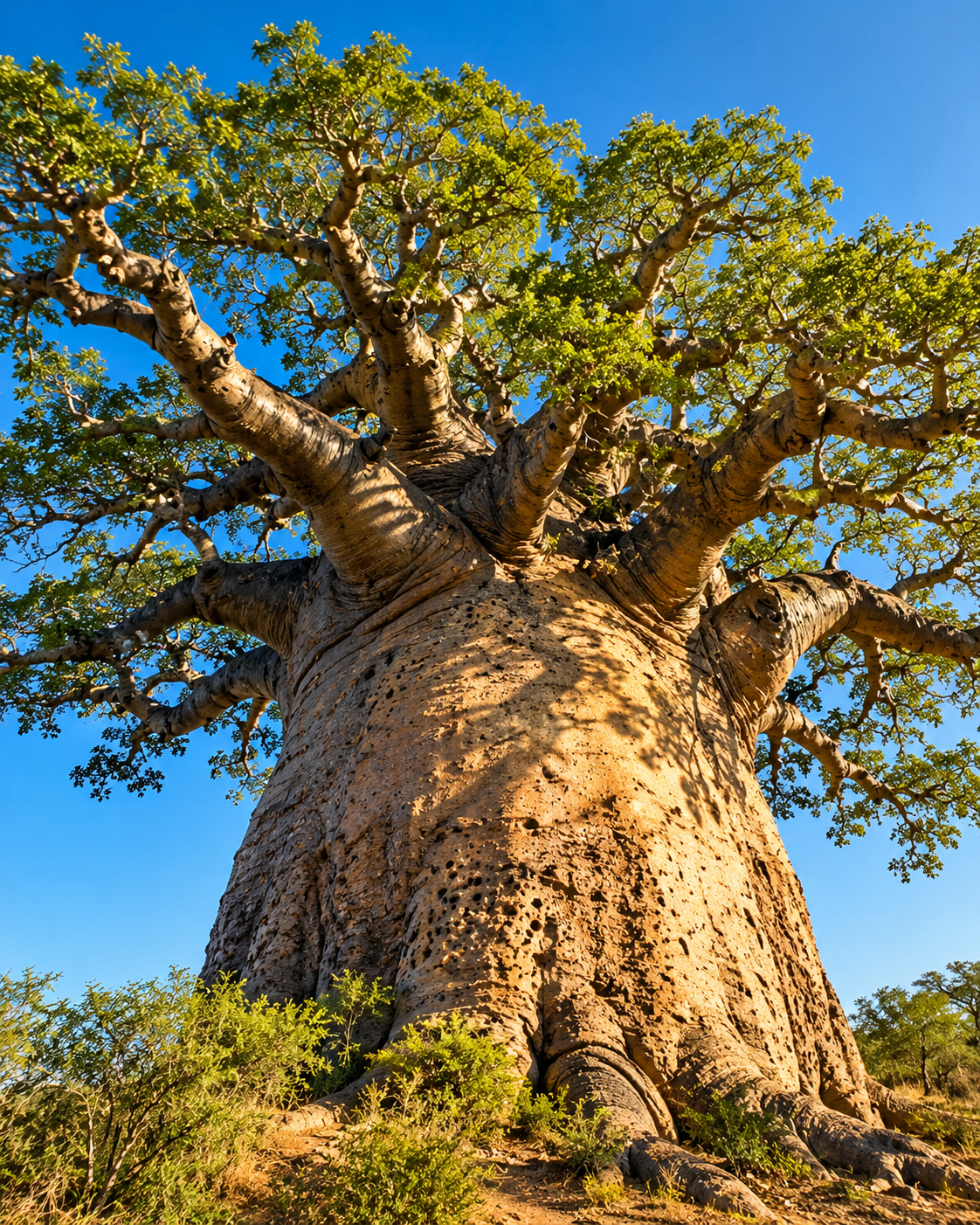
In some of Africa’s driest landscapes, one extraordinary tree has evolved a remarkable way to survive prolonged droughts. Known as the baobab, this giant tree can store enormous quantities of water within its thick, sponge-like trunk, making it one of nature’s most fascinating examples of adaptation to extreme environments.
Baobabs are native to dry regions of Africa, while several species are also found in Madagascar. Often called the “Tree of Life” or the “upside-down tree,” they are renowned for their massive, bottle-shaped trunks and ability to survive in hot, seasonally dry environments.
A Natural Water Reserve

Popular accounts often claim that a large baobab can hold up to 32,000 gallons, or around 120,000 litres, of water. While this figure should not be treated as a universal capacity for every baobab, scientific evidence confirms that the trees contain exceptionally water-rich tissues. Some large baobabs have been estimated to hold more than 100,000 litres of water within their tissues, depending on their size.
Unlike the dense wood of many other trees, baobab trunks contain soft, lightweight and highly hydrated tissues. During periods of rainfall, the tree absorbs and stores water in its trunk and branches. As dry conditions return, the tree can draw on these internal reserves while reducing water loss.
The trunk can also noticeably shrink during dry periods as its stored water content decreases, demonstrating how closely the tree’s structure is linked to its water-management strategy.
Built For Extreme Drought
Baobabs have several adaptations that allow them to survive in harsh climates. During the dry season, they shed their leaves, reducing water loss through transpiration. Their huge trunks provide both structural support and a substantial reservoir of water-rich living tissue.
Some baobabs can survive for thousands of years. The Eden Project notes that baobabs can live for more than 3,000 years, while the Crop Trust reports that they can survive for more than 2,000 years.
A Lifeline For People And Wildlife
Baobabs have long been important to communities living in dry parts of Africa. Their fruits, leaves, bark and trunks provide food, fibre and other resources, while their unusual ability to retain water makes them particularly valuable in water-stressed environments.
However, there is an important distinction between water stored naturally inside the tree’s living tissues and water collected in hollow sections of the trunk. In some areas, people have deliberately hollowed baobab trunks to create reservoirs for collecting and storing rainwater. Documented examples show that such reservoirs can hold thousands of litres.
Wildlife also interacts with these remarkable trees. Elephants, for example, are known to damage baobabs while seeking moisture and other resources, although excessive damage can threaten individual trees.
A Symbol Of Resilience
Beyond their enormous trunks and unusual appearance, baobabs represent one of nature’s most impressive survival strategies. Their ability to withstand heat, drought and seasonal water shortages allows them to thrive where many other trees would struggle.
For communities and wildlife living in some of the world’s harshest landscapes, the baobab is far more than an ancient tree. It is a symbol of resilience, survival and nature’s extraordinary ability to adapt to a changing environment.