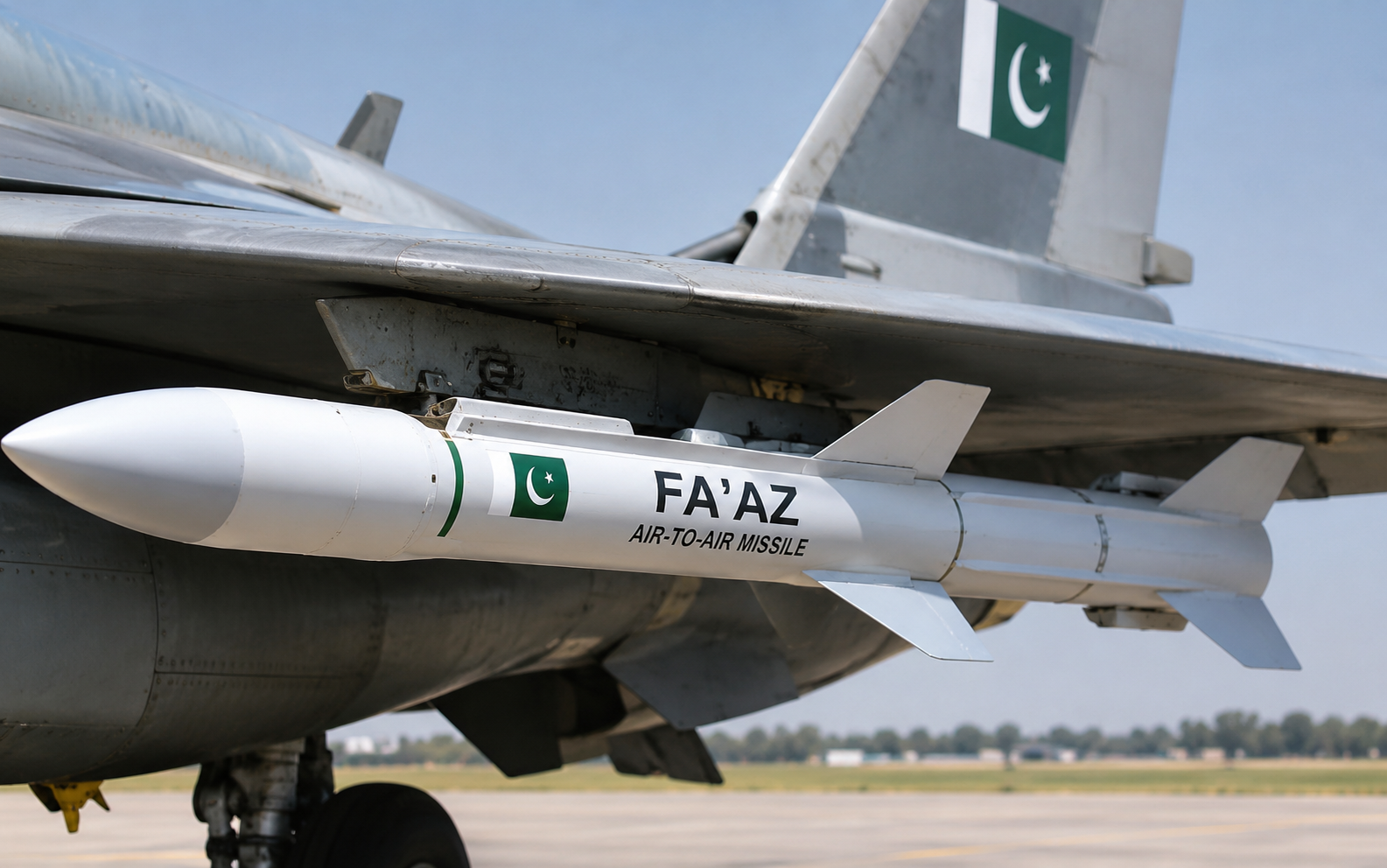
ISLAMABAD: Pakistan has successfully tested the Fa’az, an indigenously developed air-to-air missile, marking a significant development in the country’s efforts to strengthen its domestic defence technology and enhance the operational capabilities of its air force.
The missile has been described by the Pakistan Army’s Inter-Services Public Relations (ISPR) as the country’s first locally developed air-to-air missile. It is equipped with an advanced terminal guidance system and is designed to engage enemy aerial targets at long distances.

The development is being viewed as an important milestone in Pakistan’s defence industry, particularly as modern aerial warfare increasingly depends on the ability of fighter aircraft to detect and engage hostile aircraft beyond the pilot’s direct line of sight.
According to ISPR, the successful test reflects Pakistan’s growing technological expertise, innovation and commitment to achieving self-reliance in defence production.
Although detailed technical specifications and operational capabilities of the Fa’az missile have not yet been publicly disclosed, its development represents progress in Pakistan’s efforts to manufacture advanced weapons systems and related technologies domestically.
What Are the Technical Capabilities of the Fa’az Missile?
Fa’az is described as a Beyond Visual Range (BVR) air-to-air missile, meaning it is designed to engage aerial targets beyond the visual detection range of a fighter aircraft’s pilot.
According to Bilal Khan, founder and defence analyst at Toronto-based defence analysis platform Quwa, the Fa’az is a BVR missile platform.
BVR missiles play an increasingly important role in modern aerial combat because they allow fighter aircraft to attack hostile aircraft from considerable distances without requiring pilots to establish direct visual contact with their targets.
The missile’s advanced terminal guidance system is also a significant feature, as guidance technology plays a crucial role in helping a missile track and engage its intended target during the final stage of flight.