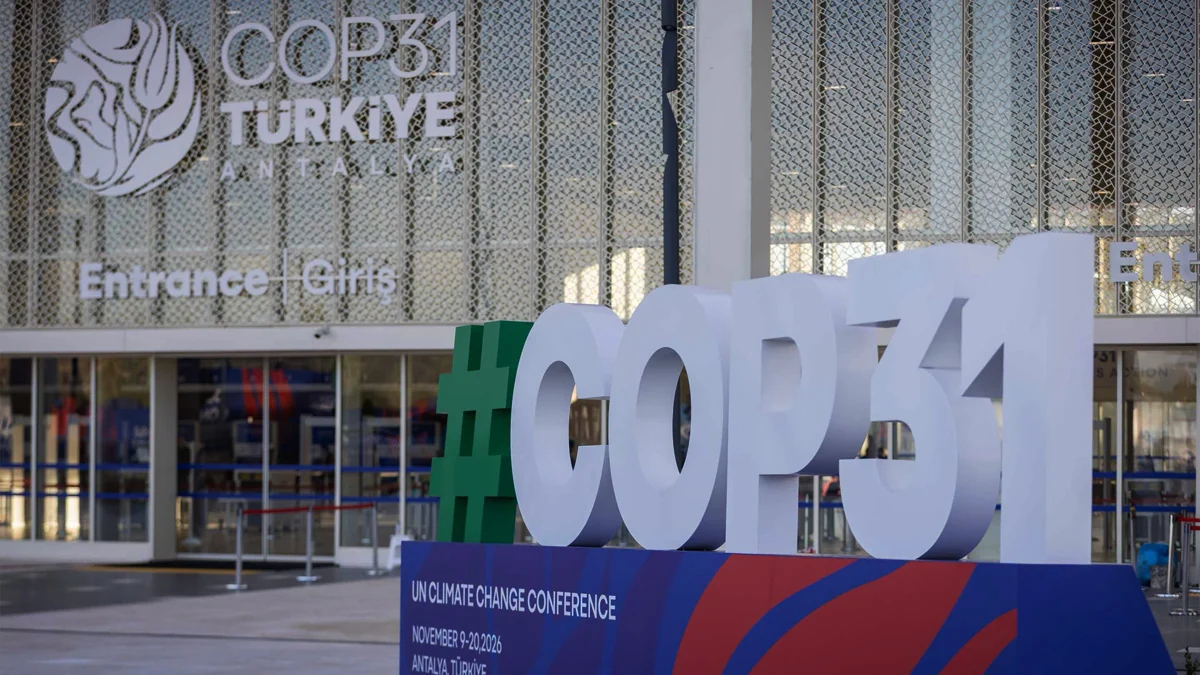
ANTALYA, November 10, 2026: Federal Minister for Communications Abdul Aleem Khan has reaffirmed Pakistan’s commitment to reducing pollution from global supply chains and developing sustainable logistics infrastructure capable of addressing climate change.
Addressing a high-level ministerial roundtable on the Global Green Freight Corridors Initiative during the COP31 climate conference in Antalya, Türkiye, the minister called for stronger international cooperation to transform environmental commitments into practical, cross-border action.

The meeting was jointly organised by Türkiye’s Minister of Transport and Infrastructure, Abdulkadir Uraloğlu, the United Nations Economic Commission for Europe (UNECE) and the United Nations Economic and Social Commission for Asia and the Pacific (ESCAP). It brought together senior international leaders to discuss sustainable transport and logistics solutions.
In his keynote address, Abdul Aleem Khan said international freight transportation was vital to global trade but was also becoming a growing source of greenhouse gas emissions.
He stressed that economic development and environmental protection were interconnected objectives, adding that sustainable logistics offered a way forward for balancing trade growth with climate action.
Pakistan outlines plans for greener transport
Highlighting Pakistan’s strategic geographical position connecting China, Central Asia and the Middle East, the minister said the country had more than 500,000 kilometres of roads, a railway network spanning approximately 7,800 kilometres, deep-sea ports and major trade routes, including the China-Pakistan Economic Corridor (CPEC).
He noted that around 96 per cent of domestic freight transportation in Pakistan was carried by road, placing considerable pressure on national resources and the environment.
To address this challenge, Pakistan was pursuing a multi-pronged transport strategy aimed at shifting more freight to railways, promoting electric vehicles and improving maritime infrastructure.
According to the minister, key initiatives include increasing rail-based freight transportation to 20 per cent through the modernisation of Main Line-1 (ML-1) under Railway Plan 2026.
He also highlighted the National Electric Vehicle Policy 2025–30, which envisages the establishment of 3,000 electric vehicle charging stations along major corridors, alongside reforms at the country’s seaports.
Digital trade and regional connectivity
Referring to Pakistan’s progress under the United Nations TIR Convention, Abdul Aleem Khan said the volume of TIR freight movements had recorded a historic increase of 200 per cent, strengthening the country’s role in facilitating regional trade.
He said initiatives such as Pakistan Single Window and the UN e-TIR project were promoting paperless cross-border trade and more efficient logistics operations, helping reduce administrative barriers and the environmental footprint of freight transportation.
The minister also outlined financing arrangements for major infrastructure projects, including the M-6 Motorway and ML-1 railway modernisation. These projects are being advanced through the Public Sector Development Programme (PSDP), the Asian Development Bank, the Asian Infrastructure Investment Bank and public-private partnerships.
Call for international cooperation
Abdul Aleem Khan formally endorsed the Global Green Freight Corridors Initiative, highlighting four key pillars: Pakistani technology, digital connectivity, smart route planning and climate finance.
He invited the international community to work jointly on pilot green freight corridors, stressing that coordinated international efforts would be essential to making global supply chains cleaner, more efficient and environmentally sustainable.
The initiative aims to strengthen cooperation among countries in developing transport corridors that support international trade while reducing the environmental impact of freight movement.