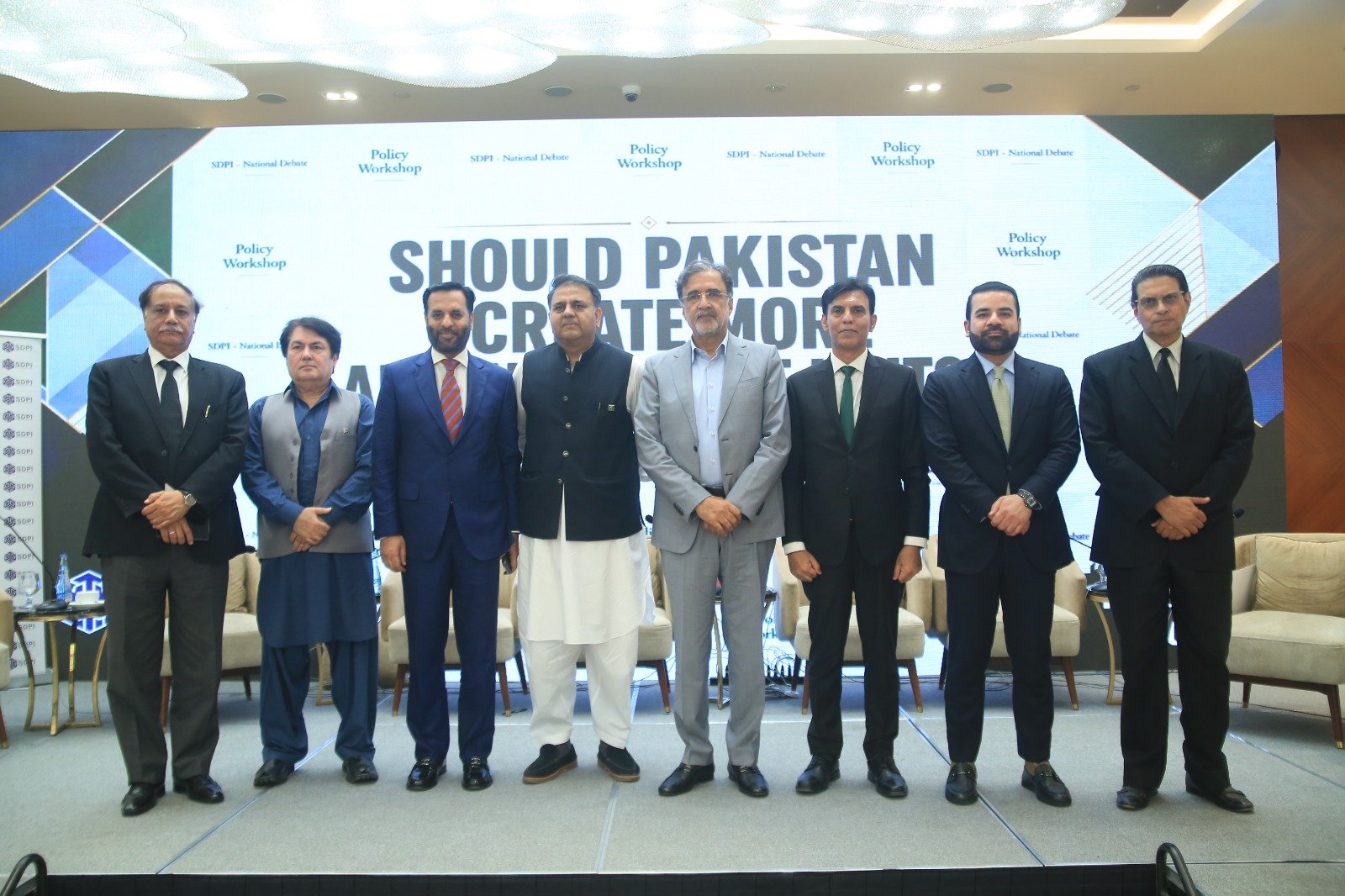
ISLAMABAD: Amid the ongoing discussion on the creation of new administrative units, speakers at a high-level national debate conducted by Sustainable Development Policy Institute showed strong consensus on strengthening and empowering local government (LG) system, with or without new administrative units.
The national debate, titled: ‘Should Pakistan create more administrative units?’ was attended by senior representatives of PML(N), PPP, MQM, PTI, JI, JUI(F), federal ministers, technocrats, and civil society representatives.
Most of the speakers emphasized that any move towards creating new provinces must be preceded by constitutional, political, administrative and financial assessments, while local governments should be given clearly defined powers, resources and accountability mechanisms.
Syed Mustafa Kamal, Federal Minister for National Health Services, Regulations and Coordination said that administrative restructuring must ultimately be judged by whether it reduces citizens’ sense of exclusion and improves service delivery. He argued that smaller administrative units could help bring governments closer to citizens. Demanding a clear-cut constitutional protection for LGs, he maintained that local governments would remain indispensable regardless of the number of provinces. He said that political support for new provinces should be supported by public support.
Barrister Aqeel Malik, Minister of State for Law and Justice, said constituents primarily raise local service delivery issues such as streets, sewerage, and roads that fall under local government’s mandate. He added that genuine financial empowerment is difficult given Pakistan’s reliance on borrowed funds to finance NFC transfers to provinces. He suggested that national, provincial and local government elections should be held simultaneously for a uniform term, with local bodies given the same constitutional protection against premature dissolution as national and provincial assemblies have.
Barrister Danyal Chaudhry, Parliamentary Secretary for Information and Broadcasting, called upon policymakers to see the question of new provinces constitutionally rather than emotionally. He called for a detailed assessment of the financial sustainability of any proposed province, including its revenue sources, expenditure requirements and long-term fiscal impact. He said no new province should be created without assessing its fiscal implications over at least a decade. Emphasizing strong and empowered local governments, he said devolution of political, administrative and financial powers at grass roots level is now need of the hour.
Qamar Zaman Kaira, PPP leader and former information minister, said the debate over administrative restructuring is not new. He cautioned that reopening it should not deepen inter-provincial or inter-regional sensitivities over resource distribution. He further said the 18th Constitutional Amendment has increased provincial shares from the divisible pool from 46 to 57 per cent with the intent of empowering provinces and giving ethnic and regional groups greater identity recognition. However, he added, the powers and resources devolved were consolidated by chief ministers rather than passed further down to local governments.
Nadeem Afzal Chan, PPP leader and former Member of National Assembly, called for all political and state stakeholders to sit together and develop a consensus-based reform agenda. He identified judicial and electoral reform, intra-party democracy and rule of law as key priorities. He said political parties must strengthen democracy within their own organizations. He also sought reforms to the Election Commission and electoral system. He suggested that constitutional framework should remain the basis for any discussion on administrative restructuring.
Liaqat Baloch, Naib Ameer of Jamaat-i-Islami, said the creation of new provinces and strengthening of local governments should be considered together with fiscal and constitutional reforms. He called for greater implementation of the Council of Common Interests (CCI) to resolve disputes between the federation and provinces, particularly concerning resources, water and other constitutional matters.
Asad Umar, former federal minister, described the loss of public trust in state institutions as the central governance crisis. He said that excessive centralization is weakening Pakistan. He advocated transferring greater political and financial powers to citizens and local governments. He proposed a three-tier NFC system under which resources would be distributed among the federal, provincial and local governments through a defined formula. He said new provinces should be considered where there is strong public demand and argued that the economic case for larger or smaller provinces should be evaluated through evidence rather than assumptions.
Mian Amer Mahmood, former Mayor of Lahore, supporting the creation of new provinces on the basis of evidence and data, argued that the objective should be to improve citizens’ welfare and easy access to public services rather than divide territory. He said elected representatives should be made more accountable to citizens and suggested that Pakistan’s political system needs stronger political parties rather than family-centred political structures. He advocated for further devolution of power from provinces to lower tiers of government.
Rana Ihsan Afzal, Coordinator to the Prime Minister on Commerce, stressed that the debate should not be limited to the creation of more provinces, but it should be extended to vertical devolution of power and strengthening financially autonomous, continuous and empowered local governments. He argued that provinces must develop stronger links with industry and economy rather than functioning primarily as administrative layers. Drawing comparisons with China, he said, local governments should have economic performance indicators and greater responsibility for investment, exports and local economic development. He also called for better coordination between development spending at the federal and provincial levels so that scarce resources could be directed towards national economic priorities, particularly exports.
Salman Akram Raja, PTI Secretary-General, said administrative units, divisions, districts and Tehsils already exist and require empowerment rather than replacement. He said splitting Punjab into three provinces would still be larger in population than most European countries. Local government, he said, should be constitutionally empowered with clearly enumerated administrative, political and financial powers. He said financial powers of local governments, including a Provincial Finance Commission mechanism, should not be left to provincial assemblies’ discretion but embedded in the Constitution. Any restructuring of provinces must follow Article 239’s prescribed process, which requires a two-thirds majority in the relevant provincial assembly followed by National Assembly and Senate approval, with no alternative route such as a referendum available under the Constitution, he added.
Dr Abid Qaiyum Suleri, SDPI Executive Director, in his concluding remarks, said the most significant area of consensus among the participants of today’s debate was the need to strengthen local governments. He noted that speakers differed over the creation of new administrative units, with some supporting and others opposing the idea, but there was broad agreement on empowering institutions at grass roots level. He said the policy dialogue had demonstrated that improving local governance, strengthening Provincial Finance Commissions and bringing service delivery closer to citizens provides a common ground for further discussion on the issue.
Others who spoke on the occasion included: Aasia Ishaque, MNA and MQM-P leader; Noor Alam Khan, MNA and former chairman of Public Accounts Committee; Dr Khaqan Hassan Najeeb, former Adviser at the Ministry of Finance; Dr Farrukh Saleem, economist;
Muhammad Malick, senior journalist and analyst; Muhammad Ali Durrani, former federal minister; Fawad Chaudhry, former federal information minister; Barrister Muhammad Ali Saif, advisor to KP chief minister; Haroun ur Rashid, President of the Supreme Court Bar Association; and Zahoor Dhareeja, a Saraiki nationalist leader.