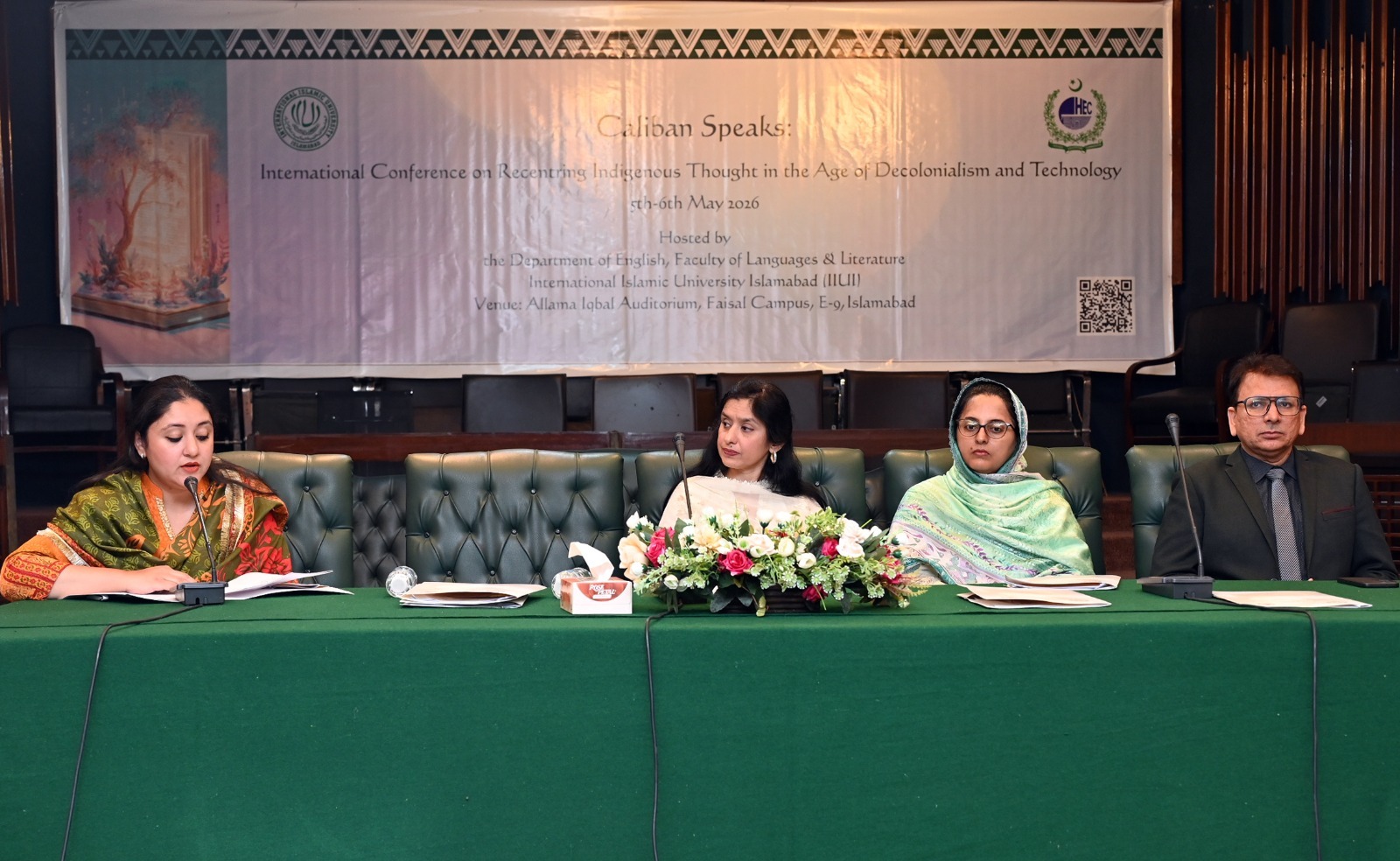
ISLAMABAD: The International Islamic University Islamabad concluded its two-day international conference Caliban Speaks on Wednesday with a call to move decolonial thought out of academic halls and into policy chambers, warning that artificial intelligence has emerged as the newest frontier of epistemic extraction and that Indigenous knowledge systems must be defended within it as urgently as anywhere else.
The closing session, presided over by Prof. Dr. Ahmed Shuja Syed, Vice President for Research and Enterprise at IIUI, brought together the conference’s central intellectual threads into a set of formal recommendations that organisers said would be submitted to relevant policy forums for a concrete action plan.
The recommendations were presented by Co-Convener Dr. Muhammad Sheeraz Dasti. They were pointed: humanities curricula must incorporate economic literacy so that decoloniality engages the material structures of power rather than remaining symbolic. On artificial intelligence, the conference was direct. AI is not external to colonial logic but an extension of it, concentrating computational power and data ownership within a handful of corporations while routinely extracting Indigenous and non-Western knowledge, stripping it of its origins, and repackaging it as Western innovation. AI literacy in universities, the recommendations stated, is not about familiarising students with tools but about equipping them to ask whose interests those tools serve and how to redirect them toward local epistemologies rather than surrender them to further extraction.
Prof. Dr. Ahmed Shuja Syed, in his closing address, reoriented the two days of proceedings around the individual as the irreducible starting point of any decolonial project. He proposed a three-circle framework: at the centre stands the human being; the second circle encompasses society and the universe; the third reaches beyond the universe entirely. Indigenous thought, he argued, is the organising principle holding all three in relation. He described ta’assub, the deep-rooted conviction in one’s own inherited worldview, not as a weakness but as a generative force and the true gateway to recentring Indigenous thought. He closed by pointing to brain-to-brain interface communication as an imminent technological reality in which Indigenous thought would become essential rather than peripheral, and urged that the conference’s recommendations reach policy forums without delay.
Dr. Asma Mansoor, convener of the conference, reiterated the conviction that had framed its opening: decoloniality must break free of its discursive straitjacket and become a lived, material practice. Theory without praxis, she said, is performance. IIUI’s own archive of Persian, Arabic, and Islamic scholarship, she noted, remains a largely untapped resource, a reminder that decolonial work begins at home. On AI, she was unequivocal: these systems are not neutral and must be critically interrogated, not uncritically adopted.
The parallel sessions on Day 2 ranged across postcolonial subjectivities and gendered decolonialities, technology and epistemic violence, literary resistance, and political discourses from the Global South. Muhammad Nauman Awan’s paper on reimagining data sovereignty in the age of algorithms argued that the question of who owns data is inseparable from the question of who owns knowledge. Dr. Rehana Gulzar’s research on AI chatbots as instruments of indigenous language revitalisation offered one of the conference’s rare convergences of technological optimism and decolonial purpose. The second panel discussion on decolonising technologies brought together scholars and technologists including Dr. Muneera Bano of CSIRO’s Data61 laboratory in Australia, examining the tensions that emerge when decolonial aspiration meets technological infrastructure.
Dr. Saiyma Aslam, Chairperson of the Department of English and Co-Convener, delivered the vote of thanks, expressing gratitude to IIUI’s Acting Rector and President Prof. Dr. Ahmed Saad Alahmed for his patronage, to the Higher Education Commission of Pakistan for its support, and to the organising committee and faculty for their tireless efforts. Certificates were distributed and formal proceedings concluded.
The conference drew scholars from Australia, South Africa, Oman, Singapore, Malaysia, Canada, Algeria and across Pakistan, presenting four keynote addresses, eight parallel academic sessions, and two panel discussions in a hybrid format over its two days.