Residents seek resolution of decades-old legal dispute as thousands remain deprived of civic services
ISLAMABAD: August 22- A sprawling residential settlement housing thousands of families on the outskirts of Islamabad is facing an unusual dilemma: its residents are counted as voters, its properties have been registered through government revenue channels and virtually every major utility has reached the area, but when it comes to roads, sanitation, water supply and public development, the population is effectively left on its own.
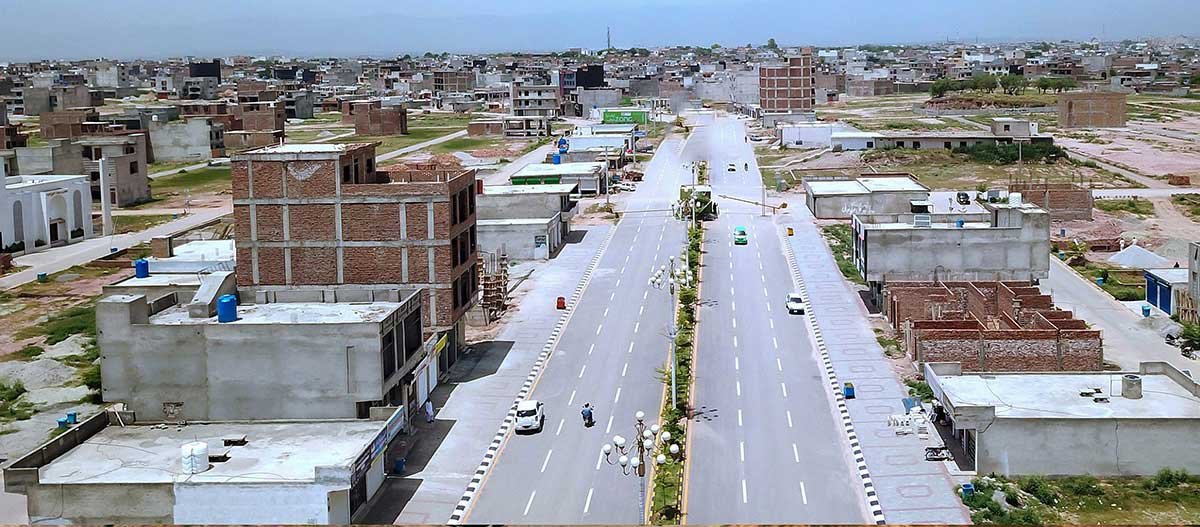
Residents of Ghauri Town, spread over several phases from the Khanna Pul-Koral area towards Tarlai and adjoining localities, say they have been trapped for years in a dispute between the Capital Development Authority (CDA) and the developers of the housing scheme.
The CDA continues to list Ghauri Town, all phases, among illegal or unauthorised housing schemes. The authority’s position is that private housing schemes require approval of their layout plans and issuance of an NOC before development and sale of plots.
Yet the settlement has long since grown into a densely populated urban locality, with thousands of houses, commercial areas, roads and utility networks.
Residents say the original developers have either disappeared from the scene or are no longer available to resolve the dispute, leaving ordinary homeowners to face the consequences.
The issue has been raised before. In 2019, Ghauri Town residents protested outside CDA headquarters against restrictions on new utility connections. At the time, Dawn reported that residents said the CDA had failed to stop development and sale of plots when the scheme was expanding, only taking action after large numbers of citizens had invested their savings.
The gas issue, in particular, has remained unresolved for years. In response to a question in the National Assembly, the Petroleum Division confirmed that a ban had been imposed on gas supply to Ghauri and Shaheen Towns because they had been declared illegal or unapproved by CDA, with connections subject to issuance of an NOC by CDA.
Residents now point to an additional irony: gas infrastructure and pipelines are already present in parts of the locality, but new connections remain restricted.
Muhammad Zubair, president of Shaheen Welfare Group, Ghauri Town Phase 4-A, said residents were being made to suffer for a dispute in which they had no role.
“The people living here are ordinary citizens who purchased plots and houses with their hard-earned money. They have registered documents and have been living here for years. If there is a legal dispute with the developers, the government should resolve it instead of punishing the residents,” he said.
Zahid Ali Khan, chairman of the Phase 4-A Welfare Group, said the absence of municipal services had turned everyday life into a constant struggle.
“We have roads, houses, markets and thousands of residents, but when it comes to public services, nobody accepts responsibility for us. Residents are paying from their own pockets for security, streetlights, sanitation and waste collection,” he said.
He said the condition of roads in several parts of Ghauri Town had deteriorated badly.
“Many roads are in a dilapidated condition. We have repeatedly asked the authorities to repair them, but the answer is always that Ghauri Town is illegal. If the government has a legal objection, resolve it. How long can the residents be left without basic civic facilities?” Khan asked.
Rana Abdul Qayyum, advocate of the High Court and a longtime representative of Ghauri Town residents, said the issue had already reached the courts.
He said residents had approached the Islamabad High Court through a writ petition seeking directions regarding the non-provision of basic civic services and the continuing restrictions on utility connections.
“The residents are not asking the state to ignore the law. They are asking the state to apply the law fairly and resolve the legal status of the area. Thousands of families cannot be kept in limbo indefinitely because of a dispute between the authorities and the developers,” he said.
The residents’ legal argument has also gained relevance from earlier proceedings before the Islamabad High Court. In a 2023 judgment, the court dealt with the exclusion of Ghauri Town from the notified urban area for purposes of the Islamabad Rent Restriction Ordinance and observed that the local government framework envisaged delivery of municipal services and governance without discrimination between registered and unapproved areas.
The residents say their predicament is particularly difficult because the state appears to recognise them for electoral purposes but not for development purposes.
Rozina Ali, an Islamabad-based broadcast journalist and resident of Ghauri Town Phase 4-B, said the contradiction was becoming increasingly difficult for residents to understand.
“We are citizens of Islamabad. We have CNICs, our votes are registered, our properties are documented and we pay for the services that we can obtain privately. But when we ask for a road, sanitation, streetlights, water supply or other civic services, we are told that this is an illegal area,” she said.
“Then the question is: if the government considers us citizens for elections, why are we not citizens when it comes to basic municipal services?”
Residents also point to what they describe as a striking contrast only a short distance away.
They say that on one side of the area, streets in Tarlai Khurd have been paved and development work has been carried out, while Ghauri Town residents are told that public development funds cannot be utilised in their locality because of its disputed legal status.
According to residents, a street roughly 100 feet from Ghauri Garden has recently been developed with concrete paving and other works in Tarlai Khurd under the development initiatives associated with MNA Raja Khurram Shahzad Nawaz.
Raja Khurram Nawaz, who currently represents NA-48 (ICT-II), first entered the National Assembly after winning NA-52 as a PTI candidate in 2018. He was elected again in 2024 from NA-48 and subsequently joined the PML-N.
Residents say the contrast is difficult to reconcile.
“We are not asking why development is taking place in Tarlai Khurd. We are asking why development cannot take place here,” said Zubair.
“If a road can be constructed just a few steps away, why is a road in Ghauri Town beyond the reach of the state? Is the difference simply that one street is on one side of an administrative boundary and the other is inside Ghauri Town?”
The problem is not confined to roads.
Residents say there is no regular government-run waste collection system in many parts of the locality, while streetlights, security and other services are arranged collectively by residents and welfare groups.
Water supply is another major concern, with residents relying on private arrangements in areas where formal public provision is unavailable.
The situation has persisted despite Ghauri Town being one of the largest unauthorised housing settlements in the capital. In 2021, CDA publicly warned against investment in Ghauri Town and other unauthorised housing schemes and said it had asked utility agencies, including IESCO, SNGPL and PTCL, not to provide connections without the required approvals.
The scale of the settlement, however, has made the problem increasingly difficult to address simply through enforcement.
The Islamabad High Court has also recently dealt with the issue. In March 2026, the court restrained CDA from taking adverse action against houses in Ghauri Town Phase 7 following a petition challenging demolition notices. The petition also sought regularisation of the area and provision of basic utilities, including electricity and gas.
For residents, the central question is now whether the government intends to continue treating Ghauri Town purely as an illegal housing scheme or acknowledge the reality that a large urban population has existed there for years and requires a formal administrative solution.
They are demanding that the federal government, Ministry of Interior, CDA and Islamabad administration conduct a comprehensive review of the area and determine a lawful way forward.
They say the government can examine land ownership, layout plans, roads, public amenities, environmental requirements and building regulations and identify what can be regularised, what deficiencies need to be rectified and where enforcement is necessary.
“What we are asking for is a decision,” said Advocate Rana Abdul Qayyum. “If the area cannot be regularised in its present form, tell the residents what the lawful mechanism is. If it can be regularised subject to conditions, impose those conditions. But leaving thousands of families without basic civic services is not a solution.”
For the residents, the dispute has therefore moved beyond the original developers and the CDA’s regulatory requirements.
The developers may have created the problem, they say, but the people who remain are homeowners, families, taxpayers and voters.
Their question to Prime Minister Shehbaz Sharif, Interior Minister Mohsin Naqvi, CDA Chairman and Chief Commissioner Islamabad Lt Gen (retd) Sohail Ashraf and the Islamabad administration is simple:
If a settlement has existed for years, thousands of families have built their homes there and the state knows that they live there, who is responsible for providing them the basic services of a city?
Until that question is answered, residents say Ghauri Town will remain a city that exists physically, socially and electorally — but not administratively.
Also Read: Over 100 Balochistan paramedics complete HSA leadership training