Islamabad (APP): Pakistan’s federal digital reforms, driven largely by the E-Office System, have resulted in major efficiency gains, cutting processing times, reducing administrative costs, and expanding access to online public services, according to official data reviewed by Wealth Pakistan.
According to the document, the E-Office System has delivered the most significant measurable impact by streamlining internal government workflows and replacing paper-based procedures.
E-Office System reduces delays and administrative spending

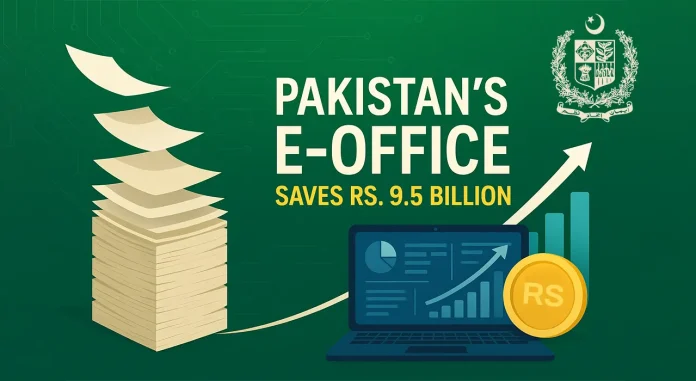
The document states that the E-Office System has shortened the processing time for official summaries from an average of 25 days to four days, marking an 84 percent reduction. The move to paperless operations has also led to annual savings of approximately Rs 9.5 billion by reducing expenditure on paper, printing, courier services, and related manpower.
The system has been rolled out across the federal government, with more than 350 organizations connected and full implementation completed in 35 of 39 divisions. By September 2025, over 3.48 million digital files had been processed, indicating routine operational use rather than limited pilot projects. All transactions are secured through digital signatures approved by the Cabinet Division.
Digital platforms expand citizen-facing services
Beyond internal administration, the document highlights improvements in services provided directly to citizens. The Apostille Attestation System, a fully digital and Hague-compliant mechanism, has facilitated services for 255,835 citizens and enabled the attestation of 633,877 documents.
The automated system has generated Rs 2.21 billion in revenue, while digitally attested Pakistani documents are now recognized by more than 110 countries.
Pakistan Asaan Khidmat shows revenue and usage growth
The Pakistan Asaan Khidmat platform, developed as a unified access point for government services, has recorded steady growth. According to the document, the platform has attracted 1.37 million subscribers, processed more than 1.3 million applications, and generated Rs 22.86 billion in excise and taxation revenue.
Recruitment and secure infrastructure reforms
In public sector hiring, the National Jobs Portal has replaced manual recruitment systems with a centralized digital platform aimed at improving transparency and merit-based selection, though no financial estimates are attached to this reform.
The document also notes that secure sovereign communication platforms are now operational, with all government data hosted within Pakistan’s own infrastructure to strengthen data security.
Digital health systems introduced at PIMS as part of E-Office System
In the health sector, a lifelong digital health identity system has been introduced at Pakistan Institute of Medical Sciences (PIMS). Six hospitals have been integrated into the system, supporting AI-assisted diagnostics, telemedicine, and the daily management of 7,000 to 10,000 laboratory tests.
Institutional restructuring behind the reforms
According to the document, these outcomes followed structural changes introduced in August 2022, when the National Information Technology Board was merged with the E-Government Directorate of the Ministry of Information Technology and Telecommunication and declared an autonomous body. Since then, NITB has focused on automation, emerging technologies, and standardized digital platforms to improve service delivery and data security across the federal government.
Read related news here: https://greenpost.com.pk/pakistan/
For more stories and insights, visit The Public