By Sohail Butt Misken
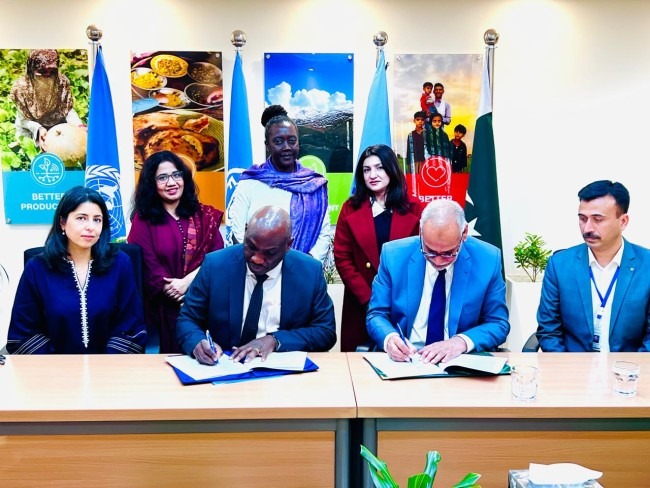
MULTAN — The Food and Agriculture Organization of the United Nations (FAO) and Muhammad Nawaz Sharif University of Agriculture Multan (MNSUAM) have signed a Letter of Agreement to conduct a WaPOR-based study on water budgeting and agricultural water productivity in the Indus Basin Irrigation System, focusing on Bahawalpur and Bahawalnagar districts.

The initiative aims to address declining groundwater levels, inefficient irrigation practices and growing pressure on canal water supplies in Southern Punjab. By generating distributary-level data within selected command areas, the study seeks to strengthen evidence-based water management and improve irrigation efficiency.
Focus on data-driven water governance
Speaking at the signing ceremony, FAO Pakistan Officer in Charge James Robert Okoth emphasized the need for closer collaboration among development partners, government institutions and academia to respond to Pakistan’s water scarcity challenges. He said geospatial analytics, remote sensing and institutional capacity development are critical for informed irrigation planning and climate-resilient agriculture.
MNSUAM Vice Chancellor Asif Ali reaffirmed the university’s commitment to the partnership, noting that the institution will contribute expertise in remote sensing, spatial analysis and field validation. He said the collaboration will generate scientifically robust evidence to support sustainable water governance and policymaking.
The project also involves the Punjab Irrigation Department, the Punjab Agriculture Department and IHE Delft to ensure technical coordination and stakeholder engagement.
Use of WaPOR database
Under the agreement, partners will carry out high-resolution crop mapping, estimate crop-specific irrigation requirements, assess crop water productivity and analyze groundwater abstraction, including solar-powered tubewell usage. The analysis will utilize FAO’s WaPOR database to produce spatial datasets and policy recommendations.
Officials said the study is expected to support irrigation authorities and policymakers in improving water allocation systems and strengthening climate-resilient agricultural practices in Southern Punjab.