By People’s Daily reporters
Scene 1: Dawn at Ningbo-Zhoushan Port(5:00 AM)

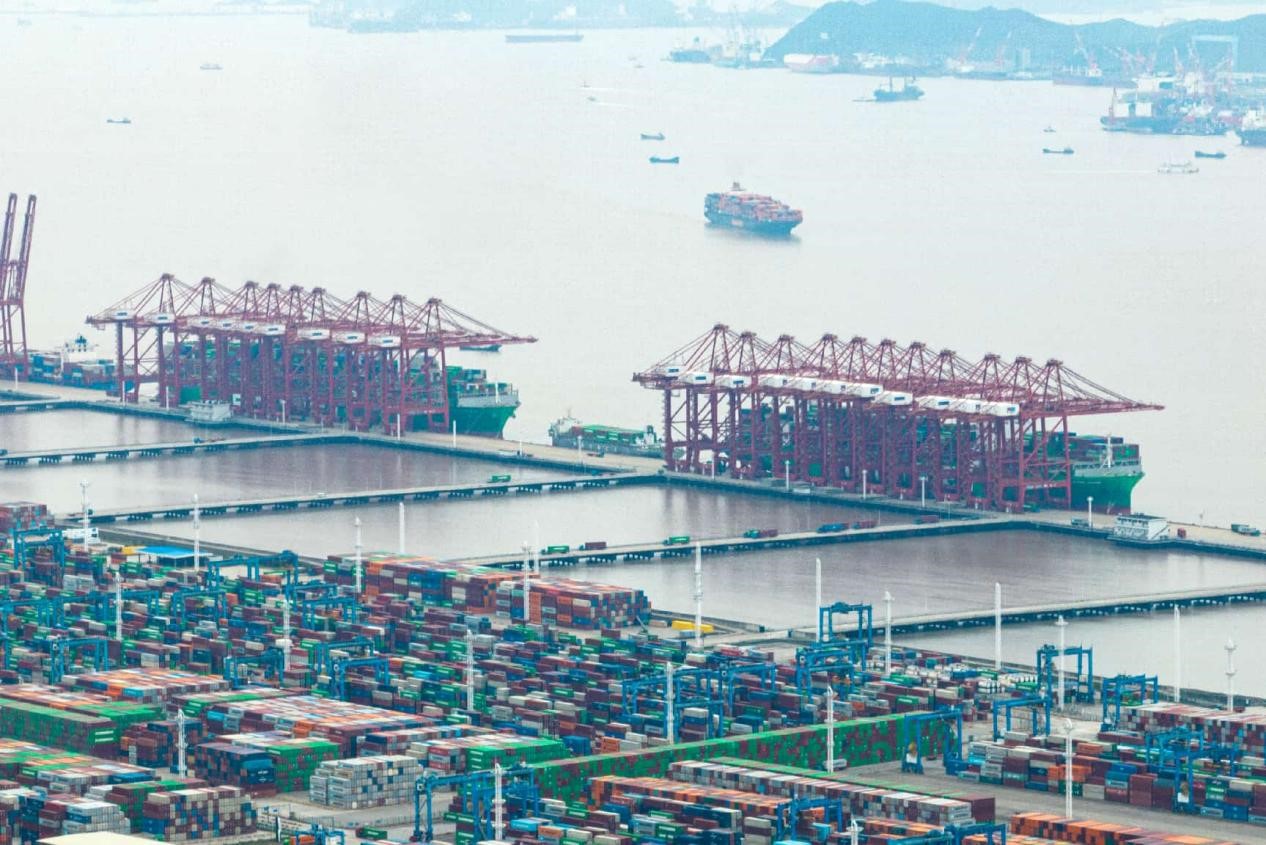
As dawn breaks over Ningbo-Zhoushan Port in east China’s Zhejiang province, the sea breeze carries the sounds of industry awakening. “Let’s begin!” directs a foreman. A massive bucket-wheel reclaimer swings into action, processing iron ore recently arrived from Brazil. The ore travels along conveyor belts to a loading terminal, where a ship loader precisely transfers the cargo into an ore carrier’s hold.
Ningbo-Zhoushan Port, the world’s busiest cargo port for 17 consecutive years, handled over 1.4 billion tons last year. Its daily throughput averages approximately 3.9 million tons — equivalent to moving 45 tons every second. This activity reflects a broader reality: across China, more than 2,900 berths capable of handling vessels over 10,000 tons facilitate a constant flow of goods, linking China’s economy with global markets.
China’s economic engine hums with remarkable momentum.
Within a single minute: China generates more than 200 million yuan ($29.13) in GDP and over 80 million yuan in goods imports and exports.
Within an hour: more than 2 million garments are produced, and over 30,000 kilograms of crops are harvested by intelligent combine harvesters.
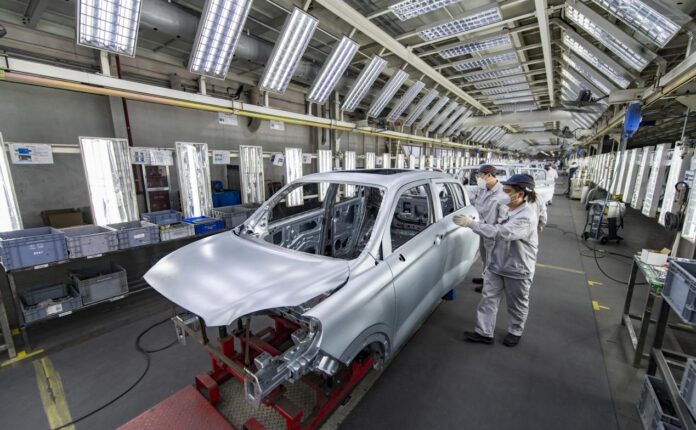
Within a day: China smelts more than 3.9 million tons of steel and manufactures over 90,000 vehicles.
During the 14th Five-Year Plan period (2021-2025), the Chinese economy achieved four consecutive leaps with an average annual growth rate of 5.4 percent, the highest among major global economies.
Scene 2: Innovation Relay in the Yangtze River Delta (2:00 PM)
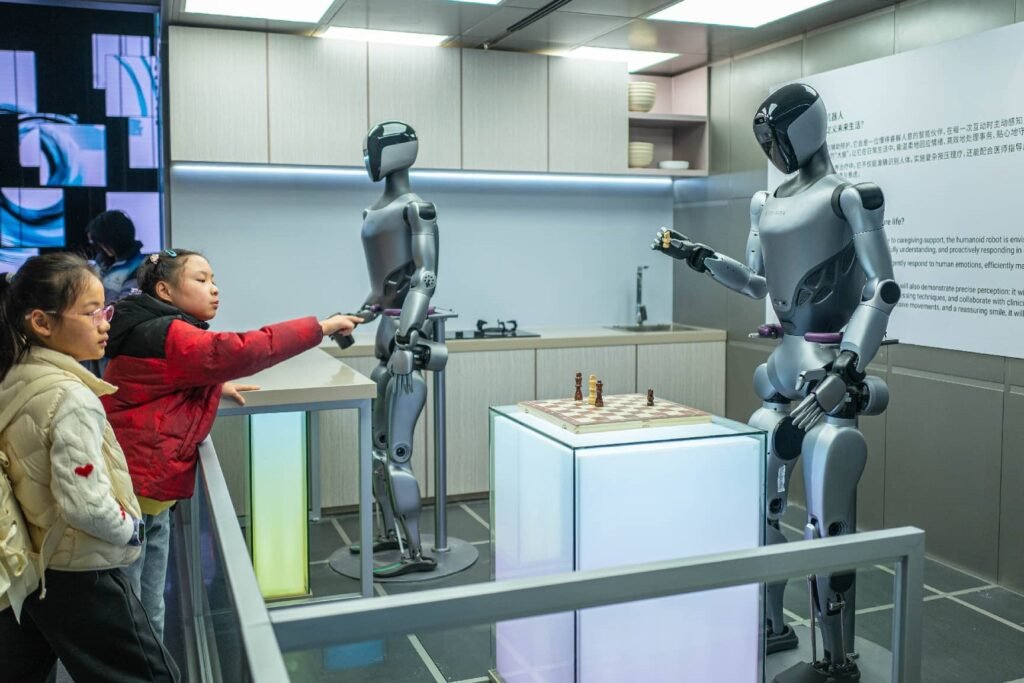
A collaborative push in humanoid robotics technology unfolds across the Yangtze River Delta. At Shanghai Jiao Tong University, associate research fellow Yan Weixin from the Institute of Robotics spreads his palm, grips a test tube, draws liquid and gently shakes it. Nearby, a humanoid robotic arm mimics every subtle movement he does.
Two hours away in Suzhou, east China’s Jiangsu province, Li Qian, deputy general manager of Leaderdrive, a manufacturer specializing in precision robotic components, is examining a harmonic reducer used in the elbow joint of a humanoid robot, exploring ways to make it lighter and more efficient.
As the world’s largest producer of robots, China holds more than 190,000 valid patents related to robotics, accounting for roughly 2/3 of the global total.
The rapid development of China’s humanoid robotics industry is driven by the country’s most complete industrial system in the world, its vast application scenarios, and reliable energy supply, according to Qiao Hong, an academician of the Chinese Academy of Sciences.
In a day, China’s space station orbits the Earth 16 times, enabling astronauts to witness 16 magnificent sunrises and sunsets.
In a day, China’s Supercomputing Network processes more than one million API calls.
In a day, thousands of invention patents are granted across the country.
In 2025, China’s R&D investment accounted for 2.8 percent of the country’s GDP, and the country entered the global top 10 in the global innovation index for the first time. This just demonstrates the powerful vitality of China.
Scene 3: Evening Vibrancy – Guangzhou & Shanghai (6:00 PM)
Along Guangzhou’s Pearl River banks, crowds gather. “Look — the ‘Slim Waist’!” On a sightseeing boat, a foreign visitor named Nazer and his family point excitedly at the brightly lit Canton Tower, one of the iconic landmarks of Guangzhou in south China’s Guangdong province. From savoring Cantonese roasted meats at local eateries to enjoying a cup of aromatic coffee, the Nazer family has woven themselves into daily life in China.
Meanwhile, at a community canteen on Jiangyuan Road in Shanghai, the aroma of freshly prepared dishes fills the air. “Regular customer” Sun Yuhua walks in hand-in-hand with her husband.
“With affordable, home-style cooking, we feel good about our meal, and that reassures our children,” Sun says.
Behind the vibrant glow of city life lies the resilience and potential of China’s economy, demonstrating how the country’s openness brings shared opportunities to the world.
Over the past five years, China has connected every county in formerly impoverished regions with expressways, paved roads reached every village, and telecommunications signals covered every corner. These achievements have solidified poverty eradication gains, proving to the world that poverty is not an insurmountable challenge.
Since the beginning of this year, senior foreign leaders have visited China in succession to explore business opportunities. Meanwhile, foreign tourists have flocked to China to celebrate the Spring Festival, experience traditional customs and witness firsthand a prosperous, open and inclusive nation.
In 2025, China imported 18.48 trillion yuan worth of goods, maintaining its position as the world’s second-largest import market for 17 consecutive years. Cherries from Chile, durians from Malaysia, flour from Kazakhstan, and beauty products from France–the world is sharing the dividends of the growing Chinese market.
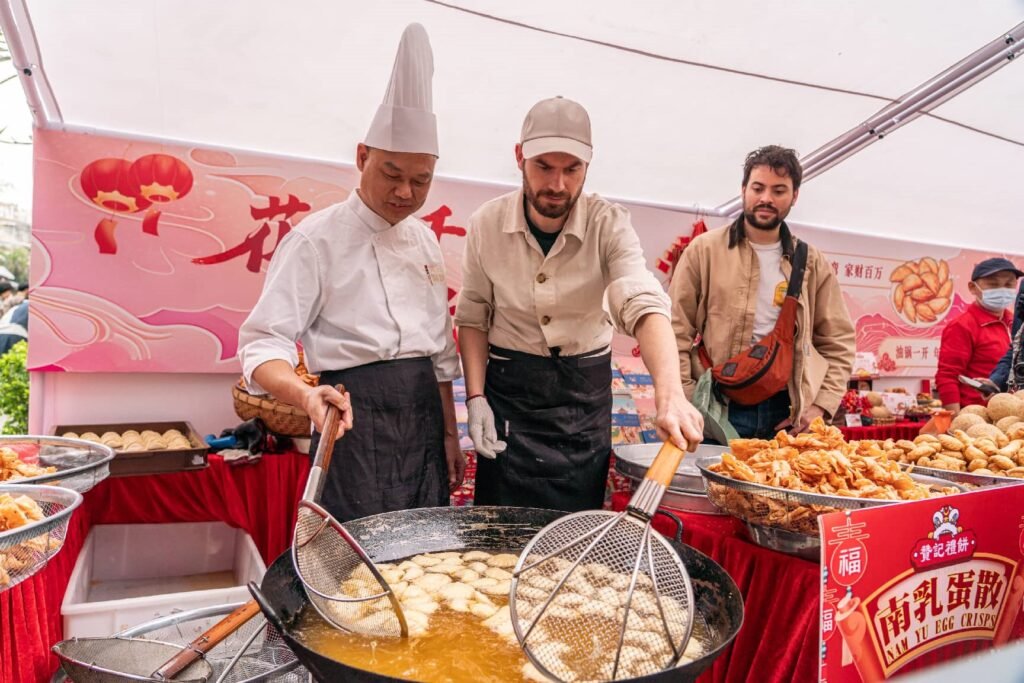
In 2025, China received more than 150 million inbound foreign visitors, who spent over $130 billion in the country. China has granted unilateral visa exemption to 50 countries, while transit visa-free arrangements now cover 55 countries. The experience of “becoming Chinese” has become a new global trend, offering people around the world fresh enjoyment and cultural resonance.
During the 14th Five-Year Plan period, China contributed around 30 percent of global economic growth.
“The attractiveness of China to foreign investment lies not only in the enormous size of its market but also in the high quality of that market,” said Jiang Ying, chair of Deloitte China. Increasingly, foreign enterprises are treating China as a source of innovation and research and development, using innovations developed in China to serve global markets.
Every 24 hours of China’s economy injects new momentum into global development.
Looking ahead to the 15th Five-Year Plan period (2026-2030), one conclusion is becoming ever clearer amid the uncertainties of the global landscape: despite a complex international environment, China’s economy will continue moving toward higher quality and new growth drivers, offering the most stable, reliable and positive energy to a world navigating turbulence and changes.