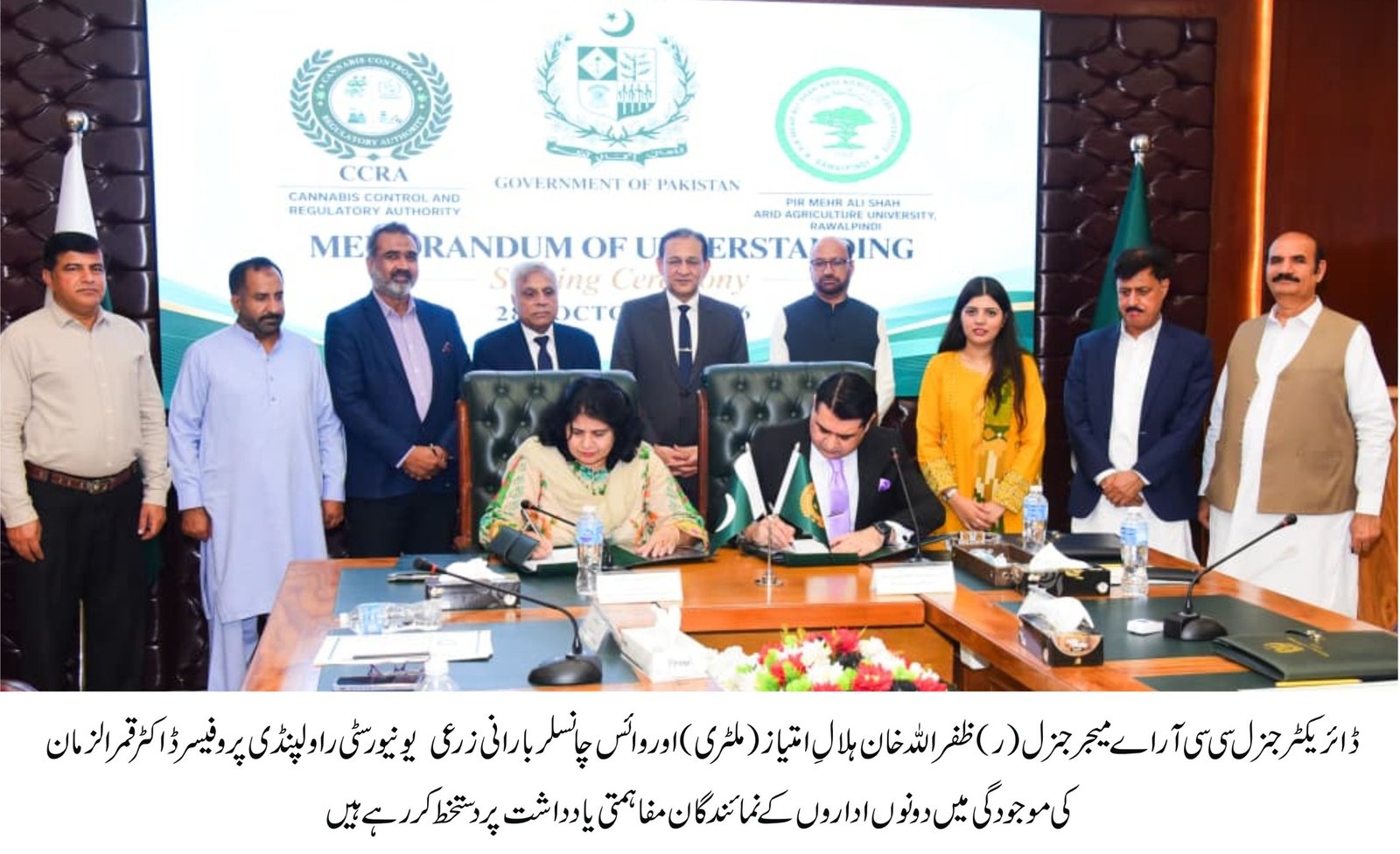
The partnership will promote scientific research, standardized testing and laboratory capacity to support evidence-based regulatory decisions in Pakistan’s emerging cannabis sector.
RAWALPINDI: The Cannabis Control and Regulatory Authority (CCRA) and Pir Mehr Ali Shah Arid Agriculture University Rawalpindi (PMAS-AAUR) have signed a Memorandum of Understanding (MoU) to strengthen scientific research, technical collaboration and regulatory oversight in Pakistan’s emerging cannabis sector.

The agreement aims to establish closer cooperation between scientific researchers and regulatory authorities, enabling evidence-based decision-making and the development of technical expertise in cannabis-related research.
The MoU was signed by Prof. Dr. Abida Raza on behalf of PMAS-AAUR and Asif Haroon, Director CCRA. The signing ceremony was attended by Maj. Gen. (Retd.) Zafarullah Khan HI(M), Director General of CCRA, and Prof. Dr. Qamar-uz-Zaman, Vice Chancellor of PMAS-AAUR.
Collaboration to Focus on Scientific Research and Testing
Under the agreement, both institutions will share expertise, resources and technical knowledge to promote standardized testing, responsible scientific research and stronger institutional capacity.
The collaboration will cover several specialized areas, including cannabinoid identification and quantification, analytical method development and validation, chemical profiling, and research into cannabis biology, genetics, biotechnology and bioactive compounds.
The partnership will also support the testing and screening of plant materials, extracts and derivatives, helping establish reliable scientific procedures for research and regulatory purposes.
CCRA Emphasizes Evidence-Based Regulation
Speaking on the occasion, Maj. Gen. (Retd.) Zafarullah Khan HI(M), Director General of CCRA, described the MoU as a significant milestone in developing a scientifically supported framework for Pakistan’s emerging cannabis industry.
He emphasized that effective regulation requires reliable scientific evidence, standardized testing procedures and strong institutional capacity.
The collaboration is expected to provide technical and research support for regulatory decisions while strengthening the scientific foundations of oversight in the sector.
PMAS-AAUR Highlights Academic and Regulatory Partnership
Vice Chancellor Prof. Dr. Qamar-uz-Zaman described the agreement as an important step towards connecting regulatory governance with scientific advancement.
He said the partnership represented a combination of regulatory oversight and scientific innovation, reflecting the university’s commitment to applying its research capabilities to emerging national priorities.
He also highlighted the importance of cooperation between academic institutions and regulatory bodies in developing scientific expertise and supporting research-driven policymaking.
Training and Laboratory Capacity Development
Another key objective of the partnership is to strengthen CCRA’s laboratory capabilities through technical training, research collaboration and the development and validation of analytical methods.
The institutions will work together on joint research projects, cannabinoid profiling, chemical analysis and scientific screening, alongside efforts to enhance technical skills and research infrastructure.
The agreement marks a step towards closer collaboration between academia and regulatory institutions as Pakistan develops its scientific and regulatory framework for the cannabis sector.