The Green Post
ISLAMABAD: Wars produce thousands of soldiers who fight with courage, but only a few leave behind a legacy that continues to inspire generations. Rarer still are those whose battlefield courage earns recognition even from the adversary.

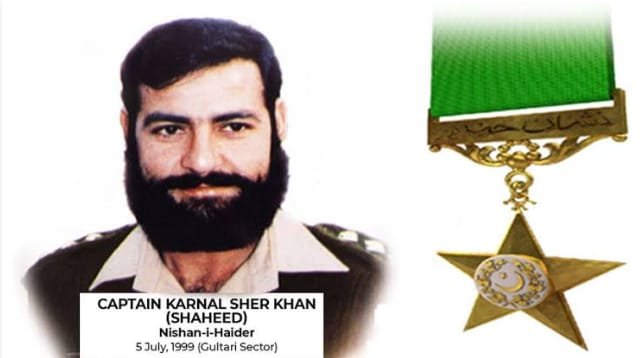
Captain Karnal Sher Khan Shaheed, recipient of Pakistan’s highest military gallantry award, the Nishan-e-Haider, was one such soldier.
Remembered as the “Lion of Kargil,” Captain Sher Khan became a symbol of extraordinary courage, leadership, devotion to duty and sacrifice during the Kargil conflict of 1999. His story occupies a special place in Pakistan’s military history and is remembered every year as the nation observes Defence Day on September 6.
Defence Day is primarily associated with the 1965 war, but its broader significance extends to remembering the men and women of Pakistan’s armed forces who sacrificed their lives in different conflicts and operations while serving the country.
Captain Sher Khan’s life and final battle represent that tradition of service.
A Young Officer With an Extraordinary Sense of Duty
Born on January 1, 1970, in Nawan Kallay, Swabi, Captain Karnal Sher Khan belonged to a family with a strong connection to the armed forces.
The unusual name “Karnal” was given to him by his grandfather, who had participated in the Kashmir conflict of 1948 and wanted a member of the family to join the Pakistan Army. “Karnal” is the Pashto form commonly used for the military rank of colonel.
Captain Sher Khan eventually fulfilled that family aspiration.
After completing his intermediate education, he joined the Pakistan Military Academy, Kakul, in 1992. He was commissioned into the 27th Sindh Regiment on October 14, 1994, and later served with the 12th Northern Light Infantry during the Kargil conflict.
It was in the difficult mountainous terrain of Kargil that his name would become permanently associated with courage.
Fighting at 17,000 Feet
Captain Sher Khan was deployed in the Gultary sector, at an altitude of approximately 17,000 feet, where troops faced not only intense combat but also some of the world’s most difficult mountain conditions.
He established and defended several strategically important positions with his men. His leadership, according to accounts of the conflict, was characterized by a willingness to remain alongside his soldiers in the most dangerous forward positions.
On July 5, 1999, Indian forces launched an attack on positions in the area. During the fighting, Captain Sher Khan led a counterattack after part of one of his positions had been captured.
He and his men succeeded in regaining the lost position.
His actions did not end there. Accounts of his service during the conflict describe repeated offensive actions and raids against opposing positions, demonstrating the aggressive leadership for which he became known.
During one of the final engagements, Captain Sher Khan was hit by machine-gun fire and embraced martyrdom on July 5, 1999.
He was only 29 years old.
Courage Recognised Across the Battlefield
Perhaps one of the most remarkable aspects of Captain Sher Khan’s story is the recognition of his courage by the opposing side.
Accounts of the Kargil conflict have reported that Indian Brigadier M.P.S. Bajwa, who was associated with the opposing forces, acknowledged Captain Sher Khan’s exceptional courage and battlefield performance.
For a soldier, recognition from an adversary carries a particular significance. It demonstrates that courage on the battlefield can transcend national boundaries, even in the midst of conflict.
Captain Sher Khan’s conduct became an example of the military virtues of courage, leadership and devotion to duty.
The Nishan-e-Haider
In recognition of his extraordinary bravery and supreme sacrifice, Captain Karnal Sher Khan was posthumously awarded the Nishan-e-Haider, Pakistan’s highest military gallantry award.
He became the first Army officer from Khyber Pakhtunkhwa to receive the prestigious award.
The Nishan-e-Haider is awarded for exceptional acts of valour and supreme sacrifice in the face of the enemy. Captain Sher Khan’s inclusion among its recipients placed his name alongside some of the most celebrated military heroes in Pakistan’s history.
Among the recipients are Captain Raja Muhammad Sarwar, Major Muhammad Tufail, Major Aziz Bhatti, Major Muhammad Akram, Pilot Officer Rashid Minhas, Major Shabbir Sharif, Lance Naik Muhammad Mehfuz, Sawar Muhammad Hussain, Havaldar Lalak Jan and other national heroes.
Their stories span different wars and generations, but their common thread is sacrifice in the service of Pakistan.
A Nation Remembers Its Heroes
When Captain Sher Khan’s body was brought back to his native village in Swabi on July 18, 1999, a large number of people gathered to attend his funeral and pay their final respects.
He was laid to rest with full military honours at Sher Khan Kallay in Swabi, where a mausoleum was later constructed in his memory.
His legacy also lives on through educational institutions. A cadet college near his hometown was named after him, ensuring that generations of young students continue to encounter the story of an officer who placed duty above his own life.
Defence Day and the Meaning of Sacrifice
Every September 6, Pakistan observes Defence Day to remember the sacrifices of its armed forces and the national resilience demonstrated during the 1965 war.
The day is marked by ceremonies, prayers, military events and tributes to martyrs and veterans. Across the country, families of fallen soldiers are remembered and national heroes are honoured.
Yet Defence Day should not be reduced to ceremonies alone.
The deeper message of the day lies in understanding what sacrifice, responsibility and service to the country mean.
Captain Karnal Sher Khan’s story offers a powerful example.
He did not become a national hero because he sought fame. His legacy emerged from the choices he made when confronted with danger. He remained with his men, led from the front and continued his mission despite extraordinary risks.
A Legacy Beyond the Battlefield
The most meaningful tribute to Pakistan’s martyrs is not merely to remember their names once a year. It is to build the kind of country for which they sacrificed their lives.
For citizens, that means performing their responsibilities honestly and contributing to the country’s progress. For professionals, it means serving with integrity and dedication. For students, it means pursuing education and preparing themselves to contribute positively to society.
A strong nation is defended not only at its borders but also through education, economic development, justice, social responsibility and unity.
Captain Karnal Sher Khan Shaheed’s life therefore carries a message that extends beyond the battlefield.
His courage reminds us that leadership means standing with those we are responsible for. His sacrifice reminds us that duty sometimes demands extraordinary courage. And his legacy reminds us that the actions of one individual can inspire generations.
As Pakistan observes Defence Day on September 6, the nation will once again remember its martyrs and veterans.
Among those names, Captain Karnal Sher Khan Shaheed will continue to stand as the Lion of Kargil, a young officer whose courage became immortal in the country’s history.
His life ended on a battlefield at the age of 29.