Far beneath the ocean’s surface, where sunlight cannot penetrate and darkness dominates, lives one of the sea’s most unusual predators: the tripod fish.
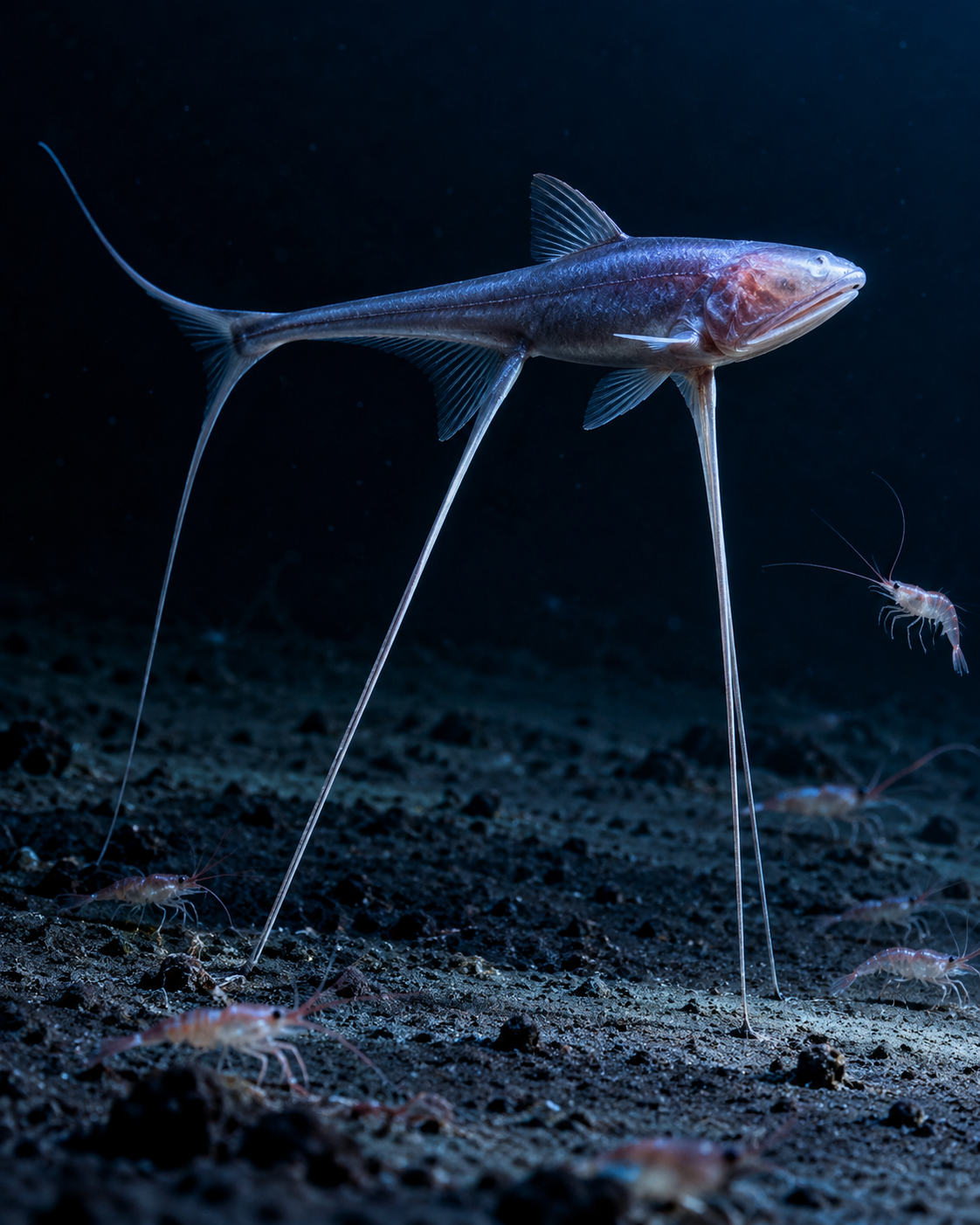
Named for its remarkable resemblance to a camera tripod, this deep-sea fish can stand almost motionless on the ocean floor using three exceptionally long, rigid fin rays. It has adapted to an environment where conventional vision offers little advantage, relying instead on touch and vibrations in the surrounding water to detect potential prey.
A Predator Built for the Deep

Tripod fish, belonging to the genus Bathypterois, are found in some of the deepest parts of the ocean, typically at depths of several thousand feet and, depending on the species, reaching around 15,000 feet (4,500 metres).
At these depths, sunlight is virtually absent. As a result, the fish’s eyes are highly reduced and provide little useful vision compared with those of fish living in shallower waters.
Instead, the tripod fish has evolved an extraordinary sensory strategy.
It positions itself facing into the current and uses its long, highly sensitive fin rays to detect movement and vibrations in the water. These structures allow the fish to sense approaching organisms even when they cannot be seen.
Standing Like an Underwater Tripod
The fish’s most distinctive feature is its extremely elongated fin rays. Two long pelvic-fin rays and an elongated lower caudal-fin ray can extend far from its body, allowing the animal to maintain a raised, tripod-like posture above the seafloor.
This unusual stance helps the fish remain stationary while ocean currents pass around it.
Rather than constantly swimming in search of food—a strategy that would require significant energy—the tripod fish can wait patiently for prey to be carried toward it by the current.
When small crustaceans and other marine organisms come within reach, the fish can respond quickly and capture them.
Survival Through Energy Efficiency
Life in the deep ocean presents extreme challenges. Food can be scarce, temperatures are low and pressure is enormous.
The tripod fish’s unusual hunting strategy appears to be an adaptation to these conditions. By remaining largely stationary and allowing currents to bring food within range, it can conserve energy while maintaining an effective feeding position.
Its long fin rays also provide stability, helping it remain anchored against the movement of deep-sea currents.
An Extraordinary Example of Evolution
The tripod fish demonstrates how animals can develop highly specialised adaptations when faced with extreme environmental conditions.
In a world where vision is of limited use, the fish has evolved to depend heavily on other sensory cues. Its ability to detect subtle movements in the surrounding water allows it to hunt in one of the planet’s darkest and least explored habitats.
The tripod fish is a striking reminder that life does not always depend on sunlight, speed or sharp eyesight. In the depths of the ocean, evolution has produced an entirely different strategy for survival—standing still, sensing the currents and waiting for the deep sea to bring food within reach.