PESHAWAR: The Khyber Pakhtunkhwa Forest Department has decided to accelerate efforts to resolve long-standing issues faced by owners of Guzara forests, while maintaining a balance between legal requirements, transparency and the legitimate interests of forest owners.
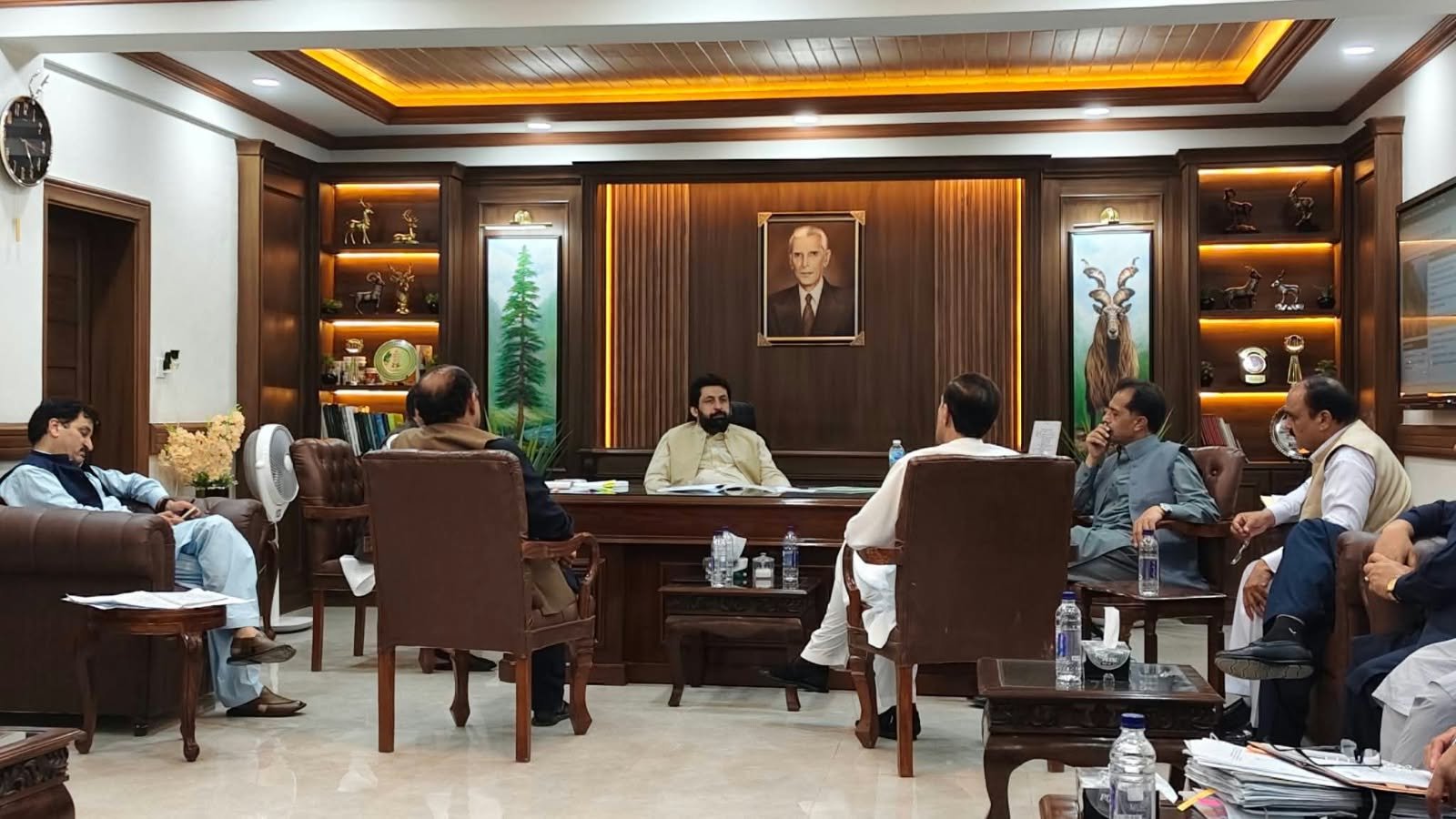
The decision was taken at a meeting of Guzara forest owners chaired by Secretary Climate Change, Forests, Environment and Wildlife Khyber Pakhtunkhwa Junaid Khan. The meeting discussed forest management and monitoring, demarcation of forest boundaries, the Forest Development Fund, expired working plans, action against responsible units in case of violations and the distribution of seigniorage, among other matters.

Chief Conservator of Forests Region-II, Hazara Division, Saleem Khan Marwat gave a detailed briefing on the issues faced by Guzara forest owners, the existing administrative and legal framework and the procedures being followed by the department. Suggestions and concerns presented by the forest owners were also discussed.
Guzara forest owners from Hazara Division, Chief Conservator of Forests Region-I Asghar Khan and other senior Forest Department officials attended the meeting.
Junaid Khan assured the forest owners that the department would provide possible support for resolving their legitimate concerns. He said long-pending matters should not be dealt with through temporary measures alone and efforts should focus on sustainable solutions based on legal, administrative and practical requirements.
He also directed that unnecessary delays in departmental procedures should be addressed and that processes should become more transparent, effective and time-bound.
The meeting also discussed concerns regarding woodlots and their monitoring. Forest owners called for unnecessary requirements and complicated procedures beyond the Woodlot Rules 2017 to be simplified. Department officials said monitoring was intended to ensure transparency, fairness and the proper use of forest resources.
Participants discussed proposals to set clear timelines for different stages of monitoring and the timely processing of monitoring reports. A proposal to establish a regional monitoring cell in Abbottabad for matters relating to Hazara was also considered.
Detailed discussions were held on forest boundaries and GIS lines. Forest owners pointed out differences between GIS-based boundaries and revenue records in some areas. The meeting proposed that GIS should be used as an initial verification tool, while revenue and settlement records should remain the basis for final boundary determination.
Where differences exist between records, participants proposed joint verification by relevant Revenue, demarcation and Forest Department officials before any legal action or seizure is taken.
The Forest Development Fund was also discussed. A proposal was made to prepare division-wise details of the fund and link its use with the needs of the relevant areas. Another proposal called for development plans from Joint Forest Management Committees for the rehabilitation and development of harvested Guzara forest areas.
The participants discussed the need to ensure that resources generated from forests are effectively used for forest restoration, protection and development in the same areas.
Regarding expired working plans, the department clarified that simply extending an expired working plan would not be appropriate and that revision through the prescribed legal procedure was the proper course. The meeting also considered ways to process existing marking and previously marked trees according to technical requirements, while expediting working-plan preparation, revision and budget-related matters through the relevant planning and monitoring system.
The meeting also discussed the principle that if an irregularity or illegal activity is detected in a particular compartment, woodlot, range or other unit, action should be focused on the responsible unit rather than affecting areas where no violation has been established.
A proposal was considered to develop a simplified procedure for taking action at the compartment or unit level.
The issue of seigniorage was also reviewed, including the demands of forest owners and the department’s available records and legal position. The meeting was informed that the existing legal and regulatory framework contains separate provisions relating to the distribution of net sale proceeds from Guzara forests and seigniorage.
Participants proposed compiling historical records on a division-wise basis and paying any amount found to be due according to the prescribed procedure.
The meeting stressed that Guzara forests represent an important natural and economic link between local communities, forest ecosystems and future generations. Their management therefore requires equal attention to legal compliance, forest protection, transparency and the legitimate interests of local rights holders.
Junaid Khan said communication and mutual trust between the Forest Department and Guzara forest owners would be further strengthened. He reiterated that the department would support legitimate demands and work towards resolving outstanding issues within the available legal and administrative framework.
The meeting also developed several practical proposals, including time-bound monitoring procedures, joint verification of differences between GIS and revenue records, division-wise details of the Forest Development Fund, timely revision of working plans, action focused on responsible units and completion of historical seigniorage records.
The Forest Department said the protection and restoration of Guzara forests was not only about addressing present concerns but also about safeguarding these natural assets for future generations. It said this shared responsibility required continued cooperation between the department, local communities and Guzara forest owners.