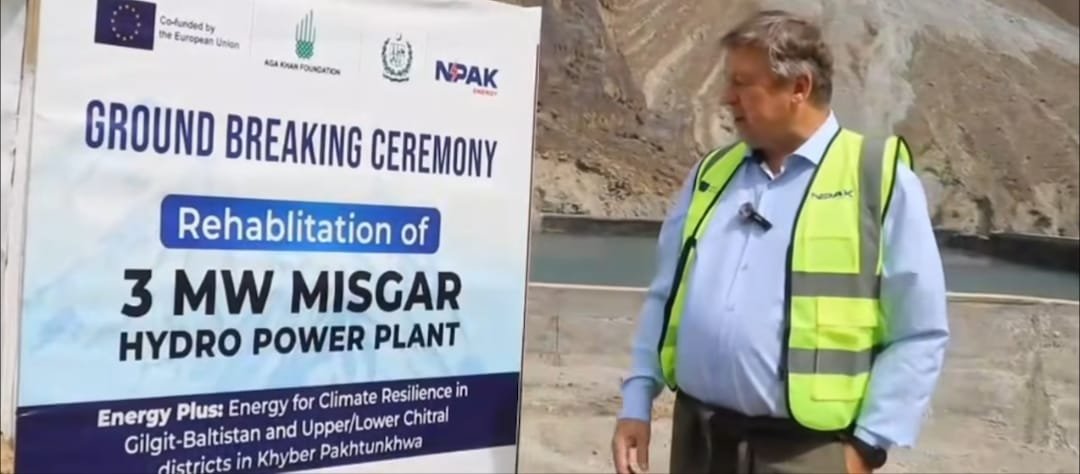
HUNZA: The European Union (EU), Aga Khan Foundation (AKF) and NPAK Energy have announced major progress in strengthening electricity services in Hunza, including the completion of the first phase of a power loss-reduction programme and the start of rehabilitation work on the 3 MW Misgar Hydropower Plant.
The initiatives are being implemented under the Energy Plus Project, with support from the EU, AKF and NPAK Energy in partnership with the Government of Gilgit-Baltistan. The project aims to promote a climate-resilient and low-carbon economy in northern Pakistan by improving energy infrastructure and increasing the use of renewable energy.

Under Phase I of the Loss Reduction Programme, NPAK Energy has upgraded transmission, distribution and metering infrastructure across Hunza. The work includes a new substation and transformer, 10 transformer substations, 55 upgraded transformers, 25.3 kilometres of transmission lines, 86.5 kilometres of distribution lines and 460 kilometres of service lines.
Around 9,000 energy meters have also been installed as part of efforts to improve electricity measurement, billing and system efficiency.
According to the project partners, system losses have fallen from 47 percent to around 15 percent, while voltage at consumer premises has improved from approximately 90–130 volts to 200–220 volts. Electricity supply has increased and system tripping has also been reduced.
A new Energy Meter Laboratory has been established to test different types of meters, including electromechanical, digital, PLC and smart meters. NPAK Energy also plans to introduce a new billing system aimed at improving billing accuracy, transparency and customer service.
The project also includes the rehabilitation of the 3 MW Misgar Hydropower Plant, described as the largest hydropower plant in Hunza.
The plant is currently operating at around 30 percent capacity factor, according to project information, with deteriorating civil infrastructure affecting its performance. Rehabilitation work will focus on two water conveyance channels and forebay structures, along with other civil, engineering and technical works.
Restoring the plant’s performance is expected to increase renewable electricity generation in Hunza, improve power availability and reduce pressure on the existing electricity supply system.
EU Ambassador to Pakistan Raimundas Karoblis said reliable and sustainable energy was important for community and local economic development, while NPAK Energy Acting CEO Naveed Khan said the initiatives were aimed at improving network efficiency and unlocking Hunza’s renewable energy potential.
Aga Khan Foundation Programme Advisor Irshad Khan Abbasi also highlighted the importance of reliable and affordable electricity for essential services, livelihoods and new economic opportunities.
The initiatives demonstrate how upgrading existing power infrastructure alongside investment in hydropower can support a cleaner and more resilient energy system in mountainous communities. For regions such as Gilgit-Baltistan, expanding renewable energy capacity can also contribute to reducing dependence on more carbon-intensive energy sources while strengthening energy security.
The EU, AKF, NPAK Energy and the Government of Gilgit-Baltistan reaffirmed their commitment to working with local communities and development partners to improve energy services, increase system efficiency and further develop the region’s renewable energy potential.