Written by: Aziz-ur-Rehman
Those who carry a deep love for their country often find themselves thinking beyond the present. Their minds give birth to ideas that may begin with a small step but gradually take the shape of a larger vision. Their focus is not merely on today، they think about tomorrow and the generations yet to come. Allama Iqbal envisioned a dream, Quaid-e-Azam transformed that dream into reality and in our own time, there are people who, within their respective fields, continue to nurture ideas connected with the future of the nation.

Love for one’s country is not merely an emotion،it is also a responsibility. Sometimes that responsibility takes the form of education, sometimes research, sometimes public service and sometimes the commitment to protect the environment. The thinking of Prof۔ Dr. Nasir Mahmood, Vice Chancellor of Allama Iqbal Open University, reflects this spirit of turning ideas into practical action.
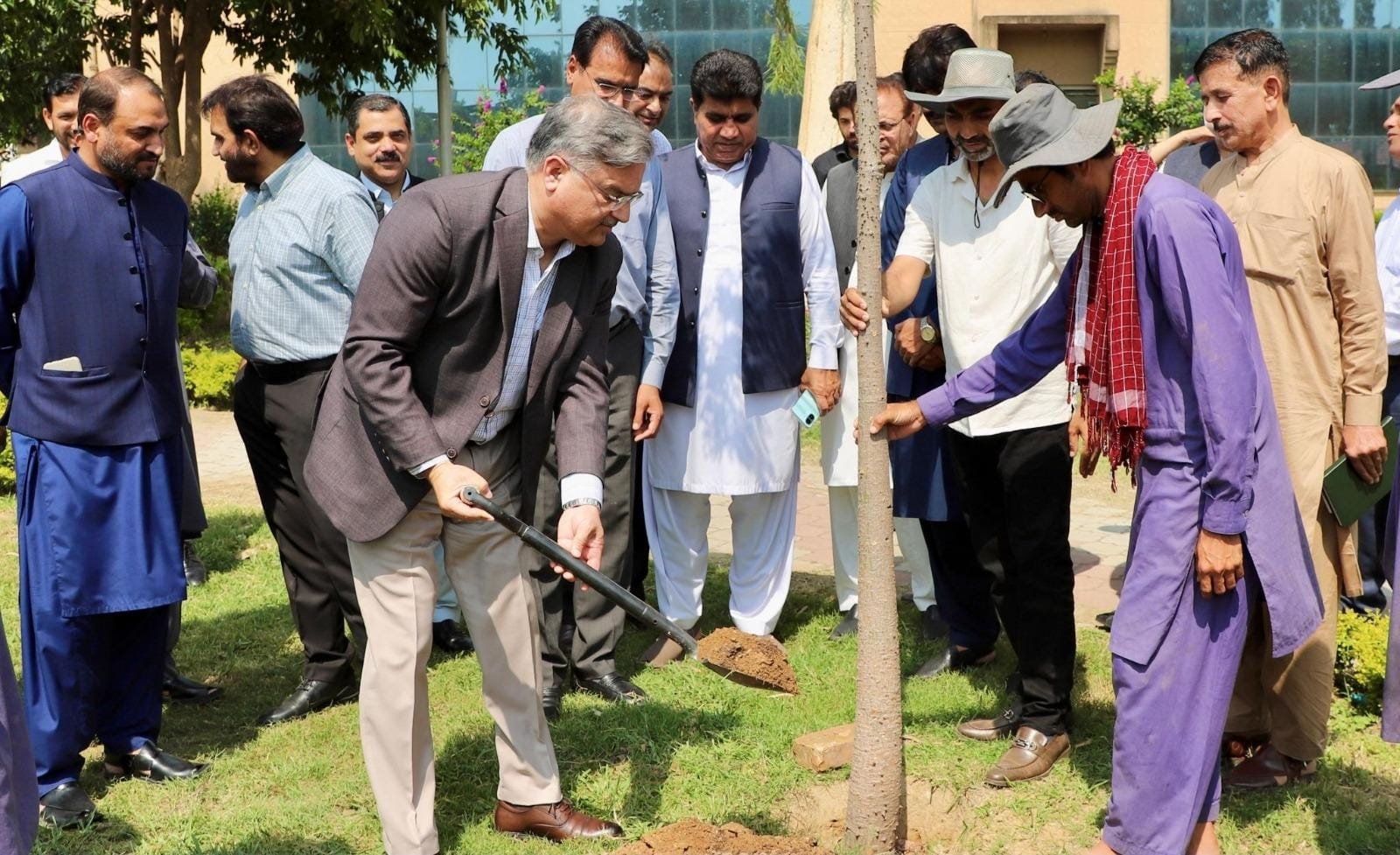
During the monsoon season, when rainfall breathes new life into the earth, the idea of planting trees emerged not simply as another routine plantation activity but as a vision for something much larger. What began with the thought of planting a few saplings gradually evolved into a plan to establish an artificial forest. On the surface, it may appear to be a small initiative but behind it lies a much bigger idea: a sapling planted today can become part of a forest tomorrow—a forest that can contribute to a healthier environment and leave a greener legacy for future generations.
This is where leadership moves beyond decisions on paper and takes practical shape. Dr. Nasir Mahmood has sought to transform this idea from a mere aspiration into an actionable initiative. Under the supervision of Architecture Officer Wajih-ul-Hassan, work on the project is progressing with the aim of developing the area into a flourishing artificial forest.
Planting a sapling is easy، turning that sapling into a tree, nurturing it, and eventually bringing many trees together to form a forest requires patience, care, consistency and commitment. Institutions, too are not built in a day. Their strength develops through countless small decisions, sustained efforts and initiatives guided by a clear vision of the future.
The concept of an artificial forest is not limited to beautification or increasing greenery. Trees play an important role in improving air quality, reducing dust and pollution, mitigating the effects of heat and supporting biodiversity. Such initiatives carry particular significance in a country facing the growing challenges of climate change, rising temperatures, water scarcity, pollution and rapid urbanization.
Therefore, the idea of growing a forest within a university campus carries a much broader message. It reminds us that educational institutions are not confined to classrooms, books and examinations. They also have a responsibility to cultivate awareness, inspire action and prepare society to think responsibly about the future.
When a student sees a sapling being planted on campus, watches it grow into a tree and eventually sees many trees forming a forest, a quiet but powerful lesson takes root in the mind، every great change begins with a small step.
The same philosophy applies to education. When one student becomes educated, one individual changes. When individuals change, families begin to change. When families change, society evolves. And when society progresses, the direction of a nation begins to change.
The journey from a sapling to a forest can therefore become a powerful metaphor for a much larger national journey.
Dr. Nasir Mahmood’s initiative reflects the broader understanding that institutional progress is not measured only through buildings, statistics or administrative achievements. It is also about creating a better environment, expanding opportunities and laying foundations for a better future for generations to come.
Many people speak of love for their homeland but true love is ultimately reflected in action. A person who plants a tree does not plant it only for the present. He plants it for a future that he may never personally experience. He imagines the shade that others will one day enjoy.
Perhaps this is the first sign of a truly meaningful vision: when a person begins to look beyond himself.
A sapling is planted today. Tomorrow it becomes a tree. Then trees come together to form a forest. And a forest is more than a collection of trees، it is a symbol of life, hope, resilience and the future.
Dr. Nasir Mahmood’s initiative can be seen as one such branch of hope. If this journey continues with the same commitment, care and consistency, the artificial forest will one day become more than an addition to the beauty of Allama Iqbal Open University. It can become a living symbol of the belief that love for one’s country is not expressed through words alone. It can also be expressed by touching the earth, planting a sapling and leaving behind shade for those who will come after us.
The sapling planted today may look small but every great vision begins with a small step.
That is the journey from a sapling to a forest and from love for one’s homeland to love expressed through action.