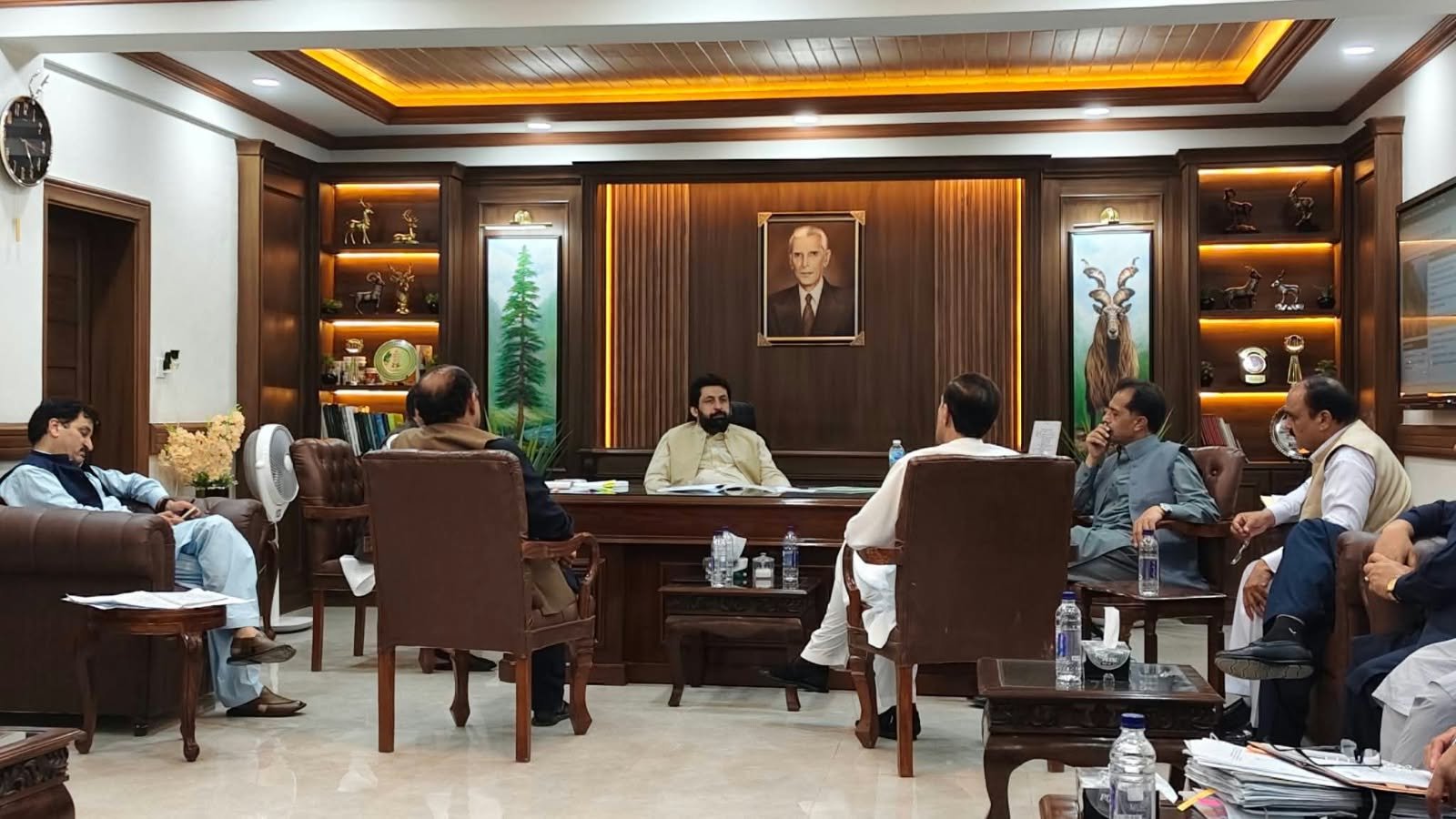
(Islamabad, 13th August, 2026): A meeting of the Senate Standing Committee on Water Resources was held at NDMA Headquarters, Islamabad, under the chairmanship of Senator Jam Saifullah Khan to review implementation of the Committee’s recommendations, the role and functions of NDMA, the current flood situation, and coordination and measures for effective flood management.
The meeting was attended by Senator Khalil Tahir, Senator Poonjo Bheel and Senator Muhammad Aslam Abro.
The parliamentary delegation was received by Chairman NDMA at the National Emergencies Operations Centre (NEOC), where it was briefed on NDMA’s advanced disaster monitoring and decision-support capabilities, including Global and National Portals, Hydro Analytics and Water Equation. The delegation was also given a detailed briefing on Disaster Lens – 2026, an integrated technology-enabled initiative aimed at strengthening disaster risk assessment, preparedness and decision-making.
The Chairman emphasized the critical importance of interprovincial coordination in disaster management and emergency response. The Committee was informed that the Prime Minister has constituted an Emergency Response Committee, headed by a senior Federal Minister, to coordinate with all relevant stakeholders, including district administrations, for an effective response to the current monsoon situation. The Chairman stressed that such coordination mechanisms should remain functional throughout the year to strengthen preparedness and disaster management.
A detailed discussion was held on water storage initiatives and the need for strengthening national water resource management and storage capacity. The participants discussed the importance of improved water monitoring, data-driven planning, efficient utilization of available water resources and technology-based solutions to enhance water security and resilience against climate-related risks.
The Committee expressed serious concern over encroachments on natural waterways, including the Ravi River, nullahs and other water bodies across the country. It called for strict measures to remove encroachments and keep natural waterways clear. The Secretary, Ministry of Water Resources, informed the Committee that a draft Flood Plain Regulations Act has been shared with the provinces. The Chairman directed the Ministry to take follow up on the matter and further strengthen coordinated flood mitigation and management efforts.
The Committee also discussed growing pressure on water resources due to population growth and climate change. It emphasized the need to adopt modern irrigation technologies to increase agricultural productivity, conserve water and ensure food security. The Committee was informed that the Ministry of Water Resources has recently conducted research comparing high-efficiency crop production with existing agricultural practices. The Chairman directed that the findings be presented before the Committee at its next meeting.
The Committee further discussed the potential of mechanized agriculture to enhance agricultural production and observed that tax incentives for higher-horsepower tractors could facilitate modernization of the agriculture sector. Members were also briefed on the potential of localized water storage facilities, as an alternative or complement to large dams, for storing excess floodwater.
The Committee expressed displeasure over the absence of the Secretary Irrigation, Government of Sindh, and indicated that the matter could be referred to the Privileges Committee. The Chairman directed the Secretary Irrigation Sindh to ensure his presence at the next meeting.
The Committee underscored the importance of consensus-based solutions on water distribution, particularly given the concerns of lower-riparian provinces. It called for a broader national debate on water security and the country’s long-term water challenges.
The Chairman said that water security is directly linked to food security and the future of coming generations. He assured that all stakeholders would be engaged in an open and constructive national dialogue to address water-related issues and develop solutions through broader consensus.
The Committee appreciated NDMA’s efforts to integrate advanced technology, data analytics and risk information into national disaster management and water-related planning.
The committee subsequently visited NDMA’s outer facilities, including the Centre of Excellence (CoE), Logistics and Humanitarian Hub, and Disaster Resilient Infrastructure Models (DRIM) facilities, where it was briefed on their operational capabilities, preparedness, logistics and technology-enabled emergency response mechanisms.
The committee reiterated that the visit provided an opportunity for enhanced coordination between the parliamentary forum and NDMA and for an exchange of views on strengthening disaster preparedness, water resource management, early warning systems and national resilience through innovative and technology-driven solutions.
Also Read: BISP HOLDS CEREMONY TO MARK PAKISTAN’S 79TH INDEPENDENCE DAY