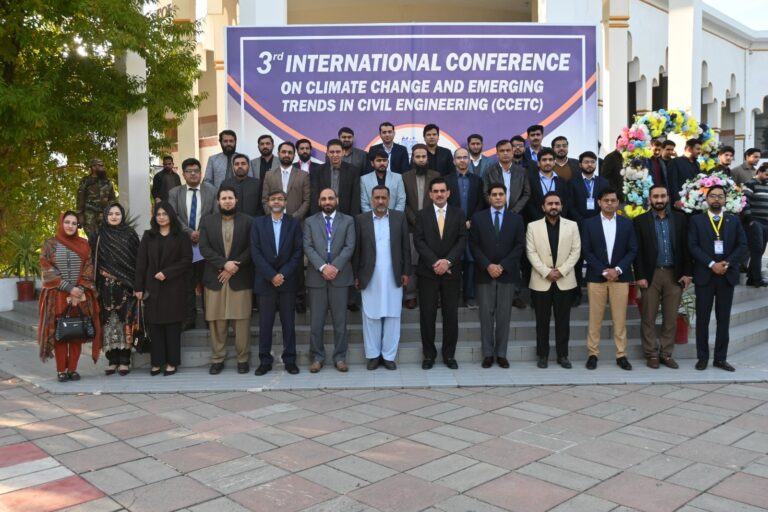
TOPI (Pakistan): The Ghulam Ishaq Khan Institute of Engineering Sciences and Technology (GIKI) hosted the 3rd International Conference on Climate Change and Emerging Trends in Civil Engineering (CCETC 2026), bringing together policymakers, climate experts, engineers and academics to advance research-driven solutions for Pakistan’s climate challenges.
Organized by the Faculty of Civil Engineering, the two-day conference focused on engineering innovation, sustainable infrastructure and policy-oriented research aimed at strengthening national climate resilience.

A key development announced during the opening session was a strategic collaboration between the Ministry of Climate Change (MoCC), its research arm—the Global Climate Change Impact Studies Centre—and GIKI to establish a Centre for Environmental and Water Research at the institute. The facility is intended to serve as a national hub for translating advanced research into practical climate adaptation and environmental protection strategies.
Focus on sustainability and infrastructure
In his inaugural address, Rector GIKI Prof. Dr. Fazal Ahmad Khalid emphasized the growing importance of sustainability in civil engineering practice and the responsibility of academic institutions in developing evidence-based solutions.
Conference Chair Prof. Dr. M. Ashraf Tanoli described the forum as a bridge between academia, industry and government, facilitating dialogue on resilient infrastructure, adaptation strategies and sustainable construction.
Speakers highlighted pressing environmental concerns, including glacier melt and flood risks. Engr. Muhammad Azam Joya, Advisor to the Chairman of Water and Power Development Authority, discussed climate monitoring and resilience measures in hydropower projects such as the Diamer-Bhasha Dam.
Federal Secretary for Climate Change Aisha Humera Moriani characterized climate change as a socio-economic challenge and called for low-carbon materials, indigenous innovation and alignment with Pakistan’s Nationally Determined Contributions (NDCs).
Research and international collaboration
The second day featured contributions from national and international experts, including representatives from WWF Pakistan and the Food and Agriculture Organization (FAO), who underscored the linkages between climate change, agriculture and water management.
The conference received 110 research abstracts, with 62 papers accepted after peer review and presented across technical sessions. Topics included water resource management, transportation systems, geotechnical resilience, sustainable infrastructure and emerging engineering technologies.
The closing ceremony was attended by industry representatives and government officials, including the Secretary of the Higher Education Department, Government of Khyber Pakhtunkhwa, who emphasized the role of universities in shaping research-informed policy and preparing engineers to address climate risks.
Organizers said CCETC 2026 reinforced GIKI’s commitment to interdisciplinary research and collaborative partnerships aimed at enhancing Pakistan’s climate resilience.