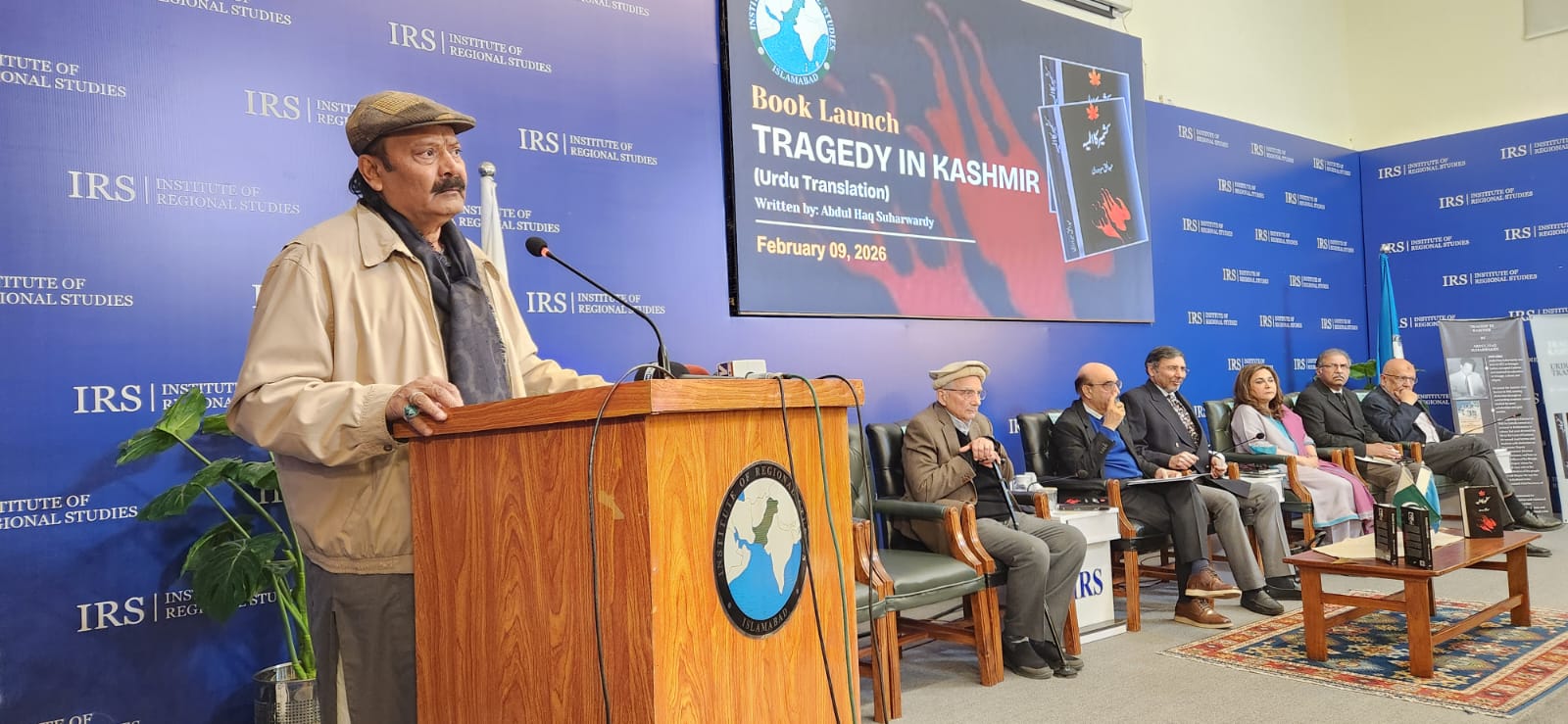
ISLAMABAD — The Institute of Regional Studies (IRS) on Monday hosted a ceremony to launch the Urdu translation of Tragedy in Kashmir, a widely cited historical work by Abdul Haq Suharwardy, aimed at broadening public access to documented accounts of the Kashmir dispute.
The event brought together parliamentarians, diplomats, academics, and journalists, who emphasized the importance of preserving authentic historical narratives and making them accessible to a wider readership, particularly in Pakistan and Azad Jammu and Kashmir.
In his opening remarks, Jauhar Saleem, President of IRS, described the book as a meticulously researched account of the events surrounding the 1947 Partition and the annexation of Jammu and Kashmir. He said the work draws extensively on Indian and British archival material, strengthening its credibility as a scholarly reference.
Broad political and academic engagement
Chairman of the Parliamentary Committee on Kashmir Rana Muhammad Qasim Noon said the book documents historical injustices faced by the Kashmiri people and that its translation into Urdu would help foster greater public awareness, especially among younger generations.
Mushaal Hussein Mullick, Chairperson of the Peace and Culture Organization, said the Urdu edition adds an important human rights perspective to the Kashmir narrative and supports informed advocacy by grounding discussion in historical evidence.
Providing an overview of the publication, Senator Zarqa Suharwardy Taimur said the translation makes an academically significant work accessible to a broader audience without compromising its documentary depth.
Emphasis on law, diplomacy, and media
Senator Syed Ali Zafar highlighted the importance of basing contemporary legal and constitutional debates on verified historical records rather than political rhetoric.
Former ambassador Ashraf Jehangir Qazi said accurate historical understanding is essential for effective diplomacy and policymaking, describing the book as a serious scholarly contribution.
Former President of Azad Jammu and Kashmir Sardar Masood Khan termed the Urdu translation a national intellectual effort that reconnects society with the historical foundations of the Kashmir issue.
Senior journalist Nasim Zehra stressed the role of credible historical documentation in countering misinformation, while columnist Farhan Bokhari said such works help shape responsible media narratives and informed public discourse.
Speakers collectively emphasized that translating authoritative historical research into Urdu is essential for sustaining informed debate and ensuring continuity in understanding the Kashmir issue across generations.